
T
he Manhattan hotel where Slick Rick is staying has exactly the kind of opulence you’d expect him to be lounging in. While waiting for our interview, I fall into a fluffy white couch in a waiting room with a giant ceiling, wooden panels carved with floral insignia, and a bevy of crystal chandeliers fit for HBO’s Gilded Age TV drama. It’s a luxurious refuge from the bustle of a rainy midtown just outside.
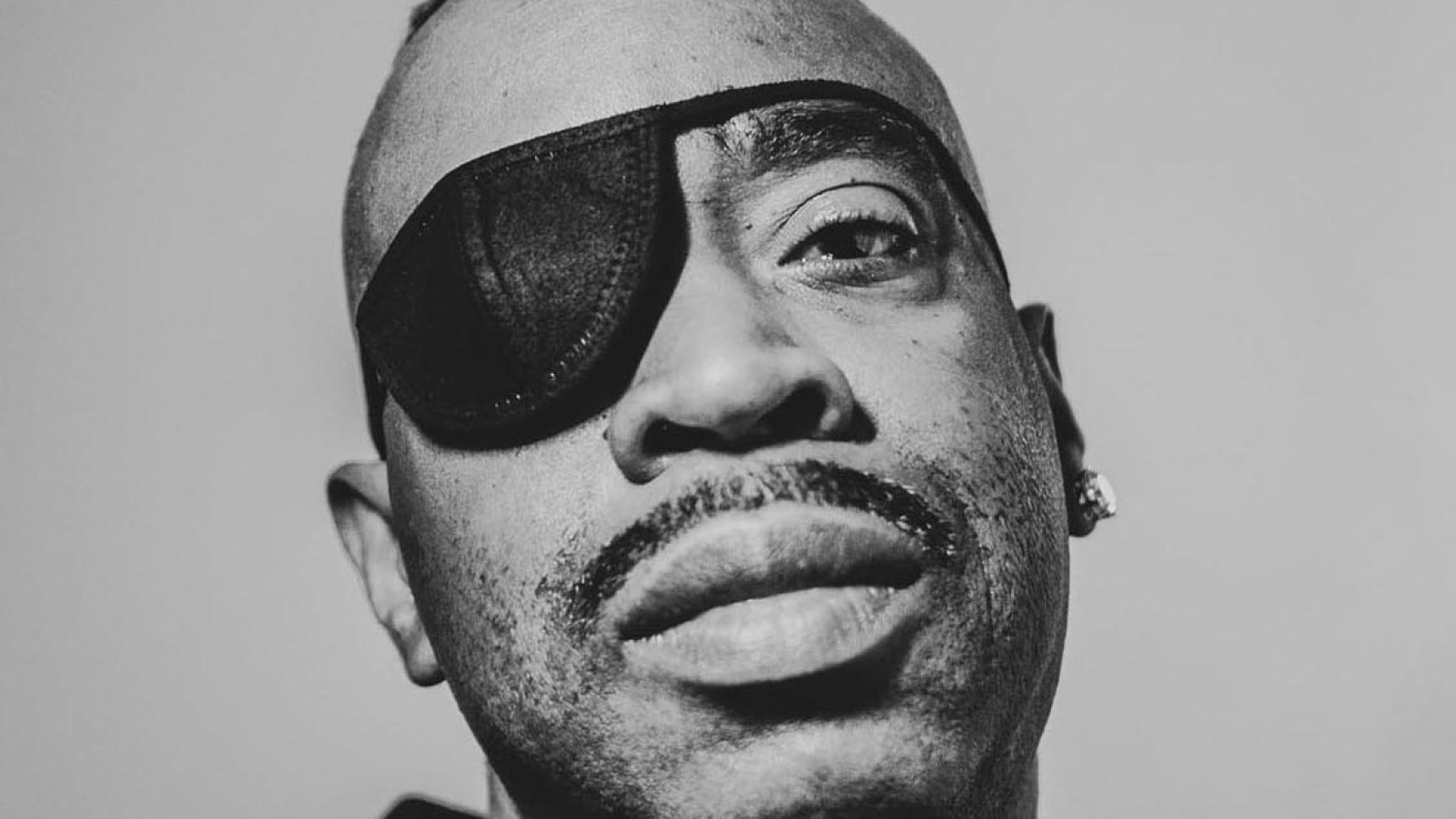
I’m soon escorted upstairs into an equally ornate hotel room, where Slick Rick, 60, is posing for pictures, unassumingly taking the photographer’s direction. While they’re sitting and observing the shoot, Rick lauds the “story” that one particular photo tells; it’s a fitting description from hip-hop’s foremost narrator. Throughout our hour-long talk, he references rapping and beat-making like they’re visual arts. “I’ve always grown in music,” he says. “As I grew, I got better and painted pictures with my art.” He sees Victory, his first album in 26 years, as giving “the public some artwork to look at.”
He’s left indelible brushstrokes on hip-hop history, with songs like 1988’s “Children’s Story,” as well as Doug E. Fresh and the Get Fresh Crew’s “La Di Da Di” and “The Show,” which both turned 40 this year. That means he’s been a professional recording artist for four decades, but he had no plans to publicly commemorate the achievement, save for some vinyl signings. “We just celebrate amongst each other,” he says. “That’s pretty much it. It’s not really a big deal.”
Questlove once told Rolling Stone that “Slick Rick’s voice was the most beautiful thing to happen to hip-hop culture,” and it’s immediately clear what he meant when you talk to Rick: Even when he’s expressing apathy, it sounds like the coolest thing you’ll hear all day. His rare vocal presence is part of why Victory felt so refreshing.
The 15-song project, released this June, commenced Mass Appeal’s Legend Has It… series, which saw seven legendary acts crafting new projects with guidance from Nas. The idea for Victory was spearheaded by actor and DJ Idris Elba, who ran into Slick Rick at a 2021 party and suggested he work on an album. Rick credits his British brethren for tapping Black Is King co-director Meji Alaba for the album’s sleek visuals. The full Victory visual, which Rick’s wife and manager Mandy Aragones helped craft alongside Alaba, was shown at SXSW London as well as the Tribeca Film Festival.

For Rick, Victory was the anchor of what he deems a successful 2025. “[We gave] the public something to entertain themselves, something to drive around in,” he says. “Give that festive vibe, good vibe, a nice cocoa fireplace atmosphere. Each song takes you in a different direction.” His first project in more than a quarter-century came at the right time, as he had been looking to fill a creative urge that he’d felt for the previous three years or so. “If you got a void within yourself, you got to feed your void,” he says. “When I fed the void within myself and my wife brought it to the marketplace, everybody was like, ‘Yes, you’re feeding the void that’s within our soul, our spirits.’” These days, Rick is still pursuing creativity in other mediums, such as designing a window for the famous Saks Fifth Avenue storefront in Manhattan.
Victory was recorded over the course of a year in the U.K,. France, and America, typified by sessions consisting of “a little bubbly, laughing, giggling” amongst Rick and his friends. He says overall, the project’s conception felt more like fun than any kind of pressure to prove himself after a long absence. While the average rapper with a two-decade gap between music might face the wrath of thirsty fans, he says he’s never experienced his fanbase “crying” for new music. That ease allowed him to reapproach his craft as easily as when he first honed it during after-work cipher sessions with friends in New York, where he settled after emigrating from London in 1976.

He tells me that in the Eighties, while hip-hop pioneers like Afrika Bambaataa and Fab Five Freddy made cross-cultural inroads in the Lower East Side club scene, his hip-hop rearing took place in uptown New York. It was at the Bronx Armory where he first met Doug E. Fresh at a 1984 rap battle event. His rent back then was just $350, and it didn’t take long for him to recoup that many times over after joining the Get Fresh Crew: “When I met Doug, I was getting $300 a night. 28 days in a month, $300 every time you walk around with this cat — our rent is paid. You got enough money to start getting cute.”
He elevated from a humble ring and bracelet combo (“You could always play it off with a tie,” he advises) into the gold truck jewelry and designer fashion that made him a style icon. His wife rattles off the names of artists who’ve asked to wear his signature chains: French Montana, Alicia Keys, and Ghostface Killah (a moment captured in Jay-Z’s Fade to Black documentary).
In the Eighties, Rick says, “We saw the drug dealers, and they had on the giant shit, not little corny nigga shit. They set the bar by accident.” Today, he’s keeping it cool, with a silver ring and watch, and a pair of necklaces tucked under a black shirt. He’s also wearing Clark Wallabees, a brand he’s long worn, even doing a Victory collaboration.
Reclining in his suite’s cream sectional, he tells me that the album allowed him to exercise his passion not just for rhyming, but beatmaking. It seems like artists don’t get recognized as rapper-producers unless they beat us over their head with it. But, like his contemporary Rakim, Slick Rick is a rap icon with an underappreciated production catalog. He contributed to the production of some of his biggest hits, and to this day, he has a vault of over 300 beats that he can cull through. The first time he got on a beat machine was at producer Teddy Riley’s house, and the inspiration deepened from there. “Once I saw the impact [of ‘La Di Da Di’ and ‘The Show’], I knew there was a value for this,” he says. “Then you say, ‘Well, if this made noise, imagine they make this shit right here.’” Trusting his own beats began to make more sense than working with outside producers.

“The industry didn’t give me the quality that I gave myself. I gave myself ‘Children’s Story,’ ‘Mona Lisa,’ ‘Hey, Young World.’ They gave me shit that didn’t make a mark on society. You can’t lie to yourself. My stuff was better than what you was giving me.”
He likens every song to “an adventure,” where he sonically traverses the map: “Maybe it took me to the Caribbean, maybe it took me to some Latin area.” His musical exploits on Victory stretch across the diaspora, from the classic hip-hop vibes of “Stress” and the surging house composition of “Come On Let’s Go” to the sample of reggae greats Dave & Ansel Collins on “Foreign”. The soundscape reflects his diverse cultural identity. On “I Did That,” he says, “I am British, I am Jamaican, I am American.” I ask him about the line, and how he thinks his worldview melds into the music.
“The spirit can be from anywhere. Get to know a spirit,” he implores. “Sometimes accents [are] like, ‘Ooh, that’s different. What kind of brown person is you?’ Think of spirit as all over the place, and the effects of a spirit being in England, or in Jamaica, or in America or Africa.” Unfortunately, America’s current assault on immigrants is threatening to make cross-cultural connection harder. Rick was convicted of attempted murder in 1990, spending two years in prison for the charge, and another three fighting the U.S. Immigration and Naturalization Service over his residency. Upon his release from jail in 1997, Rick upheld his fight for American citizenship, being granted full status in 2016. He calls the prolonged battle one of the biggest challenges of his life, and laments the “very sad” state of what’s happening today with ICE.
“When I was growing up, nobody cared what Latins was doing like that,” he says. “The West Coast practically is Mexico. I didn’t hear no ruckus about all that stuff. Now it got crazy. It got very anti-Latin and anti-Arab. It wasn’t like that when I was coming up. I see it on TV. I can’t ignore it.”
Toward the end of our conversation, a waiter comes into his room with a large tray containing toast and butter, hot chocolate, and an orange drink of some sort in a tall glass. Munching on his toast, he marvels at how hip-hop has elevated from a hobby into a full-on industry. “It’s a vein that feeds, it’s a melting pot now, and it’s a vein that feeds once it’s nurtured,” he says. “It can be educational, informative. Could be like a President standing in front of a pulpit, talking to his people.”