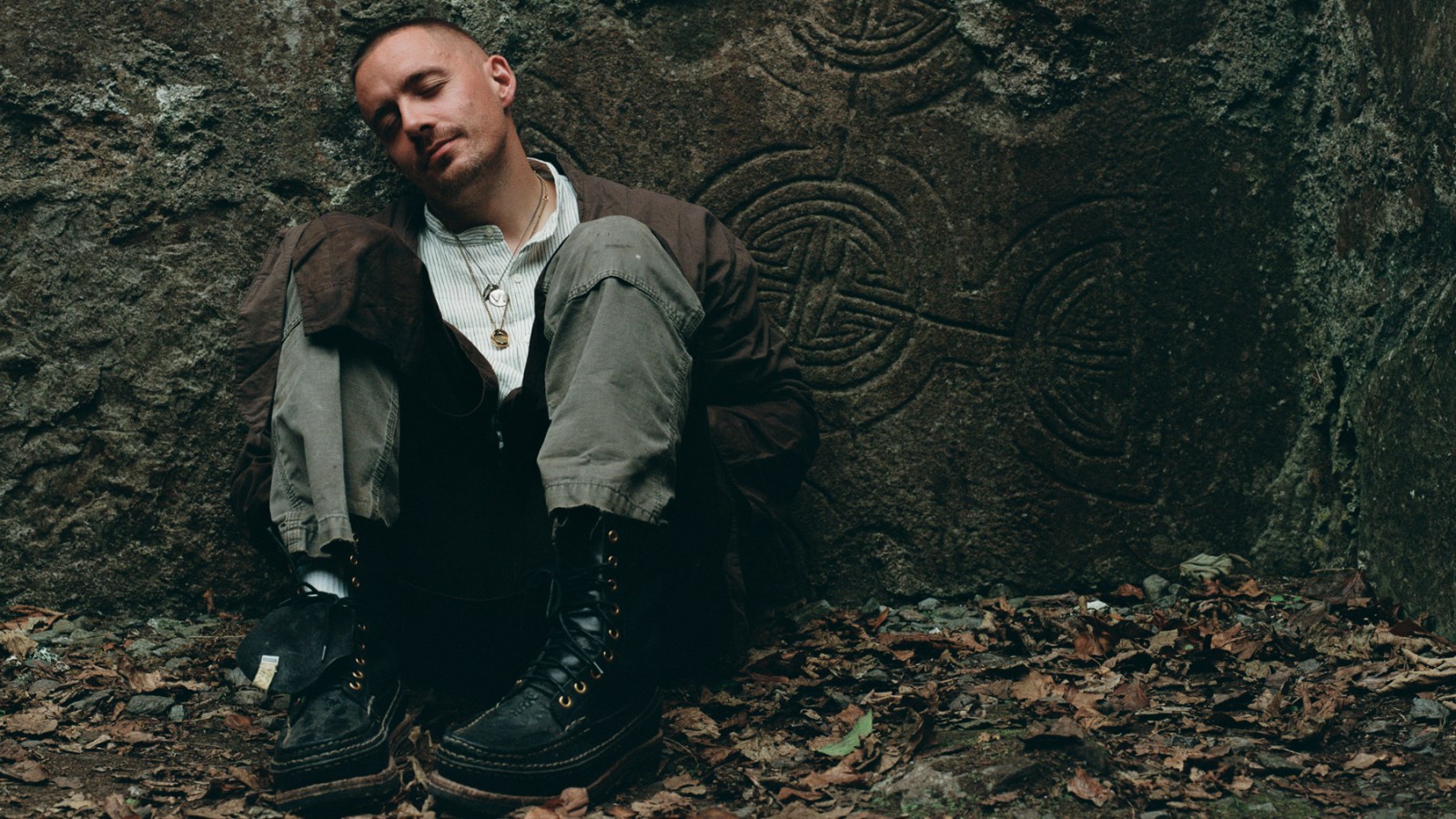

Dermot Kennedy didn’t panic when he heard the sound of drums cut through the natural silence of the forest he stood in on Christmas Day. It was nearing midnight when the singer-songwriter set off on his walk through the woods. He listened long enough to discern a pattern — the thump returned every minute or two — but the pitch-black landscape made it impossible to determine the source. Kennedy is familiar enough with the trees near his Dublin home to know this was unusual and a bit eerie. Still, he found it intriguing.
“The darkness, to me, is not necessarily a bad thing,” Kennedy tells Rolling Stone over Zoom, having just returned from another walk through the woods with his dog. “Mystical things happen there. I’m quite drawn to it.” The musician’s third studio album, The Weight of the Woods, out March 27, is a product of this magnetism.
Some variation of the word “dark” appears no less than 15 times across nine songs on the 14-track record, including on the lead single, “Funeral,” out today. “Grief is such a solid promise/Joy just leaves you in the rain/Sadness waits down in the lobby/Solace stood you up again,” Kennedy sings on the percussive track. “I’m thankful for the darkness/Everything it let me see.” Darkness, he says, represents difficulty, which is a big part of the grief, love, and loss he sings about.
An Irishman through and through, Kennedy tends to forgo blind optimism in favor of unvarnished realism. “I’m very conscious of the fact that whether things are difficult or fantastic, they’re brief and they’re just passing,” he says. On “Funeral,” setting fire to the past helps speed up the process. “I find it very difficult to be in the present moment, because I’m always dredging up the past for material — then I spend so much time, in terms of my own ambition, thinking about the future,” Kennedy says. “It felt good to talk about just getting rid of the things that burden you.”
If he weren’t able to detach from regret and remembrance, alike, he’d be haunted. At home, the past is everywhere he goes. When Kennedy’s collaborators arrived to work on The Weight of the Woods, he drove them through a map of his memories. “He’s showing all these places where he had his first kiss, his first heartbreak, all these things,” says producer Gabe Simon. “Then he’s showing places where it’s like, ‘This is where someone in my family passed away, and here’s this bridge where there was a flood.’” It took days to process it all. “It was like he didn’t have the conversational tactic to tell you,” Simon continues. “He just knew how to show you.”
Silken Weinberg*
It was the same in the studio. Simon had been drawn to Kennedy’s perspective and honesty since their first meeting in Nashville, but the musician carried an innate hesitancy. He was used to new collaborators outright asking, “What would you like to write about?” The question often sent him retreating into himself. “It’s such a crazy, intimate place to go immediately,” Kennedy says. “In that way, I feel incredibly insecure. But in terms of things I write, I feel extremely secure.” He was thrilled, then, when Simon skipped the conversation entirely and started flipping through his most personal journal entries.
“For years and for multiple projects, I had been dying to find somebody who would go the distance with me,” Kennedy says. In Simon, he found a collaborator who was willing to move his entire family over to Ireland for six weeks while the record took shape. Simon, who co-produced Noah Kahan’s breakout album, Stick Season, sees parallels in their small-town perspectives on much greater expanses. “I didn’t see the world before I saw it the way he saw it,” Simon says of Kennedy. “He’s lived in the same neighborhood his whole life. For him to have this big, beautiful imagination, it made sense to me. I imagine he probably spent a lot of time in the woods as a boy going, ‘I wonder what the world’s like out there.’”
The Weight of the Woods stays close to home. There’s a song towards the end of the album that echoes the sound of wind moving through the electrical poles just outside of the studio in Dublin. Another incorporates the sound of Kennedy crushing snow beneath his footsteps. On first listen, it sounds like a simple snare. Instrumental fakeouts are scattered all across the album. “We spent the first week and a half driving around the country, collecting instruments from Galway and Cork,” Simon says. They brought in the Irish traditional instrumentalist Cormac Begley to play a few bars; local musician Muireann Ní Shé plays uilleann pipes on the record, and an Irish bodhrán appears in place of a proper drum on some tracks.
When a storm knocked the power out at a church not far from the studio, a choir performed the chilling sequence that appears on the album’s first track in the shadowy space as snow fell outside. Some parts of The Weight of the Woods were polished off in Nashville, but these details added a sense of history to an album already deeply bound by community. Kennedy says he will, on occasion, “flirt with the idea of living somewhere else in the world.” But he more often finds himself in alignment with the old Gaelic saying “Níl aon tinteán mar do thinteán féin.” It carries more intrigue than simply saying there’s no place like home, but the heart beats the same. “Being in his home, that’s the place he cares about,” Simon says. “It’s sacred to him.”
Kennedy was further away when he created his second album, 2022’s Sonder, in New York. The follow-up to his burning and pensive 2019 debut, Without Fear, added career-highs to his catalog, like “Blossom” and “Already Gone,” and landed him a headlining gig at Madison Square Garden on an extensive world tour. But the album proved to be divisive for some fans who felt he’d veered too far into pop territory with the upbeat hits “Kiss Me” and “Better Days.” The apparent disconnect wasn’t lost on him. “I like to think even if it isolated certain people, it didn’t leave them entirely,” Kennedy says. “I hope they’re still around.”
Still, Kennedy never felt like Sonder was “a crazy departure.” He worked with some of the same producers as the previous album, including Scott Harris, and made a few tracks with Olivia Rodrigo/Chappell Roan collaborator Dan Nigro. When he played those songs live, he felt they fit right alongside his other releases. But he does admit that there were moments during the album cycle when he felt “caught up in the blur of being part of an industry and touring.” On the road, he watched fans unravel in the crowd and wondered what in their lives made them connect so deeply with his melancholic sense of hope. Offstage, he wondered what the point of any of it was.
“Sometimes, in your weaker moments, you can question the importance of what you’re doing,” Kennedy says. That was the burnout talking. In between Sonder and The Weight of the Woods, he reconnected with fans on an intimate theater tour that saw him strip back old songs and preview new material. “When people are like, ‘He’s returning to who he was,’ I’m just like, well, not really,” he says. “I was this person the whole time. I knew it would always go like this musically.” The new album restored his sense of joy, he adds. “It’s been a return to having that creative conviction and confidence, but mostly just remembering how important it all is to me, and how it’s just such a crucial part of who I am as a person.”
Kennedy saw flashes of this when he joined Zach Bryan for a performance at Indiana’s Notre Dame Stadium in September. “There’s certain things in his career that are wild to me,” he says. “I was on his in-ears for most of the gig to get my mix right and I was like, ‘Oh, man. This guy literally just has his guitar and voice and is playing to 90,000 people.’” This summer, Kennedy will perform for crowds nearly as large across two nights at Dublin’s Aviva Stadium. He relishes being able to toggle between high-scale productions and stripped-back shows. “It was so inspiring to see somebody have that conviction,” he says.
Even Bryan isn’t immune to having external noise break through his tranquility barrier. The country musician recently released the 25-track album With Heaven on Top, then followed it with an entirely acoustic version just days later. “I’m assuming this record is just like all the other ones and there’s gonna be a billion people saying it’s over-produced and shitty,” Bryan said. A decade into his career, Kennedy can see the value in his audience’s opinions, but he doesn’t feel compelled to live or die by them, either. “If you get it wrong, you know, no one died,” he says, adding, “If it all went away tomorrow, I’d be sad about it, but I’d be OK. It wouldn’t kill me. I think that puts me in quite a powerful spot to do my best work.”
There was no consideration of right or wrong when recording The Weight of the Woods. “It’s been a journey to get back to the point where I’m not concerned with what people think,” Kennedy says. “The best way for me to serve my audience is to not consider them.” There are vivid callbacks on the record to roads he once walked in places most of his listeners may never see, as well as ruminations on prayer and faith, and how they can heal a broken heart. There are moments that border on intrusive in their revelations, often desperate and steeped in devotion. The Weight of the Woods is a striking portrait of Kennedy that he hopes can still function as a mirror.
“He wants to go dark and he wants to break your fucking heart — and he does it,” Simon says, remembering a night when Kennedy brought the Ryman Auditorium to tears with just a guitar and his voice. “He also wants to leave you not standing there alone, but leaning against someone crying. He wants to leave you holding your friend’s hand as you walk out. He wants to leave you with hope and love as much as he wants to devastate you. That’s what we need right now. I don’t think he feels a sense of responsibility, but I think that his heart is naturally oriented towards hope.”
The responsibility Kennedy feels most heavily is towards honoring the love and relationships that define his worldview. “I’m very conscious of the fact that I’m just passing through, and I’ll do my best while I’m here, but, you know, won’t be around forever,” he says. When it’s all said and done, as he sings on the final track on the record, Kennedy just wants to add to the weight of the woods. “When I die, I would like to become part of that landscape,” he says. “Let me add whatever I’ve contributed and all that sort of stuff in my life. Let me just go and dissolve into being part of the forest.”