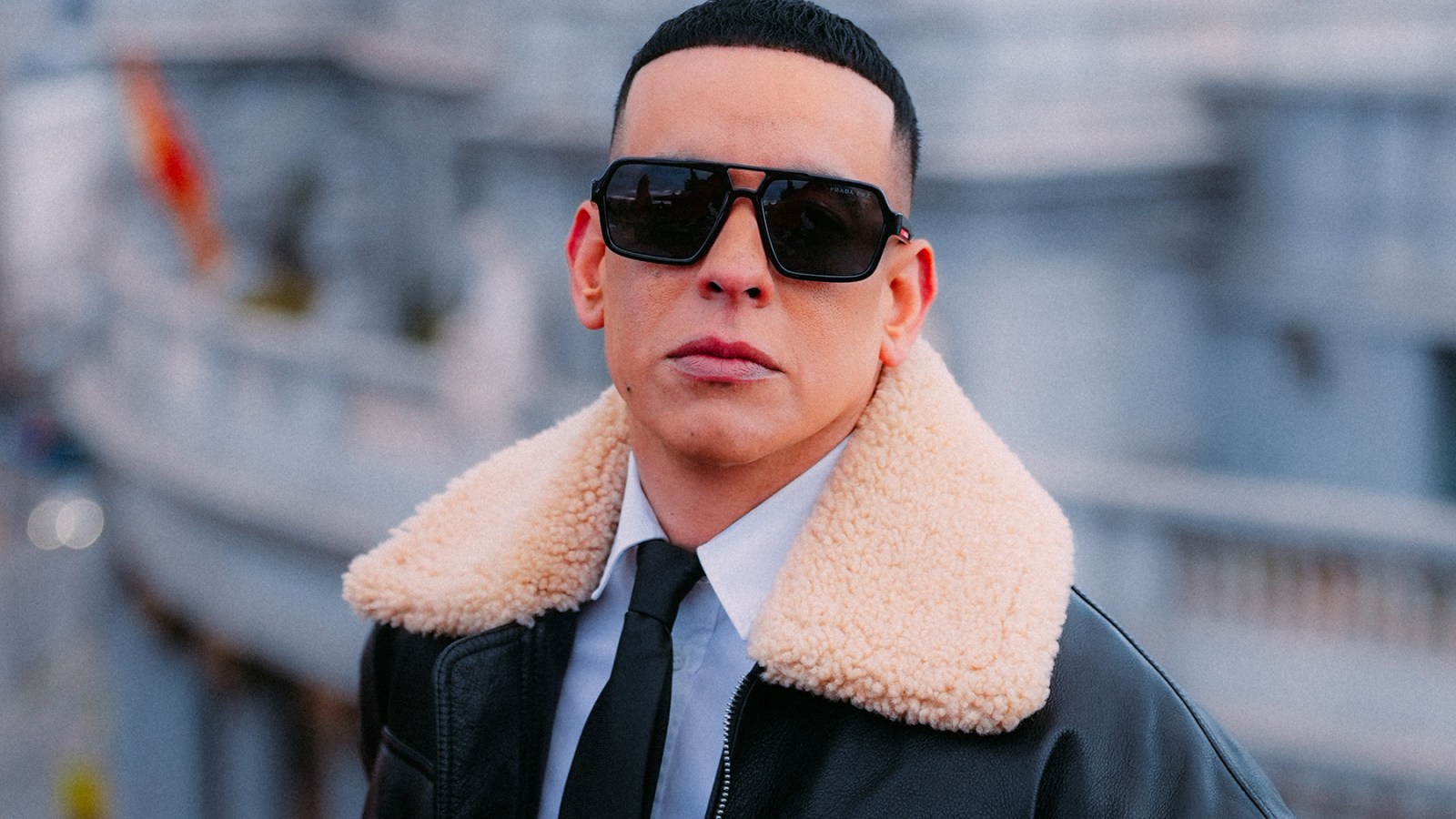

Daddy Yankee is, unequivocally, one of the biggest Latin music stars in the world. He’s talked about in the same breath as Ricky Martín, Gloria Estefan, and Shakira, and, in a lot of ways, he’s the trailblazer we have to thank for Bad Bunny and an entire generation of reggaeton artists. His catalogue stretches over decades, with commercial juggernauts like “Gasolina” and “Despacito” shaping Latin music’s legacy.
The self-proclaimed Big Boss announced his retirement back in 2022 and closed out his career with a massively successful farewell world tour. In 2023, he ended the tour in his homeland, Puerto Rico, and performed what he said would be his last concerts ever. On the final night, he shared with the audience that he had converted to Christianity and would focus the rest of his years on spreading the gospel. It would be his second bout with religion, since he first converted back when he was 19 but “strayed” to focus on his music.
Today, Daddy Yankee, whose real name is Ramon Ayala but is called Raymond by friends and family, turns 50. It’s a momentous occasion for most people, but even more for an icon of reggaeton, who has spent three decades in music. It was Daddy Yankee himself who gave the genre its name, back in the seminal Playero 34 mixtape when he was barely a teenager, impressing fans with his talents on the mic.
“From the beginning, since Playero, it’s always been something that’s come naturally to me: trying to be the tip of the spear, trying to do things differently, trying to leave a mark, a footprint. Something that transcends beyond the music,” he tells Rolling Stone in an exclusive interview.
Last week, the Puerto Rico legislature paid homage to his trajectory and contributions to the culture of the archipelago on the world stage. In addition, a street in San Juan was approved to be renamed for him. Some of his colleagues from reggaeton’s golden days were there, including Baby Rasta, Tito el Bambino, and Lito MC Cassidy, as well as Argentinian producer Bizarrap who most recently collaborated with Daddy Yankee on his popular Music Sessions series.
One day later, Daddy Yankee sat down to reflect on his start, his career, and how he feels now with what he deems a “blank canvas” in front of him as he enters a new decade. Today, he also released “Toy Hermoso” (“I Am Beautiful”) for his followers. “The song is a celebration of self-acceptance and celebrating yourself every day with God’s love,” he says. “Psalm 139:14 inspired me to create it. Every person is beautiful, original, and unique, and no one in history will ever exist again in your image. You are an admirable creation, and that should be celebrated.”
The Early Days
Not long after his debut, Daddy Yankee released his first solo album, 1995’s No Mercy. Nowadays it’s mostly brought up as fodder for memes highlighting how he looked as a 19-year-old kid on the cover art. But back then it was one of the first solo albums by a reggaeton artist — “completely groundbreaking,” he calls it — and one that skipped the typical sampling and remixing of dancehall and raggamuffin beats that was the bread and butter of early reggaeton (or “underground” as it was still called back then) for completely original music.
“People were expecting a completely underground album, and I decided to bet on myself and go against the grain so people could discover my talent,” he says. “We can see Daddy Yankee’s signature style from the beginning: the risks he took ahead of his time, and that no matter what was happening he always had a vision.”
As “underground” morphed due, in large part, to the adoption of more modern audio software and an influx of young producers eager to test the genre’s limits, Daddy Yankee didn’t miss a step either. He released a duology of compilation albums titled El Cartel (which was also the name of his successful record label), linked up with Nicky Jam to put out hits together as an unofficial duo called Los Cangris, and released an acclaimed sophomore album titled El Cangri.com. All the while, he fueled passionate fan debates about who was the genre’s leader, with people often pitting him against Don Omar. He kept moving by participating in some of the hottest albums including Luny Tunes’ 2003 debut LP, Mas Flow which featured one of his biggest hits yet, “Cógela Que Va Sin Jockey.” That song was a sign of things to come the following year when he and Luny Tunes teamed up again for an album and single that would single-handedly change the course of reggaetón forever: Barrio Fino and “Gasolina.”
What does he remember about the moment in time before that song? “Creating culture, without a doubt,” he says. “Creating culture, opening doors, continuing to build, seeing the opportunities that were emerging, preparing to explode onto the world stage — without a doubt, I knew the moment was coming.”
He says spending time in New York City during those years opened his eyes to how reggaeton was making inroads in Latin communities, not just Puerto Rican ones but also Dominican, Mexican, and beyond. This, he sensed, was a sign that the genre had staying power. “It’s music that appeals to all Latinos from all countries, and it even has the potential to go global because even Americans are already reacting to the music,” he says.
His instincts proved right, and Barrio Fino’s runaway success in 2004 kicked open the doors for reggaeton to sweep the world beyond Puerto Rico’s borders. He admits that at just 25, he felt overwhelmed by the pressure. “At 25 you feel like you’re already getting old, when in reality you’re not even starting to live,” he says. “[But that] makes you feel like life is going to pass you by. So you’re feeling like you don’t have time, which is what I felt, like [success] has to be now because I’m almost 30.” That hustler’s spirit is one of the traits that he sees as key to his accomplishments. “Anything that could open doors, any business I could do. I was doing everything,” he says.
Being an entrepreneur is a fundamental part of who he is (his Instagram bio reads: “Disciple of Christ, Musician, Entrepreneur”) and he points to his development as an artist in those early reggaeton years as what molded that spirit. “For us it was very different. We were kind of forced to be our own record label, our own distributor, because nobody wanted to deal with reggaeton, so we had to create our own opportunities, which was the best thing,” he says. “We were forced to go out and do it ourselves, and that was the beautiful thing about reggaeton: It created its own marketing lane, its own fanbase, its own strength.” He says there weren’t any real mentors guiding him either, but instead he pulled himself up by his own bootstraps, or as he jokingly calls it: “A Pulmón Records.” (Lotsa Struggle Records)
The years post-Barrio Fino saw the release of more hit albums and songs, but after 2012 he began to focus more on releasing singles and doing collabs with other artists, especially rising stars, instead of continuing to release LPs. Once again, he used his instincts to identify trends and capitalized on it. “It’s not that I wasn’t focused on albums. Now, thanks to the social media era, where people demand content, we’re in an album era. But back then it was very difficult. People consumed singles better,” he notes.
Then, in 2017, one of those singles would go on to dominate the airwaves even more than “Gasolina” did nearly 15 years earlier. Luis Fonsi and Daddy Yankee’s “Despacito” dropped in January of 2017 and became a near-instantenous hit. When the smoke cleared, the list of accolades and records broken by the track and its now-iconic music video was a mile long. At one point, it became the most streamed song of all time, and the most watched YouTube video of all time as well.
For Daddy Yankee, though, the entire “Despacito” experience felt like riding a bike. “Since I experienced it with ‘Gasolina,’ I was already quite familiar with that kind of phenomenon,” he says. He felt nary any anxiety at all when he saw how big the song was becoming. “I really enjoyed the whole thing,” he smiles.
As the 2020’s arrived, behind-the-scenes he began to work on what would become his biggest project yet: the launch of a new Daddy Yankee, while simultaneously retiring the one fans had come to know and love for over 30 years.
A New Outlook
Daddy Yankee is a reticent man who hardly speaks in absolutes or specifics. Oftentimes he’ll imply NDAs are why he’s so tight-lipped, but it’s hard not to come away from a conversation with him feeling like there’s more to it than that. He comes across as someone who guards his energy zealously, and that’s probably another factor in his success.
When asked what music he’s following since his retirement, he mentions loving Caribbean rhythms (“That’s what always draws me in”), hip-hop (“I was born into it”), and reggaeton (“I listen to all the young artists”) but noticeably never namedrops any artists. In fact, he seems to be more into the sounds than the vocals.
“I’m really into instrumentals, to be honest. I listen to instrumentals from every genre, even when I’m working out. I really like afro house right now,” he says. “Even Mexican music, I love what’s happening instrumentally with them. When I listen to the instrumentation, I’m into everything.”
He does offer one intriguing nugget that runs against type. “I like Eighties rock, and I have a playlist that I play nonstop. I love the hits of the Eighties,” he laughs. “Put on a karaoke machine and I can sing them all.”
When pressed to share a specific artist, he finally offers one surprising answer: “I really like Phil Collins. Phil Collins was one of my favorites, and obviously Michael [Jackson.]”
As he continues his mission of expanding as an entrepreneur, he’s mentioned how he wishes to invest more in sports-related ventures. He was a strong baseball prospect as a teen, before having to give up those dreams after surviving a shooting attempt that left a bullet permanently lodged in his hip. To that end, since retiring he’s become a co-owner of the Flowrida Goats, an Orland-based team in the Pro Padel League (PPL) and also formed a partnership with the Puerto Rican Fútbol Federation to help expand development of the sport on the island over the next four years.
Hip-hop fans found themselves in a similar place years ago when many of their own artists such as Jay-Z began to hit middle age, and the question of how figures that once dominated a genre dependent on young people would continue to stay relevant. It’s a notion that wasn’t lost on Daddy Yankee, but he paid attention to the moves those who came before him made.
“Everything is studied. I’m someone who studies everything. I try to study the moves of all my colleagues. What can be replicated, what might work for me, what things where others failed I should avoid,” he says. “But I also still have that intuition, that drive to keep creating, which is what I’m called to do besides music. That’s perhaps that entrepreneurial touch that comes naturally to me. It’s something that’s there, a potential that’s there that I’m going to keep exploring, maximizing, and developing all the time.”
Whether there are also plans to invest in mentoring or godfathering new artists given his own history and knack for maneuvering the music industry, he turns to the mission statement he proclaimed back in 2023. “There are plans, lots of plans, but I also want to support, above all, music with a purpose. I want to expand the reach of young artists who have music that has something to say in these times,” he says. “That’s why it’s important for me to collaborate with artists of purposeful, faith-based music.”
It’s clear that he does truly believe there’s been a shift in his life, beyond his music career coming to an end. In late-2024, he and his wife of 30 years with whom he shares three adult children, Mireddys González, filed for divorce. Those proceedings have become complicated over the last year, to say the least, but he doesn’t seem to be sweating it.
“I think that at this stage of my life, I’m really enjoying how I can contribute, and how I can continue growing as a human being. That’s my mission now,” he says. “I think maybe it comes with age, this constant desire to improve in every aspect.”
When asked how he would describe each version of himself from his three decades as an artist, he takes a pause and contemplates briefly before answering.
“Without a doubt, the 20-year-old was the fighter, the visionary,” he says. “In my 30s… I was the artist [but] with a mission, and in my 40s, well, the formation of a new self.”
That new self that comes after he spent a decade in what he refers to as “quiet development,” chipping away at who he now presents to the world. “I was in the process of inner formation, and I believe that now I’m in that state of radiance.”
“I have the great opportunity of having a completely blank canvas. The canvas I had from the first part of my life is already completely painted, and it’s a beautiful work of art, full of shadows and light,” he says. “I used to have many illusions [about the future] but now I’ve learned that I think it’s more fun to let life surprise you.”
As the conversation winds down, his enthusiasm is palpable. He underlines that growth and how he plans on making the most of the progress he’s made. “Right now, at 50, I can tell you that I’m working on living life to the fullest. I think I’ve achieved this by identifying my shadows, my light, my shortcomings, and working on what perhaps we as human beings don’t want to see, and that is our own being. So, I’m working a lot internally to live life to the fullest,” he says.