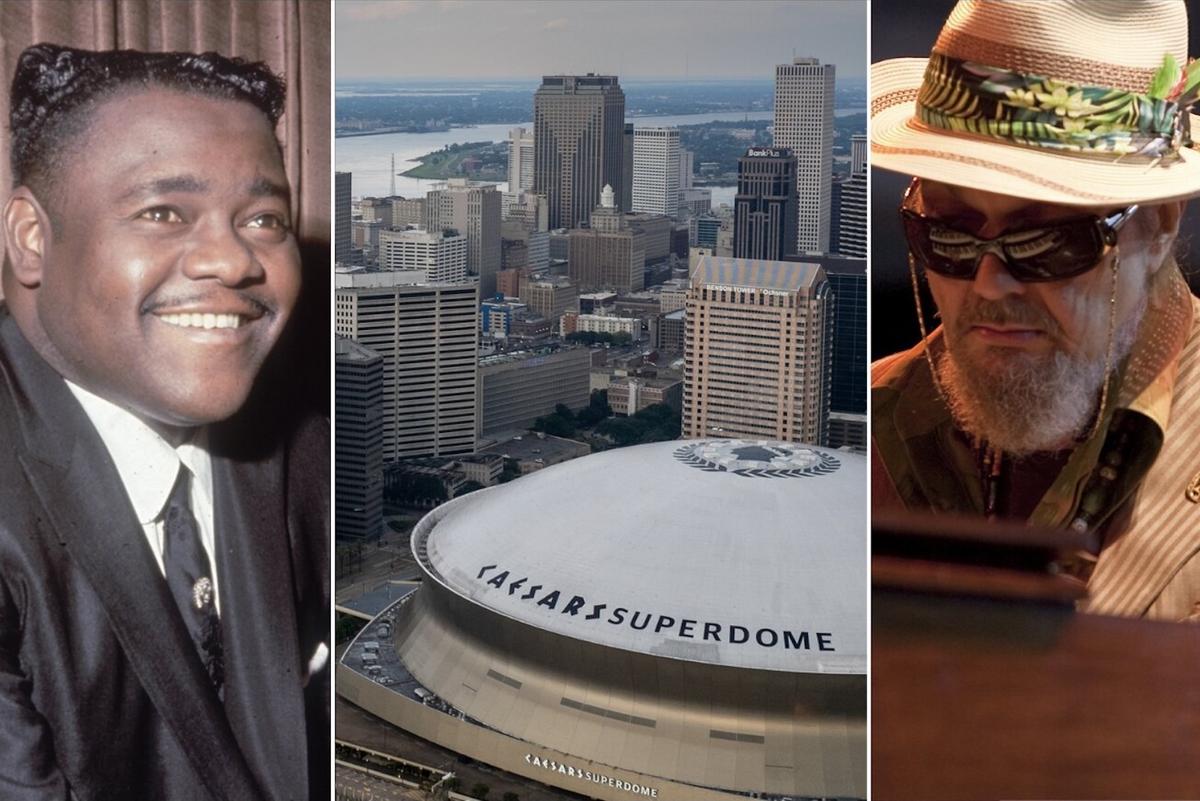

The Big 4 of New Orleans rock provide a deft representation the city’s famous gumbo-pot diversity. There’s a sardonic piano-playing storyteller, a metal pioneer, a mystic swamp-rock legend and a too-often-overlooked architect of rock ‘n’ roll.
As one of the country’s historically important port cities, New Orleans has always been defined by its cross-cultural mindset – and that certainly included its music. The city played a central role in the development of jazz and R&B, of course, but also helped define what rock ‘n’ roll could be.
Little Richard completed seminal tracks like “Tutti Fruitti,” “Long Tall Sally” and “Lucille” with a group of locals at Cosimo Matassa’s J&M Studios. He’d hardly be the last to leverage the New Orleans vibe. Fast forward a few generations, and local metalheads would change the genre’s direction all over again.
Which New Orleans Musicians Reshaped Rock Music?
Paul McCartney and Wings made a pilgrimage similar to Little Richard’s during sessions 1975’s Venus and Mars at Sea-Saint Studio in New Orleans, co-owned by Allen Toussaint. Toussaint had already written two songs that topped the Billboard Hot 100. The Rolling Stones covered him. Decades later, Elvis Costello recorded with Toussant, too.
Not everybody would enjoy that kind of longevity. Plenty of shooting stars have crossed a landscape dominated by the St. Louis Cathedral, the Superdome and the former One Shell Square skyscraper, once the tallest building in the Southeast. One-hit wonders from New Orleans are almost as numerous as drunken revelers on Bourbon Street.
READ MORE: Top 10 Allen Toussaint Classic Rock Covers
Dead Eye Dick landed at No. 27 on the Hot 100 with “New Age Girl” in 1994, after the song was included on the Dumb and Dumber soundtrack. Better Than Ezra reached No. 30 on the Hot 100 (and topped Billboard’s modern rock charts) with “Good” in 1995. Others including the Red Rockers, Zebra and the Radiators scored modern rock hits, but never broke into Billboard’s main chart.
All of this has created a perhaps surprising permanence in a genre far removed from the brassy sounds of Louis Armstrong or the Meters’ funky stuff. There’s a reason Bob Dylan holed up in an old Victorian on Soniat Street when he was eyeing a late-era comeback bid. Here’s a look at four acts who crossed generations to define New Orleans’ multi-layered rock sound:
No. 4. Randy Newman
Steve Jennings, Getty Images
These days, Randy Newman is known more for his work in TV and film than his own character-driven studio projects. But Newman has also released four deeply satisfying Top 40 albums, including 1972’s Sail Away, 1974’s Good Old Boys, 1977’s Little Criminals and 2008’s Harps and Angels. His gold-selling “Short People” single went to No. 2 in 1977; “I Love L.A.” became an MTV staple in the early ’80s.
This non-soundtrack material often includes bits of Louisiana history, settings and characters – and that’s only fitting. Newman grew up in New Orleans, where his mother’s family has roots, and continued to visit the old Uptown neighorhood every summer even after they returned to his native Los Angeles. “There’s no place I like better in the world,” Newman once admitted.
READ MORE: How Randy Newman Came Into His Own With ‘Sail Away’
Louisiana clearly never left Newman’s imagination: The main character in in “Louisiana 1927” fights not to slip under flood waters. Flamboyant Gov. Huey Long struts through “Kingfish.” Nostalgia for home leads to a boxcar ride back in “Dixie Flyer,” while an unreconstructed crank takes a swipe at LSU in “Rednecks.” Unfortunately, “New Orleans Wins the War” finds a confused little boy being whisked away to California.
Newman took along one the city’s unique local dialects when he left New Orleans. (“It was what came out of my mouth when I first started,” he later told the New Yorker. “I think it just sounds better to me to do that to the vowels.”) The scion of a family of film-score composers, Newman eventually joined the family business. His soundtracks would garner two Academy Awards, seven Grammy Awards and three Emmys.
Watch Randy Newman’s ‘Short People’ Video
No. 3. Phil Anselmo
Ethan Miller, Getty Images
Long before a deeply problematic period, Phil Anselmo helped transform metal not once but twice. Many fans likely had no idea Anselmo traced his roots back to Louis Armstrong’s hometown while he led Pantera away from their initial glammy roots. He then served as frontman for the New Orleans-based Down, who are part an often-overlooked local metal contingency that includes Eyehategod and Crowbar, among others.
Pantera topped the Billboard album charts before Anselmo had a falling out with the others. After recording his vocal parts for 1996’s The Great Southern Trendkill back in New Orleans, he left Pantera – and the groundbreaking groove metal sound they’d established together. Among the groups he fronted next was Down, a long-time side-project featuring members of Corrosion of Conformity, Eyehategod and Crowbar.
READ MORE: The Very Best Songs Featuring Pantera’s Vinnie Paul
They edged toward classic rock (with notable Led Zeppelin and Lynyrd Skynyrd influences) and stirred in some local swampiness – but stayed remarkably heavy. The New Orleans rhythm influences all around them gave the music a sludgy new menace. It’s like Black Sabbath with a splash of Tabasco. Meanwhile, Anselmo also set up Housecore Records from his rural perch on Lake Pontchartrain.
“I think that there’s a certain groove here,” Anselmo said in NOLA: Life, Death and Heavy Blues From the Bayou documentary series. “Homegrown drummers specifically have that behind-the-beat feel. Like the Meters – the funky, funky Meters. If you look at the funk and groove within that genre, if you pull it off in heavy metal? Boom, it’s super effective. It’s a showstopper; it’s badass.”
Watch Down’s ‘Stone the Crow’ Video
No. 2. Dr. John
Skip Bolen, Getty Images
The late Mac Rebennack was a six-time Grammy-winner and 2011 Rock & Roll Hall of Fame best known by his stage name, Dr. John. A native of the Third Ward, he began his music life backing up some of the city’s finest local musician in seedy nightclubs while still a teen. Early sessions work as a guitarist preceded his mid-’60s move to Los Angeles, where Rebennack debuted his new persona.
As Dr. John the Night Tripper, Rebennack created a heady new brew of traditional New Orleans rhythm elements, voodoo imagery and the wild psychedelia of the day. His debut, 1968’s Gris-Gris, was a critical success but didn’t sell much. But 1972’s Dr. John’s Gumbo remained on the charts for nearly three months. Listeners were coming around to this inventive new musical figure.
READ MORE: How Rootsy ‘Dr. John’s Gumbo’ Set the Stage for His Breakthrough
In the Right Place shot to No. 24 in 1973, while “Right Place, Wrong Time” reached the Top 10 in both the U.S. and Canada. Dr. John had crossed over into the mainstream, even if he still didn’t quite see himself as a frontman. “I said, ‘Whaddya mean me? I can’t sing,'” Rebennack told the local music writer Keith Spera. “And [his label representative] said, ‘Look, if Bob Dylan and Sonny and Cher can sing, you can sing.'”
His offbeat Mardi Gras Indian-style of dress ensured Dr. John would stand out. He later worked with the Rolling Stones, Van Morrison, James Taylor and the Band, among others. The Bonnaroo Music Festival was named after his 1974 album Desitively Bonnaroo. A belated return to his roots on 1992’s Goin’ Back to New Orleans earned one of those Grammys. The Dan Auerbach-produced 2011 LP Locked Down won another.
Listen to Dr. John’s ‘Right Place Wrong Time’
No. 1. Fats Domino
Keystone, Getty Images
In an acknowledgement that too few remember, Fats Domino was part of the inaugural class of the Rock & Roll Hall of Fame. His hitmaking period began in the pre-rock ’50s, where he laid the foundation for everything that followed. Back then, the piano was just as important as the guitar. Their roles wouldn’t be definitively reversed until the following decade. By then, Domino had already racked up 11 Top 10 hits.
Domino was actually working at a mattress factory and playing piano at night when he was discovered. “The Fat Man,” released in 1949, changed everything. It’s now credited as the first rock ‘n’ roll single to sell a million copies. Unlike, say, Arthur “Big Boy” Crudup’s “That’s All Right” or Ray Brown’s “Good Rockin’ Tonight,” “The Fat Man” squarely focuses on the galloping rhythms of rock. Domino’s left the blues behind.
READ MORE: 15 Classic Rock Fats Domino Covers
His first Top 10 smash, 1955’s “Ain’t That a Shame,” landed almost six months before Elvis Presley’s seminal “Heartbreak Hotel.” If Domino had re-released 1952’s hard-charging “Poor Me” right then, it would have undoubtedly crossed over, too. Paul McCartney was listening, as made clear by the Beatles‘ 1968 platinum-selling single “Lady Madonna.” He even mimics the day-by-day cadence of Domino’s “Blue Monday.”
Domino covered “Lady Madonna” later the same year on Fats Is Back, marking his last appearance on the Billboard charts. (This 1968 album also included Domino’s take on “Lovely Rita” from Sgt. Pepper’s Lonely Hearts Club Band.) Nodding to his bedrock influence, Cheap Trick then reached the Top 40 in 1979 with an update of “Ain’t That a Shame.” Robert Plant later covered “It Keeps Rainin’,” a No. 23 hit for Domino in 1961.
Listen to Fats Domino’s ‘I’m Walkin’’
Dr. John Released One of Rock’s Best Psychedelic Rock LPs
Blues, folk, world music – no genre escaped the kaleidoscopic pull of the ’60s’ trippiest sound.
Gallery Credit: Michael Gallucci