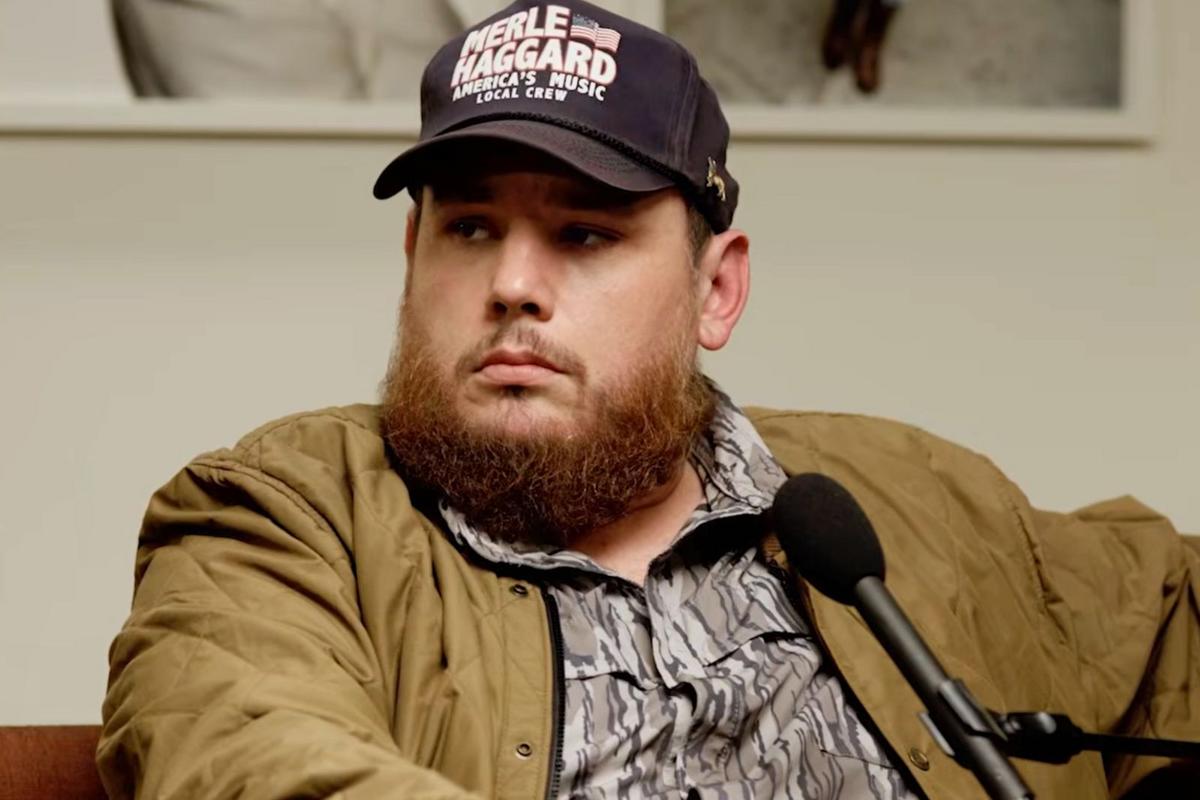

Luke Combs says it’s important to him to never push a political agenda in his music. But that hasn’t kept some listeners from assuming he’s on one side or another. In fact, he says some tried to “actively cancel” him after assuming he was politically liberal.
He spoke about the experience on a new episode of the New York Times podcast Popcast, saying that it stemmed from a moment when he spoke out against racism.
When Did Luke Combs Speak Out Against Racism?
In early 2021, Combs was part of a panel, which also included Maren Morris, that tackled the topic of racism at country radio and in the genre more broadly.
Read More: Luke Combs: There’s “No Excuse” For Using Confederate Flag in His Video
In that conversation, he apologized for his past use of the Confederate flag in a music video early on in his career, and said he’d “grown a lot as a man and as a human being, and as a citizen of the world” in the seven or eight years since.
That was a year after he first covered Tracy Chapman’s “Fast Car,” and two years before his recorded version became the first No. 1 hit in country music to be solely written by a Black woman.
What Backlash Did Luke Combs Get After Speaking Out Against Racism?
In his newest interview, Combs says some fans took his statements to mean that the singer was politically liberal, and they didn’t like it.
“There was a time when people were trying to actively cancel me [by] basically saying…’Hey man, he’s a liberal,'” the singer says, pointing out that he’s never formally identified with one political party of the other.
“I’ve never said that,” Combs continues. “Like, to me, how hard is it to say you’re not racist?”
“…Because basically, I’m coming out and saying I’m not a racist. I don’t have any problem saying that. It’s not something that I’m worried about addressing at any point,” he adds.
What Are Luke Combs’ Political Views?
We don’t really know, and that’s not an accident.
Combs says he’s glad that artists who want to speak out are able to do so through their music and other avenues like social media. But he’s not a fan of any singer preaching politics in a way that’s pushing their worldviews onto the listener.
Read More: Do Country Stars Owe It To Us to Explain Their Politics?
“Once it’s coming through my speakers, I’m over it, dude,” he explains. “…Once it comes through my speakers and I feel like I’m being told how to think or what to do, in the music itself…”
The singer also says he doesn’t gel with how black and white political divides often are, saying that he’s “heavily moderate in everything.”
“That’s to the point where I’m not liberal enough for liberals and not conservative enough for conservatives. And I kind of like it that way,” Combs reflects. “I also kind of like people not really knowing what I have going on politically. Why do we all care what everybody else is? What does it signify?”
Country Music’s Current Feuds and Beefs [UPDATED]
The difference between a true country music feud and one country singer being a punk is the response. Each of these active feuds has involved a significant back and forth between two country artists or more.
A few singers are involved in multiple feuds while others involve unexpected or unknown singers. We’ll update this list as the pairs make peace or if another fight emerges.
Gallery Credit: Billy Dukes