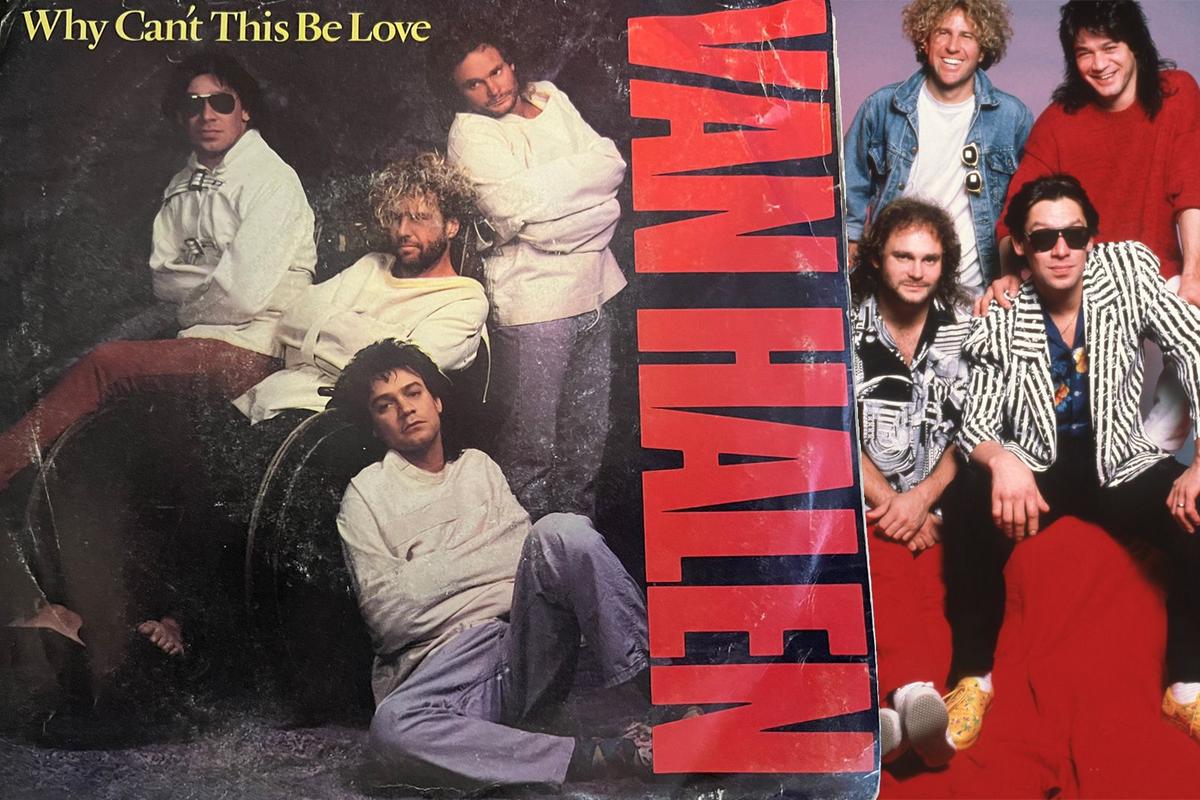

Before they even got the chance to present themselves to the outside world, Van Halen and Sammy Hagar had to overcome a lot of doubt and resistance from their inner circles when they decided to join forces in 1986.
Hot on the heels of their amazingly successful 1984 album and tour, Van Halen shocked the world by splitting with singer David Lee Roth in spectacularly messy fashion.
They would soon find out that most of the people in charge of their career thought they should change their band name if they continued on without their flamboyant frontman. As you might expect, this advice particularly rubbed guitarist Eddie and drummer Alex Van Halen the wrong way.
“We had everybody — [Van Halen’s record label] Warner Bros., our management, our lawyers — going, ‘Oh, my God. David Lee Roth’s gone.’ They thought that that was such a strong identity,” bassist Michael Anthony later explained. “Warner Bros. wanted us to change the name of the band. I remember Eddie and Alex [Van Halen], we were at Warner Bros., and they were yelling, going, ‘Hey, hey, this is our last name. This is our careers. And we’re Van Halen.'”
Read more: Rock’s 10 Ugliest Breakups
Sammy Hagar’s Team Had Doubts About Him Joining Van Halen
Meanwhile, both Hagar’s manager and label boss thought he was making a big mistake by joining the group. After all, after a long and hard-earned climb up the mountain, he had finally graduated to platinum-sales status as a solo artist with 1984′s VOA and the hit single “I Can’t Drive 55.”
“When [manager Ed] Leffler found out how much the guys had made the year before, he told me I was going to have to take a pay cut to join the band,” Hagar recalled in his 2012 book Red: My Uncensored Life in Music.
His label boss, David Geffen, understandably displeased at the thought of losing one of his best-selling artists, was equally baffled. “Why you want to be in that band?” Hagar remembered him asking. “You’re as big as them on your own.”
(Fact check: although both acts had headlined the same size venues on their most recent tours prior to teaming up, 1984 sold about ten times what VOA did.)
But the foursome stuck to their guns, eventually forcing their labels and managers to hammer out a deal that let Hagar join the group. And they refused to use the repeatedly suggested “Van Hagar” moniker.
“In spite of the doubt, we already knew it was going to work, because we were the ones in the studio working up the 5150 record and we knew we had some killer tracks,” Hagar explained. “We had ‘Why Can’t This Be Love.'”
Released as the new-look band’s debut single on Feb. 26, 1986, the bouncy synth-rock track was the next logical step for the Van Halen after they successfully broke hard rock convention by building two of 1984‘s biggest singles – “Jump” and “I’ll Wait” – around keyboards instead of guitars.
Watch Van Halen Perform ‘Why Can’t This Be Love’
This evolution was famously the source of much debate between Roth and Eddie Van Halen prior to the release of 1984. Hagar had regularly featured keyboards in his own music, and his vocal range and pure singing ability gave Van Halen a whole new palette to work with.
After telling Hagar that the singer had “no f—ing idea what you cost me” when he visited Van Halen’s 5150 studio for his first chance to listen to the new group’s music, Warner Bros. boss Mo Ostin quickly became a believer.
“Mo asked if he could hear something, so we put on our instruments, and, while he sat there, we played ‘Why Can’t This Be Love’ for him, live and in person,” Hagar recounted in Red. Afterwards, “He put his finger in the air and smiled.”
Ostin’s first words: “I smell money.”
Why Van Halen Didn’t Film Any Videos for ‘5150’
Although much of the commercial success for Van Halen’s 1984 and Hagar’s VOA could be attributed to the humorous and very popular videos they made for the singles from those albums, the band did not film one for “Why Can’t This Be Love.”
“We had no time whatsoever to do a video,” Eddie told Rolling Stone at the time, explaining that they were still rushing to mix the record in time for their first tour together. “The other thing,” he added, “was I wanted people to see us for what we are live first. Then we can goof off in a video.”
(A video featuring the Blue Angels flight group was released for the 5150 single “Dreams,” and MTV later played performance-only clips from the band’s 1986 concert movie Live Without a Net, but Van Halen didn’t appear in another filmed video until “When It’s Love,” from 1988’s OU812.)
It didn’t matter. The song soared to No. 3 on the pop charts, second only to the chart-topping “Jump” in terms of the band’s history. Released a month later, 5150 became Van Halen’s first No. 1 album, a feat they quickly followed up with a sold-out tour.
Van Halen Lineup Changes: A Complete Guide
Three different singers and two different bassists joined the Van Halen brothers over the years.