
When you first hear Haylie Davis’ music, it’s easy to think you’ve stumbled across a lost 1973 album found in a dusty record bin. The 26-year-old musician sounds like a cross between Emmylou Harris and the cult psychedelic folk singer Linda Perhacs, with melodies that beam through like Laurel Canyon sunshine. “My influences are very clear, but I wouldn’t say I’m consciously trying to mimic or recreate anything,” Davis says. “My songs are more out of my control than you’d think they are. I purely feel like a messenger.”
On her upcoming debut album, Wandering Star (out June 5 via Fire Records), she dips her toes in folk-pop (the blissful lead single “Golden Age”) and glittery Americana (the pedal steel-heavy “Lily of the Valley”), all tying together to create one cohesive knot of a new kind of Gen Z songwriter, who looks to the past without rehashing it. “Classic songwriting will never go out of style,” she says. “And that’s something I will always strive toward.”
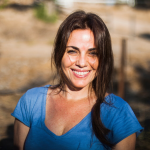
Though her music radiates SoCal warmth, Davis is actually a few hundred miles north in Sonoma County, where she grew up, when she logs onto Zoom. She’s sitting in her little brother’s green-painted bedroom, wearing a black long-sleeve shirt that’s nearly the same color as her wavy hair, her bangs strewn across her forehead. She apologizes in advance for any watery sounds I might hear, explaining it’s her brother’s fishtank.
Davis only recently began performing under her given name. Before that, she was one half of the duo Will & Haylie, alongside Will Worden, whom she used to date. Then she became Lady Apple Tree, inspired by a line from Clarissa Pinkola Estes’ beloved 1992 book Women Who Run With the Wolves. Under that name, she released a self-titled Lady Apple Tree EP — which contains the mystical “Silver Hands” — and a cover of the Lovin’ Spoonful’s “Didn’t Want to Have to Do It,” her most-streamed song on Spotify. (Davis is by far the youngest person to cover John Sebastian’s tragic love song; other notable renditions include Cass Elliot and the Rotary Connection.)
Last summer, however, she decided she’d outgrown Lady Apple Tree, and began releasing music as Haylie Davis (dropping her last name, Hostetter). “Lady Apple Tree creates a very specific visual world that I don’t want to be confined to,” she says. “It sounds folky. I’ll still make music like that, but I felt like my name was more true.”
Davis spent three years working on Wandering Star, prior to getting signed to a label. “It was all done with whatever money I had, which is not much, because I was a waitress,” she says. She cut it in L.A. at the historic Valentine Recording Studios — where everyone from the Beach Boys to Lana Del Rey have recorded — and the cozy studio Love Magnet, which owner Ian Doerr built in his Highland Park garage. Like her retro sound, Davis says that going all-analog was more of a happy accident than a choice. “I’m not really a stickler on if it’s tape or not, but the people who I associate with all pretty much stick to analog,” she says. “I’m just lucky with who my friends are.”
Going old-school did make for some magical moments, like when she was recording the new album’s title track at Love Magnet. “It was a live take, and the tape ran out right as the song was ending,” she says. “You wouldn’t really be able to get that kind of special moment if you were recording digitally.”
The oldest of three children, Davis grew up listening to her mother sing around the house. “I have this suspicion that the artist gene is inherited, and it’s not science-backed,” she says. “My dad is a carpenter and he builds houses, so I feel like I got whatever artist gene from him, but my mom has a really great natural voice.” As a teen, she loved 2000s rock like the Strokes and Arctic Monkeys, and alt darlings like Lana Del Rey and Mac DeMarco. But then she dug deeper, enamored with older acts like Gram Parsons (“that tenderness always hits,” she says), Stevie Wonder (“Talking Book was probably one of my most played”), and Joni Mitchell (“I listen to her religiously”).
In 2019, she decided to do music professionally, and dropped out of Chapman University after one year. “I studied psychology, but I was never going to be a therapist,” she says. “That wasn’t in the stars for me. It all just clicked.”
In both our conversation and on the album, Davis loves to talk about stars. She says “Wandering Star” isn’t necessarily a love song; it’s really about longing for a sense of direction. The highlight “Give Me a Rainbow” takes on a similar meaning. “It’s a song of doubt, being clouded in the weeds, and hoping for that one sign to get you through,” she says.
Davis says that she recently went through a breakup that she’s still trying to process. “That flipped everything on its head,” she says. Back in L.A., where she lived for seven years, her routine consisted of waking up at 6 a.m., drinking tea, and meditating. “Now I just want burgers and fries,” she jokes. At least music has helped her: “Go through heartbreak and then it’ll all make sense again,” she says. “I have been playing some Madonna radio. That really helped me move [out of] my apartment. You know that song ‘Hung Up’? That one got me to pack up real fast.”
This spring, Davis plans to move to New York City. She points out that other L.A. musicians have done the same, including Drugdealer’s Michael Collins and singer-songwriter Alex Amen, with whom Davis recently performed at a Neil Young tribute at the Troubadour. “I’ve noticed there’s been this exodus of a lot of musicians that I’m friends with, and I want to be a part of that,” she says. Plus, she’s a fan of NYC indie heroes Geese: “I love Cameron Winter,” she says. “I feel like he’s the darling right now. He’s so good.”
In a way, Davis predicted these life changes on Wandering Star, specifically the opener “Country Boy,” in the first two lines of the album. “Love may come and love may go,” she sings. “Can’t you hear that open road a-calling?” Wherever it takes her, she’s ready with a song.