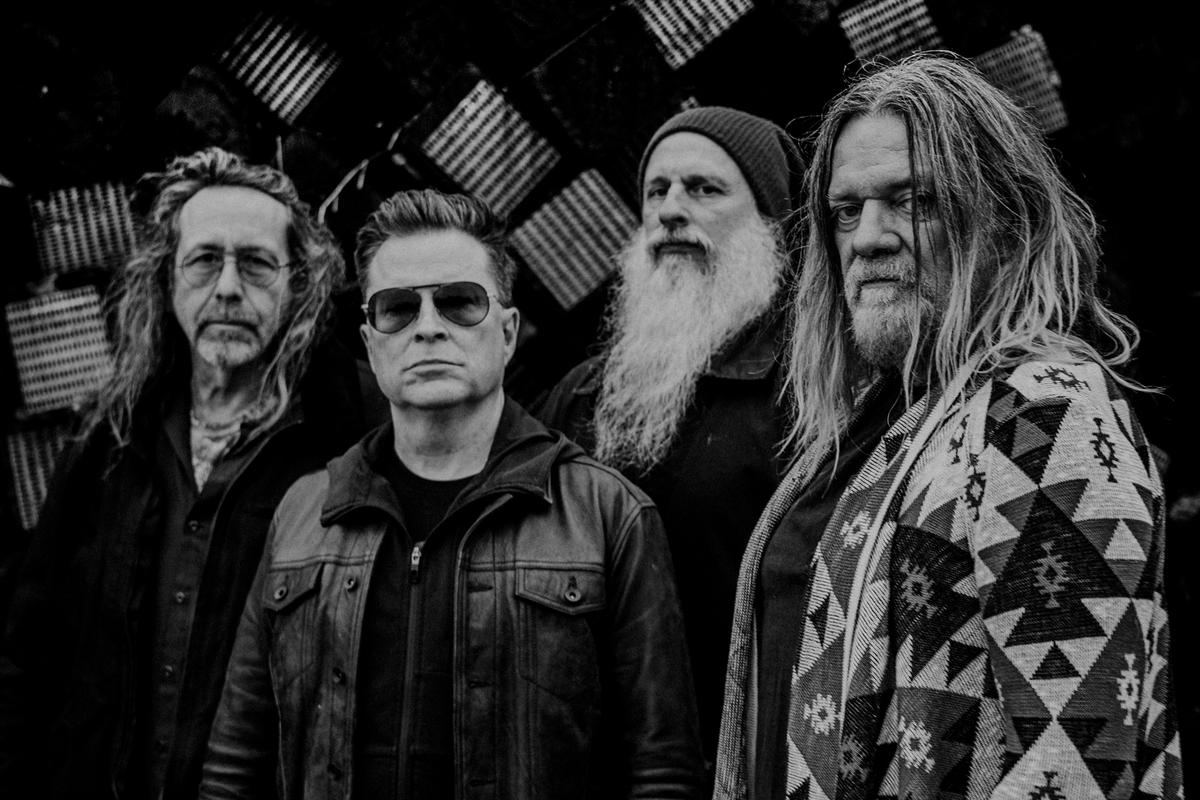

It’s been eight long years since Corrosion of Conformity released a new studio album. They made up for the long wait by seriously delivering the goods with Good God / Baad Man, which arrived this week (April 3).
The new LP (a double record, in fact) clocks in at more than an hour, a listening experience that album producer Warren Riker kept calling Dark Side of the Doom as they were making it. You can call it whatever you want, but the simple facts are that C.O.C. have made their best record in a long time. It’s one that takes everything you’ve ever loved about the North Carolina-bred group’s entire discography and jams it into one magnificent listening experience.
“This record is just a really a big love letter to f—ing rock and roll,” the band’s vocalist, Pepper Keenan, tells UCR. “It’s just all the s–t that we dug. “Me and Woody were drinking beer, listening to records and making our own. Somebody said it reminded him of a heavy metal [version of] Paul’s Boutique [by Beastie Boys], I’ll take that, dude.”
We spent more than an hour talking with Keenan and also, guitarist/founding member Woody Weatherman. You can hear our full conversation on the UCR Podcast. Here’s five things we loved hearing during the chat, which you can listen to below.
Corrosion of Conformity Carved Their Own Path
While there are plenty of bands who develop a certain formula and style, C.O.C. has taken a different route. Though they have a sound, one thing you can expect from each new album is that it’s going to be something you haven’t heard before. “[That] drives me f—ing crazy. I couldn’t do it — although AC/DC is my favorite f—ing band and they’re geniuses of that,” Keenan says. “I can’t do that, you know?”
“C.O.C., a long time ago, broke the mold on that. We freed ourselves when we put out Deliverance [in 1994] and “Albatross” came out. We took a f—ing left, and to me, that was more punk rock than anything ever we had done,” he says. “So once we had f—ing cracked the seal on that s–t and people were starting to expect these things from us, we could do whatever the f— we wanted, and it became more exciting.”
“That was all by design. We did not want to be pigeonholed into making [the same music over and over again]. There’s lots of great bands out there, you know. But Prong is not going to do that,” he adds. “I love Tommy Victor and I love what they do. It’s f—ing fantastic. But we consciously set ourselves up. You know, sometimes we might write a song that goes in a Lynyrd Skynyrd direction, or we might cover a Skynyrd song, or we might cover a FEAR song — all the things that we love.”
They Had Fun Making ‘Good God / Baad Man’
“This record was not hard to make. I mean, from a standpoint of mentally staring at it and thinking, ‘Man, we’ve got months ahead of us doing this,'” Weatherman tells UCR in a separate interview. “It was fun, every aspect of it. It was the different studios we went to, the material we were working on and I had a blast.”
“There wasn’t really any detrimental parts to it, other than just waiting. We’ve been done with it [for a while]. We were done with it before we did the [2025] tour with Judas Priest and Alice Cooper.
Listen to Corrosion of Conformity’s ‘Good God? / Final Dawn’
They Went Down the Judas Priest Rabbit Hole
That previously mentioned Judas Priest / Alice Cooper excursion was of course, a dream experience. “It was about as good as it gets for us,” Keenan confirms.
“You know, [we’re] massive Alice Cooper fans and massive Judas Priest fans and we played with them every night. They were f—ing awesome and treated us great,” he says. “I’d like to think that we did great. People seemed to dig it and it was a great point for us to be able to play in front of that many people. We had enough attitude to get up on a big stage and open for f—ing Judas Priest. It’s not an easy thing to do by any stretch of imagination, but they were super cool.”
Listen to Woody Weatherman and Pepper Keenan on the ‘UCR Podcast’
They used their idle time out there on tour in a productive fashion. “Me and Woody and the rest of the guys [including bassist Bobby Landgraf and, at the time, touring drummer John Green] started listening to Judas Priest in chronological order on a tour bus every night and we were taking notes. The next day, I’d, go ask [them] some questions, you know? We should have made a documentary,” Keenan adds. “I could have made the best Judas Priest documentary of all-time, because we listened to every record, every f—ing night in order”.
“I was like, ‘Wow, this record came out 11 months prior to f—ing British Steel. I was looking at the release dates and s–t, writing all this crap out like a f—ing maniac,” he laughs. “[Priest bassist] Ian Hill was telling us all kind of tidbits about crazy s–t. Recording at John Lennon’s studio [and things like that].”
“So we got to pick their brains. Picking their brains and hanging out with them at that level of appreciation, [I’m] trying not to be a fanboy. But I needed some answers.”
Watch Judas Priest’s ‘Living After Midnight’ Video
How the Concept for ‘Good God / Baad Man’ Developed
Fans will hear that the music on Good God / Baad Man often flows together, thematically linked by creative sound design that Weatherman says Riker played a big part in. As Keenan says now, their idea to construct that “weird love letter to all things rock n’ roll crept into the mix slowly.
Ultimately, the songs led the way, but the “love letter” played an important part too. “We used that for the freedom to go in different directions,” he shared. “Each album is its own tiny universe and has its own identity. Good God leans toward the heavier/pissed end of the spectrum. Baad Man is more on the throwdown rock scope. As we went along, it became clear which songs went on which album.”
“We loved everything from, you know, Pink Floyd albums, and I mean, even for me, like [Led] Zeppelin albums,” Weatherman adds. “But I don’t think that it evolved into that until Keenan really got heavily into the lyrical end of things.”
“We sort of knew that there was some of the music and it was in our heads, like we knew the track listing before we before we started really placing it together,” he explains. “But it really came together once Keenan had the lyrical ideas in his head and started laying down the roughs. We were like, ‘Okay, we see where we’re going with this.'”
Listen to Corrosion of Conformity’s ‘Handcuff County’
‘He’s There’ in the Music
Good God / Baad Man is the first Corrosion of Conformity album since drummer Reed Mullin passed away in 2020. As both men tell us, Mullin’s spirit hung in the air as they were working on the record.
“I mean, he was…he’s there, you know,” Weatherman tells me. “The thing about Mullin, we used to call him Reed ‘The Mule’ Mullin. He was such a big part of the swing of the band, you know?”
Reed Mullin
“His drumming is irreplaceable, really. You know, you can’t find dudes that can do that. He was a monster drummer. It’s something where we’re doing things and have another monster drummer, as in, Stanton Moore [who played on the new album], monster drummer,” Weatherman continues. “He would play things and we would hear it and go, ‘Man, you’re getting the swing of that.’ And he was like, ‘Yeah, that’s kind of one of my things too. But, you know, Mullin had that kind of s–t going on too. So there were moments where we were just in there doing it and remembering Reed as it’s going along.”
READ MORE: Reed Mullin Dies: Rockers React
“It was a big thing. Reed was our guy,” Keenan adds. “He was a driving force with that band, way before I was in it. Stanton is no dummy, you know, he wanted to do Reed proud. And there’s lots of moments on this record where I was like, that sounds like f—ing something Reed would have done. A song like ‘Swallowing the Anchor,’ the way that song starts. Reed would do s–t like that. He was classy. Reed had really good pop sensibilities, if he wanted to, [with his drumming]. He loved playing that kind of tight shit as much as going insane. So, yeah, it was a big part and Stanton did a fantastic job on that for sure,”
Listen to Corrosion of Conformity’s ‘Swallowing the Anchor’
Rock’s 20 Most Far-Out Concept Albums
Let’s return to some of the most ludicrous, messy, weird and wild records, originating from all corners of the pop music globe.
Gallery Credit: UCR Staff