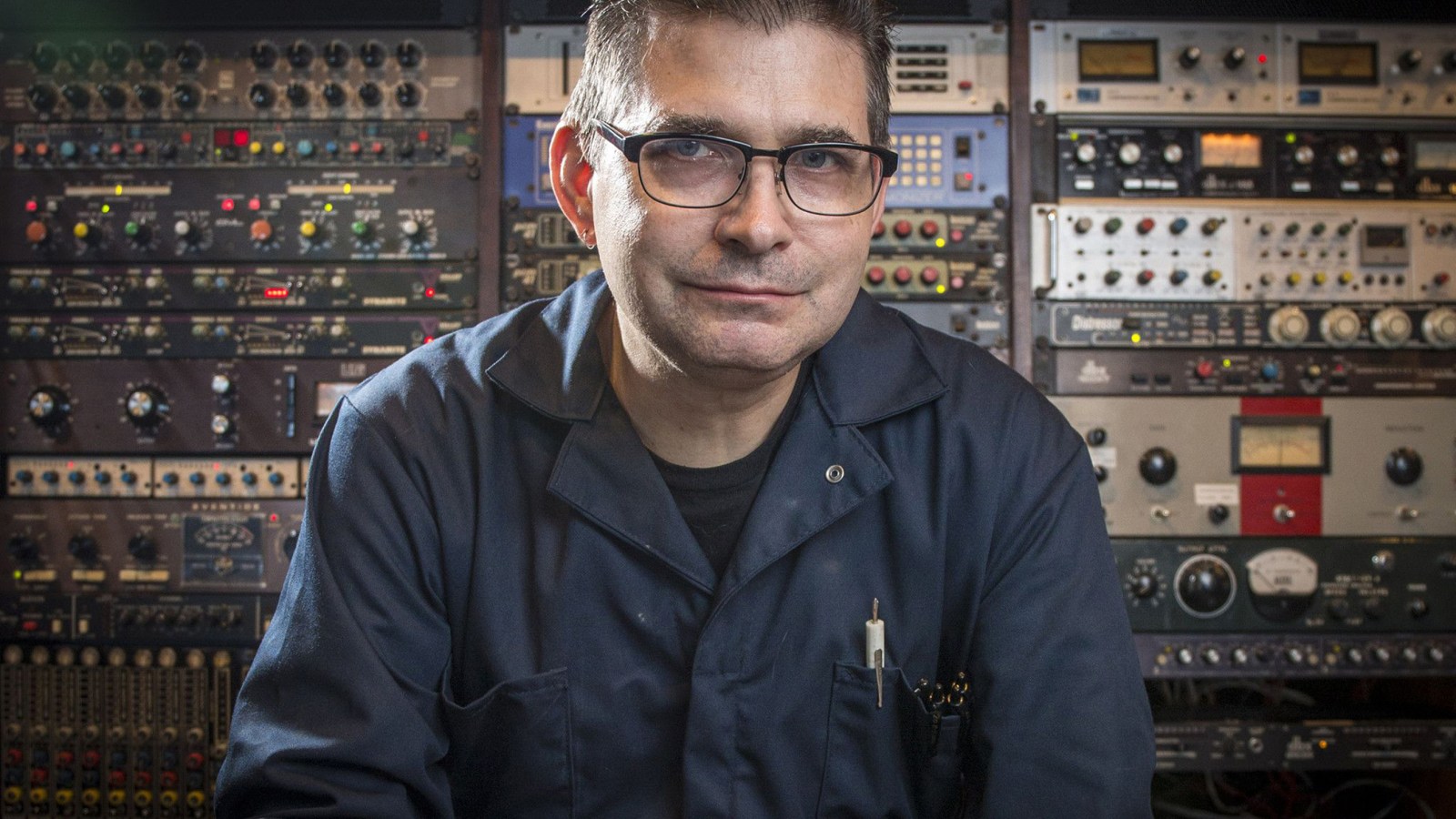

A gold record award for Nirvana‘s final album, 1993’s In Utero — which was presented to Steve Albini, who recorded the album, and kept in his archives for decades — is now for sale. The late engineer’s experience with the project became fraught when the trio’s label insisted on remixes, arguing that Albini’s approach was too abrasive. The plaque, which recognizes sales in Indonesia and has a peculiar backstory, is available through Steve Albini’s Closet, launched after the engineer’s death. The blind-bid auction starts at $5,000; bidding ends May 3.
The listing for the award explains how Albini’s punk-rock politics led him to get an Indonesian award. “When Steve was sent his RIAA Gold Record Award for In Utero, he returned it to the band’s management, as part of his philosophical stance against major labels and how they operate,” it says. “Later, perhaps at the behest of others, he requested that the award be returned. Alas, it was no longer available, although what exactly happened to it is unclear.
“In its stead, and presumably as a slap-back of sorts, Steve was sent this INDONESIAN Gold Record Award for In Utero,” the listing continues. “And that was the sole souvenir of the multi-platinum record in his archives. So, no, it is not the RIAA version, whose current whereabouts are unknown, but it IS the one Steve had and kept.”
Noted Pixies fan Kurt Cobain wanted Albini, who had a bad reputation at the time thanks to having fronted a band called Rapeman and essays he’d written, to record Nirvana based on his love for Surfer Rosa and other LPs Albini had helmed in the late Eighties and early Nineties. Cobain was also a fan of Albini’s first band, Big Black, and had attended their farewell concert in Seattle. “If he turns out to be an asshole, I’ll at least use him for his recording abilities,” Cobain told Michael Azerrad in the book Come as You Are. “Definitely a few sexist things leaked out of him, but that’s just the scene he’s in.”
When Cobain approached Albini to record their third album in the fall of 1992, after Nevermind had become a worldwide hit, Albini said he’d have to think about it. In a four-page fax that he sent to the band in November 1992, he praised their instinct to “bang a record out in a couple of days, with high quality but minimal ‘production’ and no interference from the front-office bulletheads.” He also spelled out how he saw his role: “I think paying a royalty to a producer or engineer is ethically indefensible. … I would like to be paid like a plumber: I do the job, and you pay me what it’s worth.” Albini wrote that he wouldn’t be able to sleep at night if he took hundreds of thousands of dollars from the trio. He reportedly accepted a mere $100,000 for his services.
Nirvana cut In Utero over two weeks at the Minnesota studio Pachyderm in February 1993. Cobain managed to do all of the record’s vocals in “about seven hours,” total, as he told Rolling Stone, and drummer Dave Grohl finished the drums in three days. “He was one of our heroes, I was totally intimidated,” Grohl told Revolver in 2013.
“We had to prove ourselves to Steve,” bassist Krist Novoselic said in 2013. “So we went in there and we busted out ‘Serve the Servants’ in one take. The first song you hear on the record, that was one take we did of that song. That’s how we won Steve over.”
They also clicked on a personal level. Albini and Grohl set fire to the alcohol used to clean tape equipment, and they’d prank people they knew. Albini phoned the Lemonheads’ Evan Dando and pretended to be Madonna’s assistant, and placed him on hold for 45 minutes. Another time, Albini called Gene Simmons at Cobain’s behest and pretended to be the singer. “He put on a Kurt voice a little bit,” Grohl said. “It was hilarious.”
But the good times ended when Nirvana’s label reps decided the album sounded too raw for mainstream consumption and allegedly positioned Albini as a scapegoat for a potentially bad-sounding record. “The rumors of the trouble came from the record company,” Albini said at the time. “They were trying to undermine the band’s confidence.” He maintained this story years later, too, telling Tape Op, “[The label] waged a publicity campaign to try to shame the band into doing the record again; it was pretty creepy and weird.”
Cobain took credit for the discord in a Rolling Stone interview, claiming he didn’t like the production. “We had no idea why we didn’t feel the same energy that we did from Nevermind,” he said. “We finally came to the conclusion that the vocals weren’t loud enough, and the bass was totally inaudible.” They hired R.E.M. producer Scott Litt to remix three singles: “All Apologies,” “Heart-Shaped Box,” and “Pennyroyal Tea.”
“I felt like I did a good job at the time and all of the people who weren’t in the room while the record was being made decided to pass judgment on it after the fact,” Albini said in 2013. “At the time, that seemed like ignorant griping, and it still seems like ignorant griping.” Albini took the opportunity to remix In Utero the way he initially wanted it to sound for a 2013 reissue.