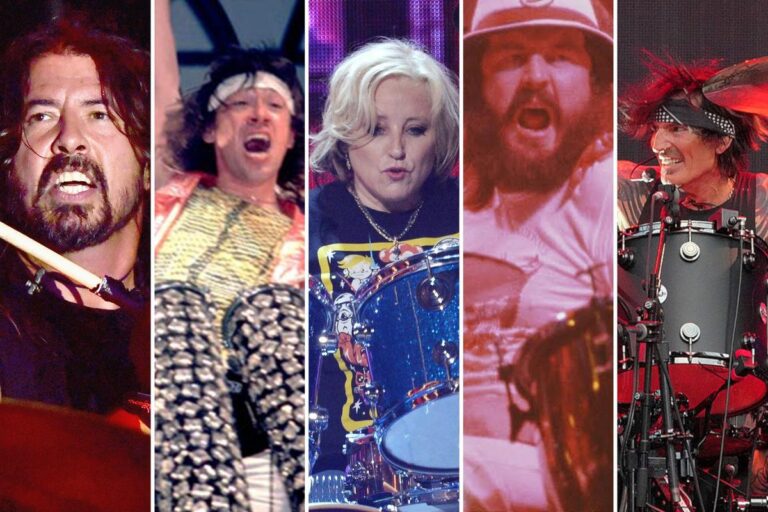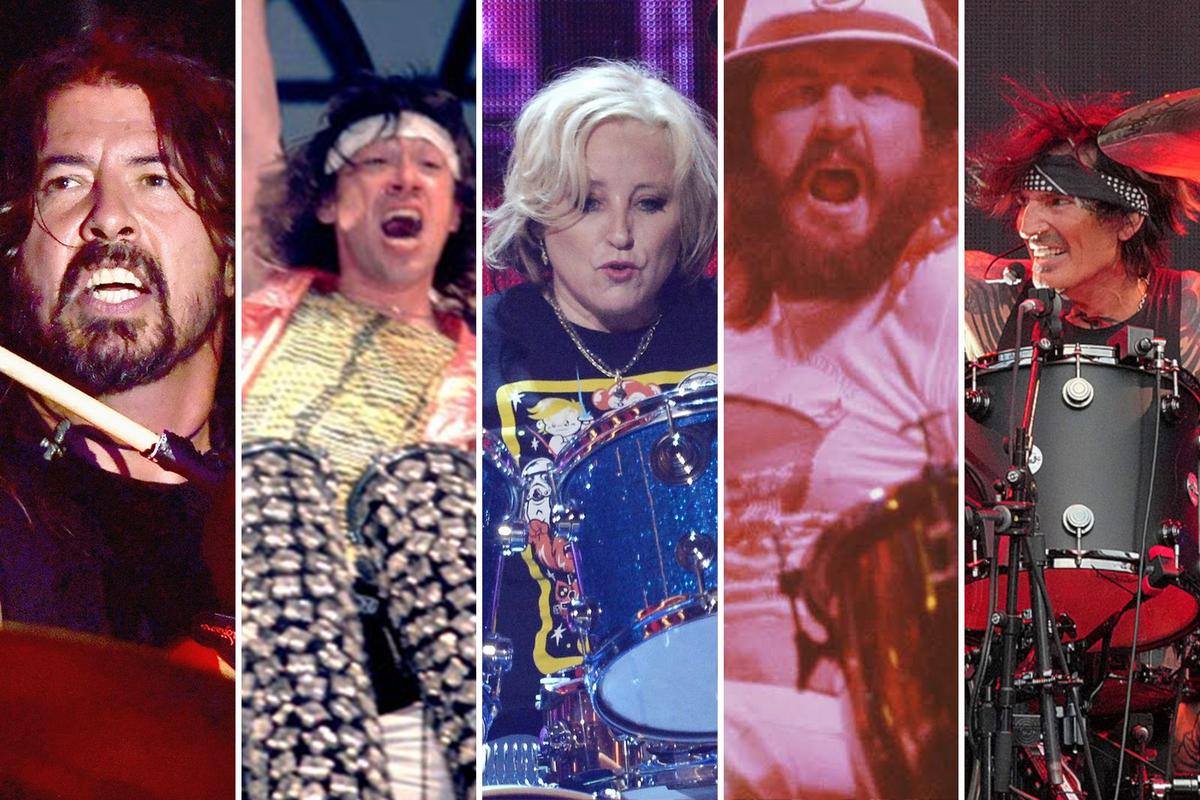

They could be two seconds long or 30; straightforward 4/4 rhythms or flights of percussive wizardry; inducers of head nodding or air drumming. They are the drum intros to classic songs, and legends from Twisted Sister to Paul Simon, Toto to the Clash, Grand Funk Railroad to U2 have at least one great drum intro in their discography.
Here, we rank the best of them. Grab those invisible drumsticks and get ready to play along to the 40 best drum intros of all time.
READ MORE: Top 30 Rock Riffs
40. ZZ Top, “Gimme All Your Lovin'”
The intro to the first single from 1983’s Eliminator is the result of drum machine programming (as Billy Gibbons sort of admits) and not Frank Beard hitting things with sticks. Because it’s ZZ Top, though, it still sounds filthy, and it gives you time to turn up the volume before the guitars kick in.
39. Spin Doctors, “Two Princes”
To quote a wise man (we believe it was Chris Barron), “Dee-dee-dee-dip. Di-di-di-didip, buh-deedly-dip buh-duh-buh-duh buh-duh-buh-dubbah-dubbah-dubbah-dubbah.” Before Barron uttered that bit of wisdom, drummer Aaron Comess let loose with a rolling intro that everyone recognized in 1992, if only because you heard it everywhere.
38. Twisted Sister, “We’re Not Gonna Take It”
The title of the song is nicked from the Who, and its drum track from A.J. Pero pretending he was the Hulk smashing through walls in perfect time. For a brief moment in 1984, the freakiest bar band in the New York area proved one could be a star, given the right song, the right image and the right level of rhythmic violence.
37. Tom Petty & the Heartbreakers, “Here Comes My Girl”
Tom Petty talks through most of “Here Comes My Girl,” and, if you talk along with Petty when the song plays on the car stereo, you wind up talking just like Tom Petty, which makes you sound as cool as you’re ever going to sound for about four and a half minutes. But the thing can’t get off the ground without the opening bar of drumming, which is all Stan Lynch, O.G. drummer for the Heartbreakers and Petty’s chief antagonist. That probably grated on Petty a little (so much of what Lynch said and did grated on his boss), but there’s no denying that sometimes a song needs momentum to get going, regardless of whether the drummer and singer are on speaking terms.
36. Steppenwolf, “Skullduggery”
Yes, they still liked smoke and lightnin’, but by 1976, Steppenwolf were way past their time as hard-rock vanguards. That didn’t stop them from plowing on, and that year’s Skullduggery album contained a few face-melters worth listening to, particularly this title track, with an unholy intro from drummer Jerry Edmonton, on what would be his final record with the band. He exited this life in 1993, so we can’t thank him for his performance, except by turning it up and playing it loud.
35. Steve Miller Band, “Take the Money and Run”
Bless that drummer Gary Mallaber for all his many contributions to the discographies of Van Morrison, Eddie Money, Bruce Springsteen, the Beach Boys and, in particular, the Steve Miller Band — particularly during Miller’s imperial period, when everything the ol’ Pompatus of Love touched went at least double platinum. Take this tale of teenaged armed robbery, which sounds like Miller made it up on the spot, but which also features Mallaber playing a remarkably cool introduction, before the “hoo-hoo” and “ooh-Lawd” interjections come forward.
34. The Sword, “Arrows in the Dark”
How were these guys not at least as popular as Mastodon? Or even Gojira? Baroness? We don’t get it. They’re all great, but those other bands have a much higher profile. You should listen to Warp Riders – it is a great record, and drummer Trivett Wingo is an underappreciated master of the instrument. Shame he left the band shortly after the album was released.
33. Pixies, “Bone Machine”
Thank you, Steve Albini, for your many gifts, particularly the way you mic’d and engineered a drum kit. And thank you, Pixie David Lovering, for your heavy right foot and left arm, and for the opening 10 seconds of this most awesome song, which introduced many people to your band.
32. Kiss, “I Love It Loud”
Eric Carr‘s drums are the sound of a heavy object falling ever downward in an echo-drenched stairwell, leading to a new rallying cry for the Kiss Army, in their early-’80s return as a viable incursion force.
31. John Mellencamp, “Hurts So Good”
Kenny Aronoff counts it in for the Artist Then Known as John Cougar, in the service of a meat-and-potatoes rock song that starts with some philosophizin’ and graduates to an invitation for a young lass to “sink your teeth right through my bones.” Whether she accepted the invitation is unclear.
30. Guns N’ Roses, “You Could Be Mine”
Perhaps best known for its tie-in with Terminator 2: Judgment Day, “You Could Be Mine” should be regarded as one of GN’R’s greatest singles for Axl Rose‘s aggression, Slash‘s solos and new guy Matt Sorum‘s machine-gun drumming in the song’s first moments.
29. Iron Maiden, “Run to the Hills”
Clive Burr’s thud-footed performance in the intro provides the slow feint that shortly segues into the breakneck tempo that marks “Run to the Hills,” and makes it a jewel in Maiden’s catalog. It was also a marker of beginnings and endings – it was Bruce Dickinson‘s first single with the band, and one of Burr’s last recordings in the Maiden fold, as conflicts in the group led to his ouster.
28. Rainbow, “Stargazer”
Cozy Powell, absolutely unleashed for 10 seconds, turns in a jaw-dropping avalanche of rolls, kick-drum shots, and open high-hat stomps. The man accomplished a lot in his short time on this plane of existence, and this short burst is among his finest moments.
27. Nirvana, “Scentless Apprentice”
Steve Albini once again showed he was a drum kit’s best friend. This time, it was Dave Grohl who was the beneficiary – the drum pattern was a variation of the main guitar riff, which Grohl had written, and Albini’s mix sharpened every serrated edge, enabling the sound to cut through any speaker fortunate enough to play it.
26. Surfaris, “Wipe Out”
Somewhere, in some suburban basement or garage, someone who serves as the lead singer for a collective of amateur musicians who call themselves a band is approaching a microphone to intone, in their best spooky falsetto, a silly laugh and a single word – “Wipeout.” The drummer of this group will then begin playing a rolling pattern on one of their tom-toms really fast, hoping to not snap any wrist joints while doing it. And so it will go, through rehearsals, parties, wedding receptions, and dances, on and on, rolling and rocking, until they break it out during soundcheck on their stadium tour.
25. Iggy Pop, “Lust for Life”
So Hunt Sales (Soupy’s kid – look it up) supercharges a Motown backbeat and the guy from the Stooges talk-sings about drugs and sex and “hypnotizin’ chickens.” And David Bowie – 1977 David Bowie; Berlin-era, dour David Bowie – produces it, somehow keeping the whole thing from coming apart. He needn’t worry, though – that rhythm is so rock solid, it practically does the work for him.
24. Judas Priest, “Living After Midnight”
The intro is just a four-on-the-floor drum beat – nothing particularly fancy – but it neatly encapsulates what’s to come. “Living After Midnight” is one of a million hedonistic declarations that metal bands have made over the years, yet it’s one of the longest lived, in no small part due to its simplicity. “We’re going to do something wild and have a great time tonight,” Rob Halford and the other guys are saying, only it takes them nearly three and a half minutes to say it. Dave Holland’s drum intro says it in eight seconds.
23. The Clash, “Train in Vain”
It’s three seconds on the unlisted final track on one of the greatest albums ever released – the “Train in Vain” intro (thank you, Topper Headon) sets the tone for the song that follows, one of the poppiest things these erstwhile punks committed to wax. It was so cool, in fact, that Garbage sampled and looped it for “Stupid Girl” 15 or so years later.
22. Grand Funk Railroad, “We’re an American Band”
A cock-rock anthem about the life of a rock band on the road, “We’re an American Band” may well be drummer Don Brewer’s masterpiece – he wrote it, sang it, played an insane amount of cowbell on it (insert Christopher Walken joke here), and came up with the percussive master class that is the song’s opening eight seconds.
21. Fleetwood Mac, “Tusk”
A song allegedly titled after the drummer’s term for the male sexual organ should not begin as hypnotically as “Tusk” does. Yes, the sound fans out into several different directions (marching band, chanted vocals, and whatever that insane drum and crowd noise breakdown is in the middle), but the opening is calming, almost quietly tribal. It gives very little indication of what is to come, which is counter to what is usually represented by a drum intro, but that’s one sign of its greatness. Go figure.
20. Queens of the Stone Age, “A Song for the Dead”
While Josh Homme plays a single note on his gee-tar, Dave Grohl (him again; he’s in this list a bunch) cracks off some of the most vicious smacks any drum head has ever received – and that’s before the song really gets moving.
19. Rush, “Animate”
There are many who would list the intro to “YYZ” as the late, great Neil Peart‘s finest introductory statement, with its precision and degree of difficulty (in purely Olympic terms) and interplay with the other guys in the band. As occasional contrarians, though, we selected this gem from 1993’s Counterparts, and we did so for its muscularity, its forward motion and for the way Geddy Lee and Alex Lifeson clear the lane for their colleague, letting Peart establish what must be established before closing in around him to proceed. We would give anything to hear Peart play this again.
18. Paul Simon, “The Obvious Child”
… in which a 10-piece drumming collective from Brazil (Grupo Cultural Olodum) creates a percussive dream sequence, moving and playing as one organism, initiating the rhythm that carries the song and establishes a sense of wonderment in the listener, a sense of marvel. There’s magic in this dream, and Simon conjures it at will; all you need to do to experience it is turn it up and open your ears.
17. Electric Light Orchestra, “Don’t Bring Me Down”
A final, rocking statement on a dance-forward album (1979’s Discovery) that should have been packaged with its own disco ball. Bev Bevan’s count-in tells you something different is afoot, something not as Bee Gee-ish as the previous eight songs, maybe something with a couple loud guitars poking out of the mix. And voila – from this auspicious beginning comes what might be ELO’s finest hour – or their finest four minutes.
16. The Black Crowes, “Hard to Handle”
The opening drumbeat here is proof of how smart the Black Crowes are, at least where covering material is concerned. Otis Redding’s original had Al Jackson Jr. (of Booker T. & the M.G.’s) drumming, laying down a smooth, understated rhythm. Steve Gorman – the Crowe with the sticks – knew better than to try to copy that, so he did a 180, pounding out the beat like he was trying to knock over somebody on the other side of the arena. That was the way to go, and from late 1990 well into the next summer, you couldn’t escape this song, in part because of that drumming.
15. Motley Crue, “Too Young to Fall in Love”
No, that’s not a Panzer division rolling down the Sunset Strip. It’s Tommy Lee establishing a tempo, filtered through whatever mixing desk mojo producer Tom Werman conjured up to make Lee’s drums sound like weapons of war. In fact, the blast and boom of the first 10 seconds make the rest of the instruments sound a little thin by comparison (Vince Neil included, though he always sounds thin).
14. Led Zeppelin, “When the Levee Breaks”
The musical equivalent of a landslide, a slow-motion, downhill movement of a great mass of earth come completely unglued, with deadly consequences. Yes, John Bonham was capable of that kind of destruction, and it gets more intense the louder you crank it.
13. Van Halen, “Hot for Teacher”
Alex Van Halen‘s imagination writes checks that most drummers’ appendages can’t cash. Case in point: this arm- and leg-wrecker from 1984, with its ungodly floor tom and double kick gymnastics, accompanied by snare drum and ride cymbal accents, all given to the support of brother Eddie‘s finger-tappin’ guitar goodness. It sounds like complete chaos, but Alex Van Halen is in complete control.
12. U2, “Sunday Bloody Sunday”
Larry Mullen Jr.’s first 10 seconds here are aggressive, warlike strikes, teeming with force and precision. They’re a wonder to behold live, but you have to hand it to Steve Lillywhite, who produced the studio version of the song on 1983’s War – you hear the ticking of the hi-hat and the crack of the stick hitting the drum as clearly as if Mullen were playing in the room where you’re sitting.
11. Creedence Clearwater Revival, “Fortunate Son”
Doug Clifford leads CCR into their angriest song with bassist Stu Cook in tow, and you can feel the storm brewing, even though it’s just a few seconds before the guitar hook follows suit.
10. The Rolling Stones, “Honky Tonk Women”
Producer Jimmy Miller played the opening cowbell, but Charlie Watts brought the country swing to Mick Jagger and Keith Richards‘ bluesy tale of a “gin-soaked barroom queen” – as distinctive an opening as they’d ever come up with, and they’d come up with some doozies.
9. The Go-Go’s, “We Got the Beat”
By several accounts, Go-Go’s drummer Gina Schock’s height is approximately 5 feet 2 inches. To hear her play the beginning of “We Got the Beat,” you’d think she’s 10 feet tall.
8. Foo Fighters, “My Hero”
Dave Grohl’s paean to everyday valor begins with him pounding out a Grohlian racket on his drum kit, one that keeps pummelling even as the song is built over top of it. Of course, when the band played live, this was handled by the masterful Taylor Hawkins. We miss Hawkins, so we dedicate this entry to him — which comes with sadness, of course, but also joy that we had him for the time we did. “My Hero” remains a testament to Hawkins’ greatness as well as Grohl’s.
7. Kiss, “Do You Love Me?”
Who knows if Peter Criss actually played drums on “Do You Love Me?” Destroyer was the record on which Kiss (really, producer Bob Ezrin) started substituting studio players for Criss and Ace Frehley, just as the band incorporated choirs and orchestras and sound effects to make the album more of a production and less the raw snapshot of a great live band in the studio. The rawness of this intro is what makes it so cool – just drums and Paul Stanley‘s voice, leading us into a rocking put-down of a naughty girlfriend/hanger-on.
6. Billy Squier, “The Stroke”
Bobby Chouinard was Billy Squier’s big gun, an American John Bonham, a drummer so heavy he transcended decades and genres, fueling not just hard rock tracks but also hip-hop cuts via samples that feed Squier’s bank accounts to this day. As far as drum intros go, there are few quite as recognizable as Chouinard’s on “The Stroke,” the boom-THWAP of destiny that sets heads nodding and gets Squier doing his loosey-goosey lead singer dance.
5. Stevie Wonder, “Superstition”
There is little Stevie Wonder did in the 1970s that did not speak to his genius as a songwriter, singer, and musician. The Clavinet riff in “Superstition” is one example, but you can’t get to that clavinet unless you ride the funk Wonder establishes on the drums.
4. Pretenders, “Middle of the Road”
This song is a vehicle moving downhill, picking up momentum and barely being steered. Martin Chambers’ drum intro is what happens when the vehicle crests over the hill and you figure out what’s about to happen. You can’t do much but hold on.
3. Aerosmith, “Walk This Way”
This spot could just as easily have gone to “Lord of the Thighs” from Get Your Wings, but “Walk This Way” is the more widely known of the two songs and of Aerosmith’s drum intros. That siss-BOP-buh-boom-boom-BOP became a hip-hop staple as well as a rock rallying call, the welcome mat leading into the jive-talkin’, riff-playin’, drug-takin’, groupie-defilin’ world of our favorite Boston bad boys.
2. Toto, “Rosanna”
Jeff Porcaro’s ghost notes here – the soft strikes between the accents – give the song’s shuffling intro breath and swing. On AM radio in 1982, that kind of detail often went right by you, if the DJ played it at all (the previous record had to be faded out, after all). Drop the needle on the record at home, though, and you’ll get the fuller picture; you’ll understand how dead-on perfect Porcaro was, not just as a drummer, but also as an idea guy (it’s doubtful songwriter David Paich came up with the intro). “Rosanna” was a smash that has remained in the public consciousness for decades, thanks in no small part to Porcaro’s groove.
1. Led Zeppelin, “Rock and Roll”
There are many drummers who can bash their instrument in time, lending an air of violence to the simple pleasures of rocking out. John Bonham had few peers in this regard; perhaps only Keith Moon could match Bonzo as a sheer force behind the kit. But Moon tended to be all over the place – if there was a rack tom within a quarter mile of where he was sitting, he’d manage to hit it, because a drum that was unhit was wasted. Bonham was all about propulsion, moving the song forward with tempo and force. Here, the constant cymbal strikes in the intro make you think the whole thing could careen out of control. But this was Zeppelin – everything was played as intended, every hammer drop and crash in its place. This was rock ‘n’ roll, and for a while there wasn’t another band on the planet that could play it better. There still might not be.
Step out from behind the kit and head to the front of the stage with our list of rock’s greatest singers:
Top 40 Rock Singers
It’s not just about voice, but style and stage presence.
Gallery Credit: Ultimate Classic Rock Staff