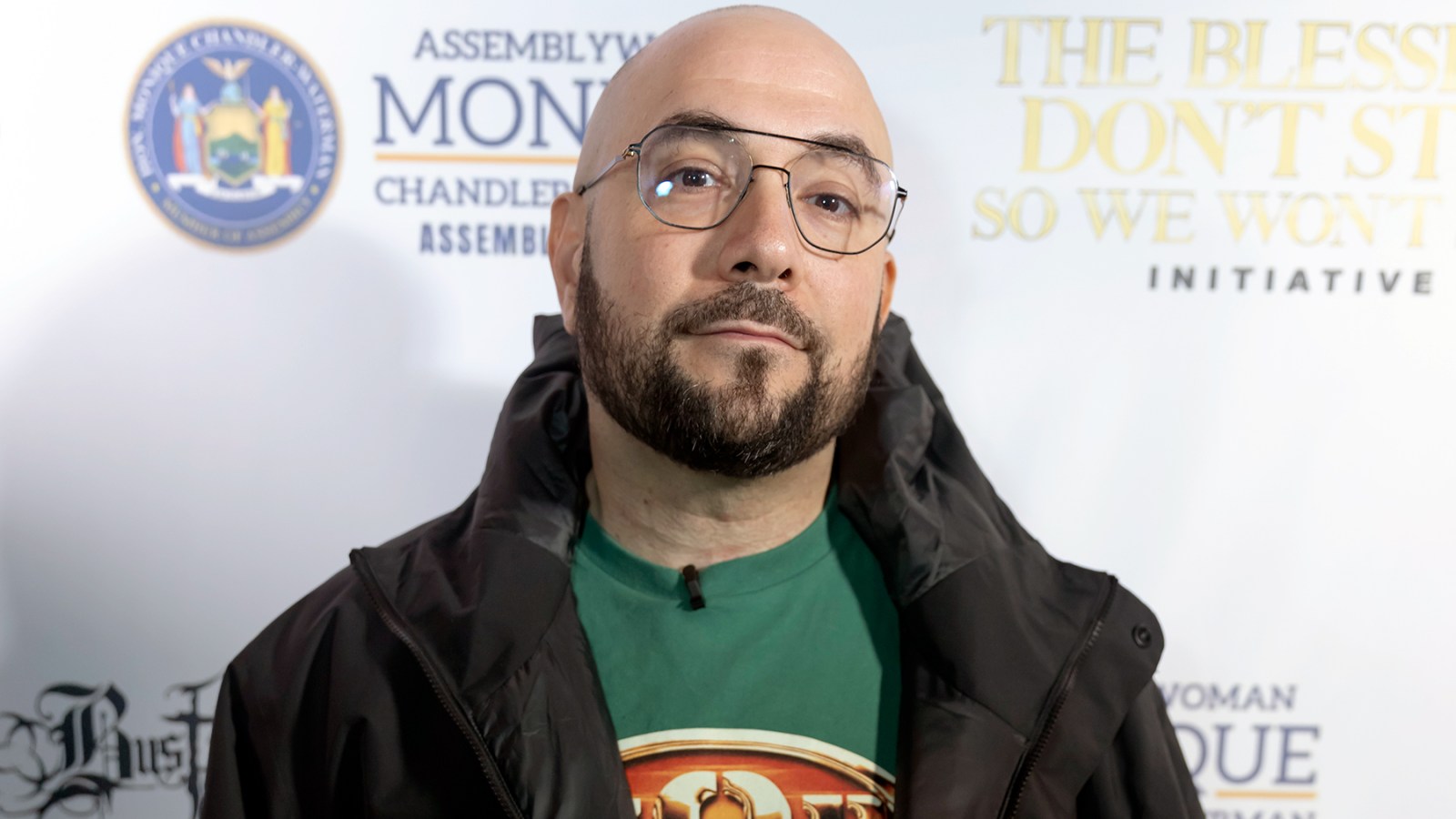

When it comes to hip-hop, there are two Rosenbergs who reign supreme: Paul Rosenberg, longtime manager of Eminem, and Peter Rosenberg, the former Hot 97 host who now cohosts the Ebro Laura Rosenberg Show. Five minutes into my talk with Peter, I tell him as much, trying to impart that his success, like Paul’s, is a source of pride among Jews working in the music business. Whether someone listened to tri-state area radio or not, Peter Rosenberg’s name carries credibility — something earned, not given — through a career in a difficult and often unforgiving industry.
Being Jewish in the music business this past week has been especially fraught. Ed Sheeran, a superstar pop artist, found himself caught in the crossfire of Middle Eastern politics after his opening act, Macklemore, used the stage as a podium to rally the “free Palestine” cause. Sheeran was eight months into his Loop Tour, but after two dates in New Jersey — both featuring Macklemore — the fate of the rest of its North American leg was suddenly uncertain.
How did we get here? You could put a date on it — October 7; May 1948; the first century — but it doesn’t really matter, because we all have our version of history, and it is very difficult to convince someone to let go of their heritage for a version of yours. It might be trite to say two things can be true at the same time, but in the case of Israel as a sovereign nation, it could be 10 things, each difficult to parse, often debated, and rarely compromised.
It was in this environment that two members of the music media, and of the Jewish and Israeli communities, attempted to have a conversation. When Rosenberg and I first connected, Rolling Stone had not yet broken news of Macklemore’s exit from the tour, prompted by Robert Kraft, the New England Patriots owner and proprietor of Gillette Stadium. Kraft stated that he viewed Macklemore’s onstage comments as hate speech. Macklemore held steadfast to his position — that the ongoing war in Gaza has resulted in the deaths of thousands of children — and found supporters among the other openers on Sheeran’s tour and his backing band, who dropped out in solidarity.
Amid the controversy, Rosenberg wrote on X, “A lot of people I love are being openly lame about Kanye. I am not saying no one deserves forgiveness or empathy but this man sang Heil Hitler ONE YEAR AGO. Disappointed in a lot of people,” later drawing a contrast between Macklemore’s treatment and the return of Ye, whose public statements have included admiration for Adolf Hitler and the sale of swastika-themed merchandise.
That the messaging is a mess is something Rosenberg and I agree on. How is someone supposed to find a way through this complex, emotional, deep-rooted conflict when it constantly contradicts itself? Another view we shared: that the loudest extremes drown out the rational middle. And that’s on all sides. The internal struggle we’re facing as individuals is rarely talked through. Talk, for the most part, doesn’t exist.
What follows is an edited conversation.
Can you tell me a bit about your background and where you grew up?
I’m from Chevy Chase, Maryland. It’s a pretty Jewish suburb of D.C. Generally speaking, very progressive politically and a Democrat-heavy area. My mom was born in a displaced persons camp in Germany [after World War II]. Her side is all Polish and ran from the Nazis. My dad is from New York and we would visit quite a bit as kids … and listen to 98.7 Kiss and WBLS. In retrospect, my brother and I were really, really lucky to be listening to this foundational hip-hop radio as it was happening.
Were you bar-mitzvah’d, and did you have a theme?
We did not really have a proper theme, but it was at a lovely Holiday Inn — the proper Holiday Inn, not an Express. [Laughs] I wore a Penguins Mario Lemieux jersey over my suit. My brother rapped over the instrumental to “What Goes Around Comes Around” by Grand Puba about being proud of me, and I cried at the end of it. But yeah, I was bar-mitzvah’d and went to synagogue somewhat regularly as a kid. We kept kosher in my house. We did Shabbat on Fridays.
Was your radio name always Rosenberg?
No. In college and in my early days on commercial radio in DC, my name was PMD, which [stood for] Peter from Maryland. It was my DJ name until I got to Hot 97 in 2007, and Ebro was like, “Nah, you should go by your real name.” I think he saw that as more intriguing and interesting than having a generic three-letter name.
With such an obviously Jewish name, did you ever confront any resistance from the hip-hop community?
No, I felt really cool as the fish out of water. I was still somewhat unique. Now, when I look at the landscape and many of the interviewers and DJs are white suburbanites, there are definitely more than when I came along. So I really enjoyed the novelty of it — of me being different. I was so passionate about it and I believed in my heart, I was so sincerely in love with everything, not just about the music, but what the music stood for politically. I was so aligned with it that I really felt confident and I felt like I’d really done the work and people would respect my knowledge. And for the most part, people really did.
What was Ebro’s thinking?
It’s hilarious because now, with how fucked up everything is, people would just be like, “Well, that’s because he’s a Jew …” Ebro is half-Jewish by blood, but he’s hardly Jewish Jewish. When it comes to Jewish stuff, he’s one of my non-Jewish friends. [Laughs] Ebro’s being Black informs so much of who he is. His mom being Jewish is how often he’ll describe it.
He would have been defined as Jewish in Nazi Germany…
Exactly. Which makes him Jewish technically, and people would assume it’s one Jew looking out for another Jew, but that’s not it. I think Ebro thought of me as other. … The decision to use my real name was ultimately about radio, not Jewish solidarity. He’s just a smart radio programmer and was like, ‘Your name being Rosenberg is much more interesting. Let’s stir it up.’”
Your first Hot 97 billboards made that identity explicit, right?
Our first billboards for Hot 97, the marketing was: a Black, a Puerto Rican, and a Jew. So the first things people saw of me was literally my face on a billboard in New York and under my face it just said “Jew.” At the time we just thought it was funny. It was just like, “This is wacky. We’re a multi-ethnic show and we’re going to be in people’s face about being multi-ethnic.” But yeah, it certainly hits differently now.
“The internet won’t allow for it”
When did the casual antisemitism you experienced begin to feel different?
There were always things said to me. I always ignored very casual antisemitism, like people coming up on the street being like, “Yo, I don’t really fuck with Jews, but I fuck with you.” I got that all the time. Or, “I know you got money.” And I was like, “No, you actually have money. I don’t have money, but okay.” That kind of stuff was always there, but it did not really start to hit in the same way where I was like, “Oh, this is really bad.” I had big moments. I feuded with Nicki Minaj, so her fans would say crazy shit. But it was still antisemitic and hurtful.
I would say, and this is part of my resentment to Kanye, Kanye’s anti-Semitic sort of quest he went on, his tour of Jew hate, I could viscerally feel the difference from that moment on in terms of my social media and how, whether it’s real people or bots, the responses of, “Yeah, well, you’re a Jew,” or, “Yeah, but go put on your little hat,” or, “Kanye’s right.” I noticed it spike and start to get worse post the Kanye “Fuck the Jews” tour.
Which was the perfect precursor to what was to come. And it was all pre-October 7th.
Yeah. I mean, that was the setup. It was fucking disgusting. And it felt like they were trying to say, “Well, it’s all due to his mental health situation,” which is kind of like, “Well, does mental health really make you anti-Jewish?” It didn’t really track.
Ebro, Laura Stylez, and Peter Rosenberg in New York in 2024
Johnny Nunez/WireImage
And then October 7th?
Yeah. And then October 7th. It ratcheted up right away. I remember I got into a fight immediately with the porn star Mia Khalifa. She posted something like, “Freedom fighters, send your videos so we can see what you’re doing.” And I’m like, “You’re really calling Hamas freedom fighters? You sound fucking nuts.”
It was kind of like, in retrospect, it was a real indicator of where this shit was going to go. The situation had gotten so out of hand and people weren’t going to have the nuance to be able to say, “Israel has been doing really terrible shit for a long time, and also massacring Jews at a music festival is evil.” We’re not going to be able to say both those things at the same time. The internet won’t allow for it.
That’s a bone of contention for Israelis. Why was there zero empathy for what they went through — an unprovoked attack on a mostly peace-forward population of Kibbutz members and festival attendees?
I think about that, too. If I’m trying to be empathetic and remember, sometimes it’s hard because it’s been going on for a few years and the response has been so disproportionate by Israel, that it’s hard to remember how I used to feel. But when I do go back, I remember being like, “Damn, nobody even stopped to say that that shit was horrifying.”
In my world, there really weren’t a lot of people being like, “Yo, this October 7th thing is so fucked up.” It sort of went right to, “Israel’s fucked up.” And I was like, “Whoa, can’t we get a day or two?” … And I think that broke some people. I honestly believe Michael Rapaport, for example, it broke his brain. It made him like, “Oh my God, everybody hates Jews. Nobody cares.”
But there’s a disconnect that’s built into it, and I think that’s been a real problem ever since. I don’t think it has anything to do with the fact that people don’t care about Jews or don’t think October 7th was fucked up. I think it’s that we live in a time now where people have a much bigger view of what’s happening.
“We should be capable of holding two things at the same time”
You said that you found Ed Sheeran’s statement horrifying. Do you want to elaborate on that?
Horrifying is more just speaking about how poor it was. It was horrifying in how just unaffected it would possibly be in making him look any better. It was just another really bad misstep.
But God, I think the most interesting thing happening here is that we are in real time watching the wind blow a different direction than it’s ever blown before.
It feels like a tipping point.
Yeah. The tipping point happened. There was [a time] in history [when] it would have made sense in the eyes of the people around him to make the decision that he made. However, this time is not that. And he made the worst decision possible because Israel has completely lost the public.
I’ve said this for some time: if Jews control the media, we have the worst PR.
It’s an unbelievable thing to think about: how they were able to turn everybody against them, but that is what they’ve done. And so I think that he thought he was making the safest decision probably. And I’m not trying to say it was an easy decision either. Everyone wants to oversimplify it. Every person in the comments who’s never risked anything for any issue wants to tell everybody to throw everything away in a heartbeat — like nothing even needs to be considered. That’s a tough spot for him, but man, they just completely got it wrong.
What do you think he should have done or said?
I really think the only way to go was, “Hey, this is the tour that we agreed to. This is the tour that I’m on with the artists that I’m on. If you, Robert Kraft and other building owners, have a problem with this, then you should bring it to court and we should legally dig into it.” He didn’t even have to take a huge political stand. He just had to stand by the artists that he said he was with. That’s all he had to do.
Again, who knows what all the inner workings are with the contracts, but I would think everybody agreed to this tour. You’re now saying you don’t want me in your building. Let’s play that out and let the court of public opinion have their say as well. Instead, he chose to go one direction and now he is still playing in the public court of public opinion, but he’s the one who’s on trial. And he’s now the bigger story than Macklemore.
It’s really not all that different from the BDS movement, where Western artists were being stopped from performing for Israeli audiences. Here’s a pro-Palestinian artist performing for Jewish audiences and they want him gone. The messaging is really conflicting.
And also feels really disingenuous because Robert Kraft made time — or whoever constructed that statement made a point to say, “Oh, I care about Palestinians. Oh, I respect Macklemore, this and that. I’d love to talk to him.” So why didn’t you just talk to him?
The only person who could solve this problem immediately is Robert Kraft. He seems like the only person who, if his statement was remotely sincere, could have said, “Hey, obviously I see things differently than Macklemore. We’re going to sit down and have our conversation and see if Macklemore is interested in talking to you about the issue in earnest.” Which my guess is, knowing the kind of person [Macklemore] is, he probably would.
But that’s not what they did. They did the same thing everybody accuses Jewish people in Hollywood of doing. They did the worst thing possible. And then you have something like this happen and not only does it totally corroborate everything that Kanye West was saying [about Hollywood and the music business], it also inextricably connects American Jews and Israel in this way that’s not helpful for any of us. I just don’t understand where they thought the wind was. There was a time they thought that they could just silence everybody and the internet has changed that. They just can’t do it. It’s not going to work.

Macklemore in France in August
ARNAUD FINISTRE/AFP/Getty Images
An argument has been made that Kanye’s show doesn’t include any political messaging, coupled with Kraft’s assertion that Macklemore’s comment constitutes hate speech.
What hateful language did he use? It was language that they didn’t like. It wasn’t hateful language.
That’s the part that’s so awful about it: he made a painstaking effort to not be at all malicious to anyone. We have to accept the fact that there are a lot of people who literally believe the words “free Palestine” is an attack on Jewish people. And we have to separate ourselves from that idea as American Jews.
We should be capable of holding two things at the same time. One, that there is immense, real Jew hatred that we have seen espoused by people like Kanye West, who think it’s a joke to talk about Hitler and that it’s funny as he has expressed previously on multiple occasions. Whether he writes it off, or others write it off, as mental illness or not, he has expressed that his beliefs, at least at one point, have been that basically Jews are fundamentally evil, run the world and pull the strings like puppet masters — all the true antisemitic tropes that exist. Real Jew hatred like that exists.
And simultaneously, what the Israeli government has been doing for a long time, but especially the last three years, is outright evil and we do not want it done in our name. In fact, I think they go hand in hand. They’re both the same thing. It’s standing up against hatred, standing up against Jew hatred and standing up against state-sanctioned hatred against Palestinian people. Both of those things can be true and are true.
Would things have turned out this way if Macklemore had said something about those who were killed at a music festival on October 7th?
That’s a fair point. … I understand people being frustrated or upset that they feel like no one seemed to care about October 7th. I had those feelings at the time. I shed real tears, as I think many people did, watching videos of the Nova Music Festival and thinking about it.
But at the same time, you have to look at the big picture here and not just this immediate moment of like, “Well, when Macklemore says ‘Free Palestine,’ why doesn’t he include Israel?” It’s like that’s a little bit of, “what about white history?”he people in power are the Jews in this case, the Israeli government. So the people that are powerless and are being actively attacked and killed are not Jewish Israelis. That’s not what’s happening.
So I think that context is important for us to remember. We are the people — we are the definition — our history is being displaced, is being the people under attack. We’ve been there so many times throughout history, but in this specific circumstance, that’s not what this is. So people trying to do the “woe is me” thing for Jewish people, while I understand it’s easy with our history to be sensitive, you have to be specific to this situation. And in this situation, that’s not the role that we’re in.
“My dad was a very devout Zionist”
You grew up with a strong connection to Israel. Can you talk about that?
Listen, it’s a big part of my childhood. My dad was a very devout Zionist. He wrote for the Village Voice and worked for AIPAC for several years and got to really see inside the machine. And he came away from that experience being like, “Oh, these people don’t want peace.” I mean, he was basically sort of told when he would write about more dovish, peace-loving Palestinians, they’d be like, “Hey, we don’t need that. Nobody’s trying to hear about these peaceful moderates. That doesn’t help our cause.”
And so once he realized what it was, he just started going the other way. And I would say by the time [Yitzhak] Rabin was killed [in 1995], that was a last straw —seeing an extremist right-wing lunatic in Israel kill Rabin and kill the dreams of peace. He was like, “Oh, these people are not what I thought.” And so it’s just been going the other direction ever since. (Read MJ Rosenberg’s Substack here.)
You’ve visited Israel, and you’re married to an Israeli. How do you reconcile your love for Israel with your criticism of its government?
I’m immensely proud of being Jewish. I married an Israeli. I’m not some person who believes that Israel is cultureless and has no place. Of course it does. I mean, Israel’s like so many other colonialist countries that did a lot of shitty things, but also have good things as well. And culturally, there are things that I love about it, but that doesn’t change what’s right is right and what’s wrong is wrong.
The word “Zionist” has been changed and bastardized so much. How do you think about it now?
It is a super complicated piece of it because at first, I heard someone comment on this: the word Zionist doesn’t mean anything anymore except it’s just a hateful term and anybody who says it is an antisemite. I used to feel that way.
This is the hard part about us adapting and unlearning certain things and realizing that everything has changed. There was a time when people didn’t know what Zionism was even about. They would just be like, “Shut up, Zionist pig.” And you’re like, “Oh, you just hate Jews.”
I know it’s kind of crazy because that was only a few years ago, but the climate has changed and now people really do have more of an understanding of what it is fundamentally about. And I think unfortunately, again, when you go do the work and look into it, it unfortunately is really problematic going all the way back to the foundation of the Zionist movement.
What about the argument that Jews are indigenous to the area?
I think you can make an argument for the place of Jews in parts of the area, but that doesn’t change the fact that when they showed up, when that movement began and they’re like, “Hey, we’re going to go there now,” they were not there.
One thing we can agree on: everyone is fighting over this tiny piece of land because it’s so special to so many people. What do you do with that?
All you could do is choose to have a one-state solution with everybody having equal rights. It doesn’t feel like rocket science.
I always think back to what Golda Meir said: that this conflict will be over when Arabs love their children more than they want to kill Jews.
Unfortunately, she didn’t recognize that was the other way also, because this government, they love killing Palestinians. [Minister of National Security Itamar] Ben-Gvir is all he wants to do. That’s the part that we also have to eliminate is exceptionalism that other people are a certain way, but not Jews. We could never be that way. Apparently we can be that way.
And I think it’s been really hard for us to accept that either. I think we all just accepted, no, well, Israel couldn’t do bad because the Jewish people I know in my life are the most generous defenders of downtrodden, all the good things. That’s where I got every sort of good ideology I’ve ever had, I feel like, comes from my Judaism. And then you’re like, “But there are people who are really using it for evil.”
Every religious group has people who are lunatics. I remember when I saw the Bill Maher movie Religulous, I was like, “How do you do a whole movie about how crazy religion is and not include Judaism?” He left it out like we’re normal. I was like, “Wait, hold on. You think only Christianity and Islam are weird?”
You’ve been very critical of both Hamas and the Israeli government.
Neither side gives a fuck about innocent death. I mean, I’ll say this, the Israeli government probably cares more about Israeli innocent death than Hamas cares about Palestinian innocent death, but Israel’s completely indiscriminate about Palestinian innocent death. And Hamas doesn’t care about any sort of death. They viewed it all as like, let’s just make as much noise as we can. And the crazy part is how much they’ve succeeded.
We hear that noise on both extremes, like a never-ending shouting match. The people in the middle, rational and peace-seeking, are the silenced ones.
The problem is, and neither side is led by people who care about people like you.