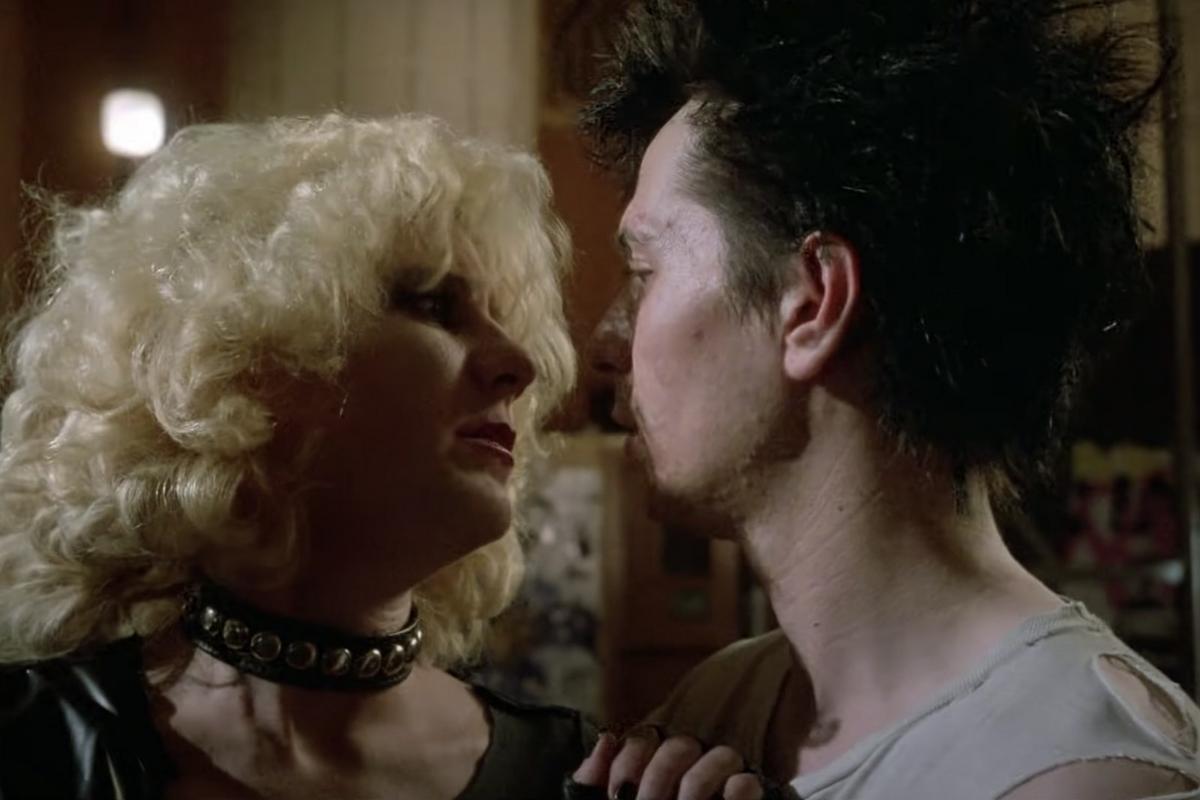

This starts as a fairly straightforward story: Boy meets girl, boy falls for girl while becoming insanely famous very fast, girl gets boy strung out on smack. But then Sid and Nancy gets interesting, and not just because both Sid Vicious and Nancy Spungen ended up dead.
Alex Cox’s film, which premiered on Nov. 7, 1986, takes liberties with the timeline surrounding characters and ready facts in service of a story that sought to humanize the Sex Pistols‘ doomed second bassist.
“I thought, for the times, the story was a good one to tell,” Cox later argued. “Sid and Nancy were terrible fuck ups, and they betrayed the punk ideal, but in the midst of all this chaos was a romantic story. It was all so tragic the way it played out.”
How Sid Vicious Joined the Sex Pistols
The Sex Pistols emerged from a period of deep malaise in England, pushing back hard against convention – and against each other. Original bassist Glen Matlock was ousted during the recording of their first (and only) album. The band basically replaced him with a fan from the crowd.
Vicious tended to instinctively rebel, without ever maturing enough to figure out what he actually wanted. In the end, he was as incompetent on his instrument as he was a symbol of how the punk aesthetic could devolve into pointless self-destruction.
“I grew up in the 1970s, and they were deadly dull and boring,” Gary Oldman, who played Vicious, told the Chicago Tribune. “The ’60s offered so much more, but in the ’70s fashion, music and politics were dull. Politically in England, the employment situation was a disaster. You could leave school with a [degree] and still not have an opportunity to work. Fashion was terrible; music was sterile.
“The story of Sid and Nancy grew out of that dullness,” Oldman added. “Things needed shaking up. For kids, things like fashion and music are important, and I think the whole punk movement came out of this pop culture depression.”
‘Why Did These Two Have to Die?’
“God Save the Queen,” one of Sex Pistols’ most identifiable songs, found frontman Johnny Rotten decrying the state of things by howling: “There’s no future, no future – no future for you.” Sid Vicious, born Simon Ritchie, actually lived that reality: He was only in the band from February 1977 through January 1978, appearing on just one song on their album.
Yet that was long enough for the Sex Pistols to go supernova, and the out-of-his-depth Vicious was simply swept along. He later sang three songs on The Great Rock ‘n’ Roll Swindle – including a nearly unrecognizable dismantling of the Frank Sinatra favorite “My Way” – but the soundtrack for this largely fictionalized film arrived after Vicious died.
Watch the Trailer for ‘Sid and Nancy’
Spungen had gotten him hooked on heroin, beginning a slow and awful slide toward her own mysterious death from a knife wound in the Chelsea Hotel in New York. Vicious was arrested at the scene and charged with her murder, only to fatally overdose while awaiting trial. They were both 21.
READ MORE: Top 10 Sex Pistols Songs
“Now why did these two have to die?” Oldman asked in the Tribune interview. “Well, it’s been said before, but partly you die like you live. Sid and his group and Nancy were on some kind of big roller-coaster ride. At some point, I think Sid needed a friend to tell him that he wasn’t a legitimate bass-guitar player, that he wasn’t a rock star, that he was given the name ‘Vicious,’ and that he wasn’t what that name implied.
“Maybe Johnny Rotten should have been that friend,” Oldman added, “but regardless, Sid did some very stupid and outrageous things to himself and to others – maybe because he felt obliged to act out the image he was given and perpetuated.”
The Controversy Surrounding ‘Sid and Nancy’
That was ultimately the story Cox wanted to tell; it was a story about someone who got lost along the way. But there was controversy over the casting, then came questions about the accuracy and intent of the script. When a reporter asked Rotten – whose real name is John Lydon – if the movie got anything right, he caustically replied: “Maybe the name Sid.”
Cox wasn’t trying for authenticity. Instead, he framed the larger tragedy of this modern-day Romeo and Juliet’s senseless end with fantasy elements meant to give his narrative a more gritty resonance. Rather than creating another run-of-the-mill rock biopic, Cox went on an elusive quest to discover deeper truths through movie fictionalization.
“What’s tragic in his case is that I’m absolutely sure that [Vicious] died accidentally,” Oldman told the Tribune. “And the whole death of his girlfriend Nancy was overblown. It wasn’t a brutal killing. She died of a half-inch knife wound; she died … because she was a hemophiliac and was so loaded with drugs.”

Cox basically shot the film, which he co-wrote with Abbe Wool, in sequence. That meant Oldman and Chloe Webb (who played Nancy Spungen) ended up sharing an acting experience that very much resembled their own bout with addiction.
“It was like being on a road trip that grew increasingly oppressive,” Webb told the Los Angeles Times. “Sid and Nancy’s world got smaller and smaller; they saw other people less and less and grew increasingly obsessed with each other. Toward the end of the film, it’s as if Gary and I were alone together on a filthy mattress that was like a tiny life raft.”
‘Naturally, We Had to Cheat a Bit’
Because both Oldman and Webb were stage veterans, rather than movie stars, Cox was able to shoot with very little rehearsal. They approached their roles with deep seriousness, studying Vicious and Spungen’s mannerisms, and even meeting with family members. Oldman lost 30 pounds in order to look the part of a strung-out junkie and did all of his own singing.
Vicious’ mother, Anne Beverley, actually loaned the actor some of her son’s favorite fashion accessories, including a leather spike bracelet and a padlock on a chain. That everything in Sid and Nancy didn’t meet the same standard of exactness wasn’t really a concern, according to Webb.
Watch a Key Scene From ‘Sid and Nancy’
“People should remember that the film doesn’t profess to be a history of punk,” she told the Los Angeles Times. “It’s the story of an intense relationship between two eccentrics. Even within the punk world, Sid and Nancy were very unconventional. Most punks sneered at the idea of romantic love, but Sid and Nancy went around kissing and holding hands.
“Naturally, we had to cheat a bit here and there,” she explained, “because how could anyone know what went on between them when they were alone together? You just try to get a clear idea of the character and remain true to that spirit.”
‘Sid and Nancy’ Still Has a Complicated Legacy
This deep sense of empathy continues through the movie’s hallucinogenic conclusion, as Vicious finds a somehow still-alive Spungen in the back of a taxi and they ride away together. Some, including Rotten, questioned whether Sid and Nancy was actually glorifying heroin use, and Cox later admitted that he second-guessed some of his choices.
READ MORE: When Sex Pistols Announced Their Unlikely First Reunion
“The scene in the film that was the important one for my co-writer Abbe Wool and I was the scene where they go to the methadone clinic, and the character played by Sy Richardson gives them a lecture,” Cox subsequently argued. “He won’t give them the methadone until he tells them that they’ve completely betrayed the movement, and they’ve betrayed themselves.
“That was the point of the film,” Cox added, “but I think that gets forgotten and gets undercut by the quasi-happy ending. If I was to remake it, I would end it with Sid dying in a pool of his own vomit.”
Listen to Sid Vicious’ Version of ‘My Way
Oldman has also admitted to mixed feelings about his portrayal of Vicious, later telling Playboy that he refuses to watch reruns of Sid and Nancy on television. Still, as with so many others involved with this project, the devastation of it all continued to reverberate.
“The sad, pathetic irony of their deaths is that they had talked about going out in a blaze of glory, but there was no spectacular double suicide,” Oldman told the Tribune. “Their lives just petered out. She bled to death by accident; he overdosed by accident.”
Looking back, “his death was nothing more than an example of how if you burn the candle at both ends, you’re going to fuck up,” Oldman said. “Some people can handle a drink; alcoholics can’t. Sid couldn’t handle drugs or fame.”
Top 10 Punk Albums
You’ll find some familiar names, but also bands that didn’t sell as many records while having just as much impact.
Gallery Credit: Michael Gallucci