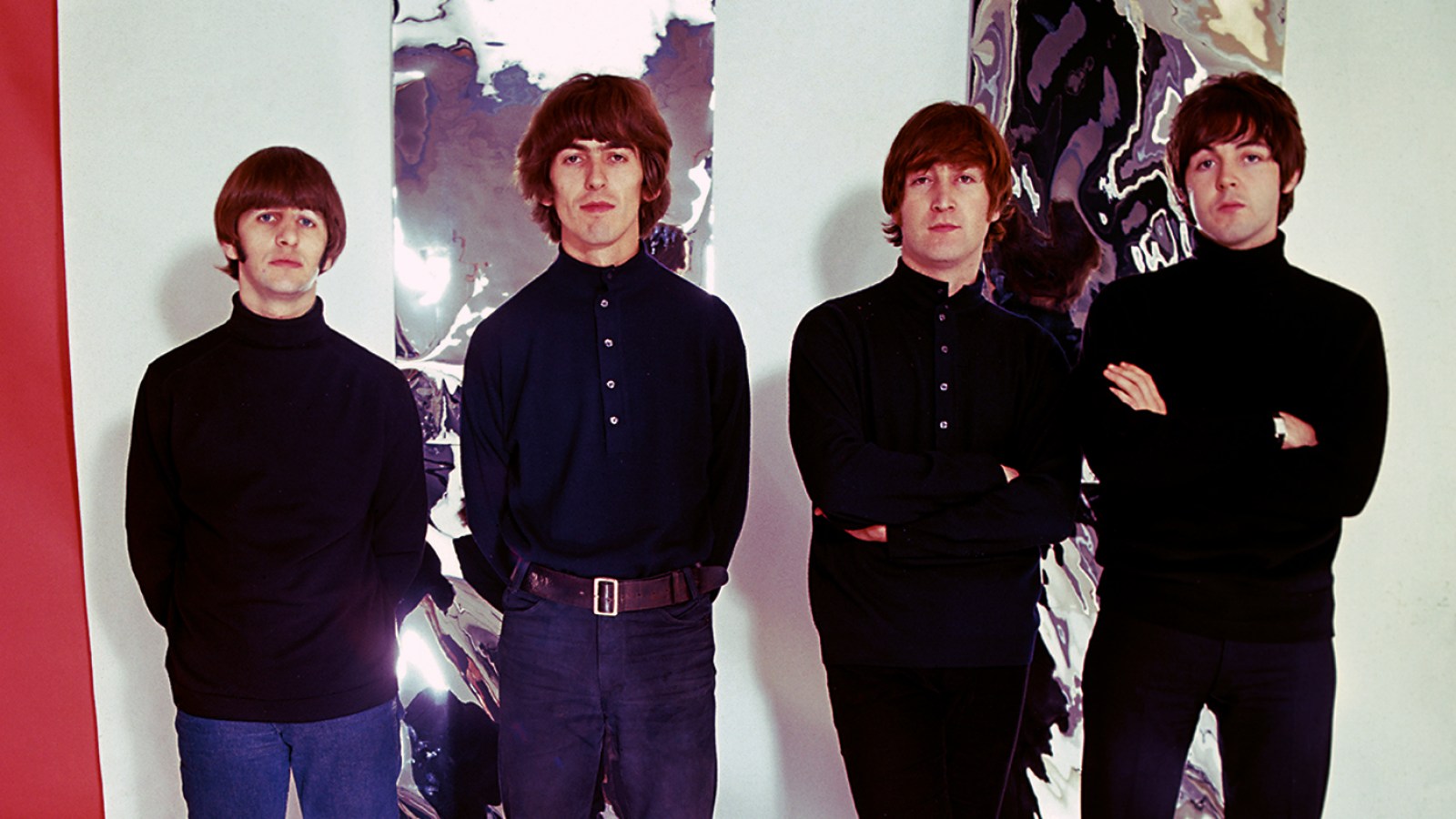

Fall is always Rubber Soul Season. The Beatles’ 1965 masterpiece has always been autumn-coded, with its bristling guitars, wistful vocals, pensive lyrics. But this fall, Rubber Soul has been in the air even more than usual, because of the phenomenal new Special Edition, which gets you up close with John, Paul, George, and Ringo like never before. Their most emotional album. Their moodiest. Their wittiest. Their best.
So what is it that makes Rubber Soul the Beatles’ best album? It’s a loaded question, but for some of us, there’s a correct answer, and it’s simple: It all comes down to the singing. In addition to everything else it is, Rubber Soul is the best place to hear John, Paul, George, and Ringo sing together. It’s four boys telling their stories out loud—you can hear them puzzling out the tales as they sing, bouncing ideas off each other, daring each other to dig a little deeper.
Over the decades, each era chooses its own Beatles album to deify as the ultimate Fabs masterpiece. In the vinyl era, it was Sgt. Pepper; the CD era chose Revolver; the streaming era has anointed Abbey Road. It would be diplomatic and civilized to say that all these albums are equally great…but this will never do, because we all take our own personal Beatles so seriously, and you’d have to be some kind of Mr. Mustard to pretend you don’t have a favorite, and for me, that’s always been Rubber Soul.
The Beatles had to bash out this album in a hurry, in October 1965, to rush some product into the shops in time for Christmas. They wrote seven of the songs in a week, pushing the deadline right down to the final hours. But they had a phenomenal hot streak. (Or should we say, it once had them?) Even the quickies have soul — like “Michelle,” a trifle Paul wrote in his teens for the specific purpose of wooing Liverpool art-student girls by pretending to be French.
But the thing that makes Rubber Soul stand out, head and moptops above the rest, is the singing, with these four boys mingling their voices, each sha-la-la and each na-na-na, each in-my-life and no-I-wouldn’t so charged with raw emotion. Their voices were changing from boys to men — Ringo and John were 25, Paul 23, George 22 — and you can hear their irresistible excitement that they can now emote as the world-weary men they always aspired to be.
Just a year earlier, in tunes like “I’m a Loser” and “No Reply,” John was trying to sing like a gritty Dylan-esque folk rogue; now he not only had the voice to pull it off, he could write tunes to match. Paul had never sounded so rugged as he did in “I’m Looking Through You,” but never so boyish as he does in the middle eight of “Wait.” The way he purrs “I feel as though you ought to know,” he sounds so guileless, even though he’s cheerfully admitting he’s been cheating like crazy on the road. (That “I’ve been good, as good as I can be” is an all-time Paul line reading.)
George, after playing grown-up with his voice on Help! (with the magnificently boyish “I Need You” and “You Like Me Too Much”), got all the way there. Why was the Quiet One suddenly using words like “opaque” and “rectify”? Because his groovy mod wife Pattie Boyd bought him a thesaurus, hoping it would help him write some eloquent love songs to tell the world about her. It’s safe to say “Think for Yourself” wasn’t what she had in mind.
But that’s just the lead vocals, which are only part of the story here, because you can get lost forever immersing yourself in the background vocals. None of them are holding back, no matter whose song it is. Listen to what Paul adds to “Norwegian Wood” or “Nowhere Man” or “If I Needed Someone”; listen to what John brings to “You Won’t See Me” or “Wait.” In the vivid new remix from Giles Martin and Sam Okell, you can go deeper than ever into these harmonies.
The lads were cranking around the clock to get Rubber Soul finished. They didn’t go into the studio with a plan to revolutionize pop music; they went in with a deadline. Nobody was asking for a great work of art— nobody except themselves, and their genius producer George Martin, who believed in them no matter what. The “harpsichord” solo in “In My Life”: That’s Mr. Martin, who went into the studio early, played his composed solo at half-speed on piano, sped it up to fit the tempo, then played it for the lads’ approval. That’s the spirit of collective make-it-work energy that made Rubber Soul come out as vibrant and fluent and unfettered as it is.
The pace was set right on the first day at Abbey Road, when John brought in two songs, from opposite sides of the genius spectrum: “Norwegian Wood,” a candidly introspective tale of getting outmaneuvered by a smarter operator, and “Run for Your Life,” a cheap Elvis joke that John somehow turned into one of his saddest, loneliest, most self-loathing vocals. “Run for Your Life” is the kind of song you’d bring to the studio if you scared yourself with how vulnerable you got in “Norwegian Wood.”
But both songs tell the truth about John’s miserable psyche in 1965. John was a recluse in his mansion, totally dependent on the Beatles as his only friends. He rarely even saw his wife or son without the TV blaring. He was a nowhere man, all right, and he told the truth about it in these songs. It might sound bizarre to think John brought in these different tunes the same day — yet it feels like “Run for Your Life” was a joke for him to hide behind, in case the other lads laughed at him for baring his soul in “Norwegian Wood.”
But they didn’t laugh. All four threw themselves into this song, wholeheartedly. George Harrison brought in an instrument he was still learning to play — he got it wrong, but came up with one of the most seductive sounds on any Beatles record, while Paul lifted John’s story with his ruggedly bruised vocals. (Rubber Soul is the place to start appreciating Paul’s underrated generosity as a team player; you don’t even notice him in “Norwegian Wood” or “If I Needed Someone,” until you do, but that’s when you realize how selflessly he’s elevating his fellow Beatles’ songs, and how bravely they wrote when they knew they could count on Paul covering their asses.)
There are no happy endings on the album — it’s the first Beatles album where none of the songs have “love” in the title, even though there’s a song about the word “love.” When Paul wrote his Rubber Soul songs, he was 23, the age Olivia Rodrigo is now — he really does seem pretty sad for a boy in love. (It’s the right age to be singing, “Love has a nasty habit of disappearing overnight.”)
But the dominant emotion here — in the voices and melodies far more than mere lyrics — is curiosity, as the boys chronicle a wide range of charismatic and complex women. Whether it’s John in “Girl” and “Norwegian Wood,” or George in “If I Needed Someone” and “Think for Yourself,” or Paul in “You Won’t See Me” and “I’m Looking Through You,” they’re on a quest to learn from these female characters, to communicate in their languages. (Even a goof like “Michelle” is about struggling to understand her native tongue; all we know about Michelle is she’s not learning Paul’s language at all.)
The first line of the album is John and Paul singing, “Asked a girl what she wanted to be.” In 1965, that was a question asked of boys, not girls. But the women on Rubber Soul have jobs, they have plans, they have interior lives and philosophical questions — none of them are waiting for a man, not even a Beatle.
On the final night of the sessions, they still needed two more songs to finish the album. So they showed up with two of their best: John’s “Girl” and Paul’s “You Won’t See Me.” You can hear the strain in their throats — you can also hear them revel in it. But all over Rubber Soul, you hear the Beatles listen to each other, openly imitating each other. They tell the truth about themselves by singing together.
As for “In My Life,” it’s the only Lennon-McCartney song where John and Paul seriously disputed who wrote it, which says a lot about how deep this song reached into both boys’ souls. John was eager to claim it for himself, while vacillating on how much Paul contributed. But in strictly musical terms, it has the Macca fingerprints all over, especially the “all these places had their moments” bridge.
As always, whichever Beatles are singing, you can hear their drummer listen to them and support them. No group of singers ever had a drummer like Ringo, and everybody always does their bravest singing when they’ve got Ringo behind them. He works hard to make himself easy to overlook — he always makes it a point of professional pride not to call attention to himself. “Singers love the way I play,” he told me in 2018. “I don’t play all over them.”
But he’s the heartbeat of these tunes — the singers go to all the personal places they visit because they know Ringo is lifting them up. In a song like “In My Life,” he makes it easy for John to be vulnerable, guiding him through these really difficult memories. That’s why every cover version falls flat — the song doesn’t soar without him. You can make a case for Abbey Road or Revolver as his drumming-is-my-madness peak, but Rubber Soul really shines as Ringo’s greatest hit.
The Special Edition adds both sides of the stand-alone single they cut at the sessions, “Day Tripper” and “We Can Work It Out.” There’s an instrumental take of “Day Tripper,” for those of us who love the guitars and percussion but not the vocal. To my personal (and undoubtedly wrong) perspective, it’s one of the lamest Beatles vocals, one of the few where they come off as phonies. Paul trying to sound disdainful and unimpressed by a girl is just out of his vocal skill set, the equivalent of Mick Jagger trying to sound sincere and sensitive. There’s an acoustic take where John and Paul sound far more charming, treating it as a joke — John can’t stop laughing at the final verse, which deserved no better.
The U.S. record company, as usual, tried to water down the album with an American version. However, they failed, because this version was arguably even better, kicking off with the double-whammy of “I’ve Just Seen a Face” and “Norwegian Wood” — is there a more euphoric five-minute intro to any album? “I’ve Just Seen a Face” came out that summer, on the original U.K. Help! There’s a great scene in the early Rolling Stones documentary Charlie Is My Darling where Mick and Keith are on tour in 1965, bored and dour in their hotel room, until Keith begins strumming “I’ve Just Seen a Face” and they sing it together — suddenly, even these bitchy Glimmer Twins can’t help grinning.
Capitol didn’t plan on making Rubber Soul sound like a “folk-rock” album — when they pulled “I’ve Just Seen a Face” and “It’s Only Love” from Help!, they had no idea how Rubber Soul would sound. Neither did the Beatles, who hadn’t written the songs yet. But it’s the only case where the butchered U.S. version might top the original. The American Rubber Soul turned out to be even more influential — it’s the one that inspired Brian Wilson to make Pet Sounds, the one that challenged Bob Dylan to make Blonde on Blonde, the one that blew the minds of Marvin Gaye and Carole King and Stevie Wonder and the Grateful Dead.
I’ve spent my entire life trying and failing to make up my mind which one I love better, so it’s good to have both of them bundled together on the Special Edition. But either way, it settles the question of the Beatles’ greatest album. In my life, I love Rubber Soul more.