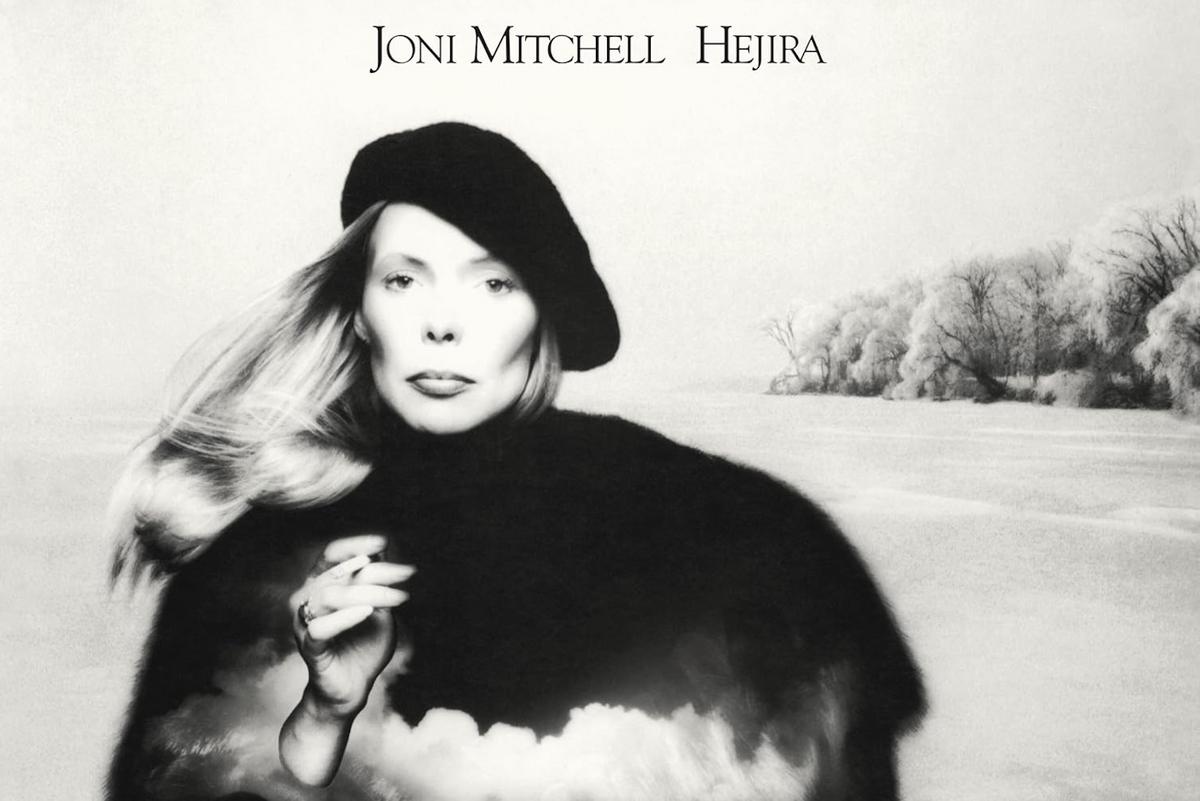

By the mid ’70s, Joni Mitchell‘s music had turned toward something that was difficult to classify in the age of FM radio — jazzier, moodier and highly sophisticated. That was certainly the sound of Mitchell’s eighth album, Hejira, released on Nov. 21, 1976.
“I suppose a lot of people could have written a lot of my other songs,” she once said, “but I feel the songs on Hejira could only have come from me.” Mitchell’s departure from more traditional folk rock wasn’t entirely well-received. Critics appreciated Hejira, but the charts told a different story. It went to No. 13 on the U.S. Billboard 200 and No. 11 in the U.K. — not bad, but not as impressive as previous releases.
Still, the nomadic vibe of Hejira would become deeply inspirational to future singer-songwriters, women in particular. “It’s an intimate, beautiful record that is so modern that it sounds like stuff that didn’t happen for another 10 years. Lots of pedal steel and weird electric guitar, very futuristic,” Natalie Mering, aka Weyes Blood, told Under the Radar, in 2020. “I think as a kid I didn’t see the innovation. As a woman, growing up, I didn’t recognize how rampant sexism was and how people wrote certain women under the table for being really innovative, and instead of being praised for their innovation they were essentially crucified because people wanted them to stay a certain way. As a woman, seeing the record in that context now, having been through the music industry in that way, makes it pop that much more.”
Hejira is often cited as one of Mitchell’s career highlights, and even if you know the album, we’ve found a few things you might not have learned yet…
1. Many of the songs were written during Mitchell’s journeys across America, both on the road with Bob Dylan’s Rolling Thunder Revue and solo dressed in disguises.
It was during this period that Mitchell took not just one but several cross-country road trips, writing songs along the way that would ultimately be a part of Hejira.
On some occasions, she was alone, dressing in disguises, giving out a false name and driving without a license behind truckers who would signal when police were up ahead.
On another occasion, she traveled with Bob Dylan‘s Rolling Thunder Revue — below is a clip from that time, featuring Mitchell, Dylan and Roger McGuinn gathered at Gordon Lightfoot‘s home. “Coyote” would later become Hejira‘s leadoff track.
2. The back cover photograph features a Canadian Olympic medalist.
The picture you see of Mitchell on the front cover of Hejira was taken by Norman Seeff, but on the back is a different person. It’s a photo of the Canadian figure skater Toller Cranston, who won a bronze medal at the 1976 Olympics. “You sing, don”t you?” he said when she called him with the request to be photographed.
3. That’s Neil Young playing harmonica on “Furry Sings the Blues.”
Mitchell and Neil Young, both Canadians, have always been dear friends, but they’ve also occasionally been collaborators. That’s Young playing the harmonica on Hejira‘s “Furry Sings the Blues,” a song Mitchell wrote after meeting bluesman Furry Lewis in Memphis, Tennessee during her travels.
Unfortunately, Lewis was upset by this. “The way I feel,” he told Rolling Stone back in 1977, “is that your name is proper only to you, and when you use it you should get results from it. She shouldn’t have used my name in no way, shape, form or faction without consultin’ me ’bout it first. The woman came over here and I treated her right, just like I does everybody that comes over. She wanted to hear ’bout the old days, said it was for her own personal self, and I told it to her like it was, gave her straight oil from the can. But then she goes and puts it all down on a record, using my name and not giving me nothing!”
Mitchell’s manager, Elliot Roberts, did provide a response for this: “All she said about him was, ‘Furry sings the blues’ the rest is about the neighborhood. She doesn’t even mention his last name. She really enjoyed meeting him, and wrote about her impressions of the meeting, He did tell her that he didn’t like her, but we can’t pay him royalties for that. I don’t pay royalties to everybody who says they don’t like me. I’d go broke.”
READ MORE: Underrated Joni Mitchell: The Most Overlooked Track From Each LP
4. This was the era in which Mitchell met and began working with jazz bassist Jaco Pastorius.
If you know anything about Mitchel”s discography, then you probably know that it was around this time that she shifted her attention toward jazz session players. For Mitchell, something had been lacking, especially in the bass department.
“Everybody’d heard my lament about the trouble I was having,” she explained to Musician magazine in 1987. “I was trying to find a certain sound on the bottom end, going against the vogue at the time. It’s very difficult to buck a vogue. Bass players were playing with dead strings; you couldn’t get them to change to get a round, full-bodied tone. I liked that old analog, jukebox, Fifties sound-upright bass, boomier. In the Sixties and early Seventies you had this dead, distant bass sound. I didn’t care for it. And the other thing was, I had started to think, ‘Why couldn’t the bass leave the bottom sometimes and go up and play in the midrange and then return?’ Why did it have to always play the root?”
And this is where fretless bassist Jaco Pastorius entered the picture, someone Mitchell immediately liked and hired to play on four of Hejira‘s songs. “It was exactly what I was waiting for,” she said.
Listen to Jaco Pastorious on ‘Hejira’
5. Mitchell plucked the album title out of a dictionary.
The title Hejira is a transliteration from the Arabic word “hijrah,” meaning “departure,” “journey” or “exodus.” Mitchell found it in a dictionary, the perfect word for what she once described as the feeling of “running away with honor.”
Listen to ‘Amelia’ From ‘Hejira’
Joni Mitchell Albums Ranked
Individuality set her apart from other singer-songwriters in the ’70s.
Gallery Credit: Michael Gallucci