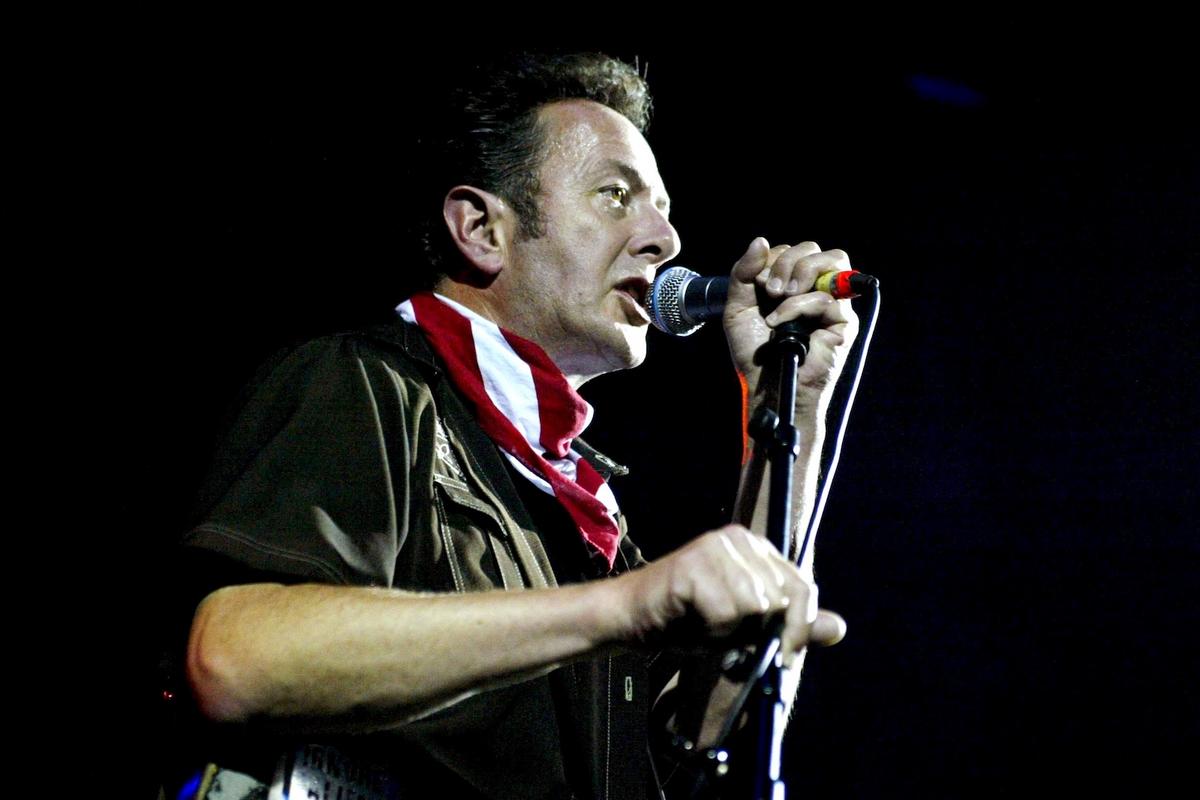

When Joe Strummer, former lead singer for the Clash, was found dead in his home on Dec. 22, 2002, he was only 50 years old.
He’d just gotten back from walking his dogs near where he lived in Somerset, an area of Southwest England. It was his wife, Lucinda, who found him unresponsive. Following an autopsy, it was discovered that Strummer had died from an undiagnosed congenital heart defect that could have killed him at any point in time.
“It was such a shock. It wasn’t like he’d been ill,” his daughter, Lola, recalled to The Guardian a decade after her father’s death. “The day before, we’d all had such a great day with him. He had been away on tour and we hadn’t seen him for a couple of months. So we all met up – our mum, our grandparents, his second wife Lucinda and her daughter Eliza, and we’d all gone out for a meal and then sat in the Groucho [club] drinking champagne. It was a really, really lovely day.”
Lola was 16 at the time. Her sister, Jazz, 18. Lola had been out Christmas shopping in London when she got a phone call requesting that she come home.
“So I got on the tube and I remember sitting there, weighing up the options,” she recalled. “I knew it wasn’t my mum because I had spoken to her earlier, and so I thought it must be either Jazz or my dad. By the time I got off the tube I rang home and said, ‘Dad’s dead isn’t he?'”
Joe Strummer’s Last Years and Months
At the time of his death, Strummer was at work on a third album with his post-Clash band, the Mescaleros. (Streetcore would eventually be released posthumously in October of 2003). Additionally, he was in the process of writing a song with Bono and Dave Stewart that would be used at the upcoming Mandela SOS fundraising concert, an AIDS awareness event to be held in South Africa on Feb. 2, 2003.
If it sounds like Strummer was busy, he was. From just about the moment the Clash ended in 1986, the singer moved ahead with other work. He dabbled in film, toured with the Pogues and formed the Mescaleros.
It was liberating for Strummer. “This is my Indian summer,” he said to a reporter in 2000. “I learnt that fame is an illusion and everything about it is just a joke. I’m far more dangerous now, because I don’t care at all.”
But Strummer was also ready to relax a bit. After all, he’d already been in “the only band that matters,” as the famous slogan went. There were plenty of projects for Strummer in the ’90s, but not so many that his whole life was consumed.
“Well, there’s a nice hammock in my yard, made from Guyanese mountain goat wool. [Laughs] I am a lazy sod though — let’s put that down front,” he said in a September 1999 interview. “I have reached the top, now I can coast! [Laughs] … Yes! Me and Isaac Hayes, buddy. The rest of you guys, lick your hearts out! You’ll never make that rarified plateau. Give up now! [Laughs]”
The Rock World’s Reaction to Joe Strummer’s Passing
Naturally, an outpouring of tributes followed the announcement of Strummer’s death.
“That heart of his always worked too hard,” Pete Townshend said in a statement shortly after the news broke (via Rolling Stone). “I will really miss him.”
“The Clash was the greatest rock band,” Bono added. “They wrote the rule book for U2.”
“He was a clear contemporary and we were rivals,” Live Aid organizer and Boomtown Rats vocalist Bob Geldof said. “I believed we had to get inside the pop culture — he believed you should always stay outside and hurl things at it. He was a very important musician. The Clash will be endlessly influential. They will always be one of the deathless rock bands.”
READ MORE: When the Clash Finally Played Their First U.S. Show
The following January, the Clash was inducted into the Rock & Roll Hall of Fame, something Strummer had spoken to Rolling Stone about a month before he died. He was asked then whether the band — Strummer, Mick Jones, Paul Simonon and Nicky “Topper” Headon — would reform for the ceremony.
“I’m sure I’d do it,” he replied, “and I’m sure Topper would do it, but it’s only fair and polite to inquire of the others.”
A week after giving that answer, Strummer and Jones performed a handful of Clash songs together in London, marking the first time they’d played together on stage in close to 20 years. The full reunion, of course, would never take place.
Tom Morello and the Edge did the honors of delivering the Clash’s induction speech.
“Joe Strummer died on December 22nd, 2002,” Morello said. “But when Joe Strummer played, he played as if the world could be changed by a three minute song. And he was right. Those songs changed a lot of people’s worlds forever, mine at the top of the list. He was a brilliant lyricist, with anger and wit, always stood up for the underdog. And his idealism and conviction instilled in me the courage to pick up a guitar and the courage to try to make a difference with it.”
In February, an all-star lineup of Elvis Costello, Bruce Springsteen, Steven Van Zandt, Dave Grohl, Pete Thomas and Tony Kanal performed “London Calling” at the Grammy Awards in honor of Strummer.
Watch the Joe Strummer Tribute at the 2003 Grammys
Toward the end of his life, Strummer found himself in an enjoyable artistic position. He was at once excited about the prospect of new ideas and content to enjoy the little things in life.
“I look forward to things like last night — we stayed up all night writing songs,” he said in the aforementioned 1999 interview. “Out in the city, brimming full of ideas, jabbering like madmen, writing on everything, meeting new people. I get my energy from the idea of ideas. The notion of a good idea or the thought of a good idea. That’s when I perk up, when I feel that there’s a good idea in the house, in my brain pan. That’s when I feel alive and that’s what I want to continue doing, connecting with that. Also, I want to continue eating sardine sandwiches with sardines and tomatoes. That’s what I did today.”
The Clash Albums Ranked
There was a time when the Clash were called “the only band that matters.”
Gallery Credit: Michael Gallucci