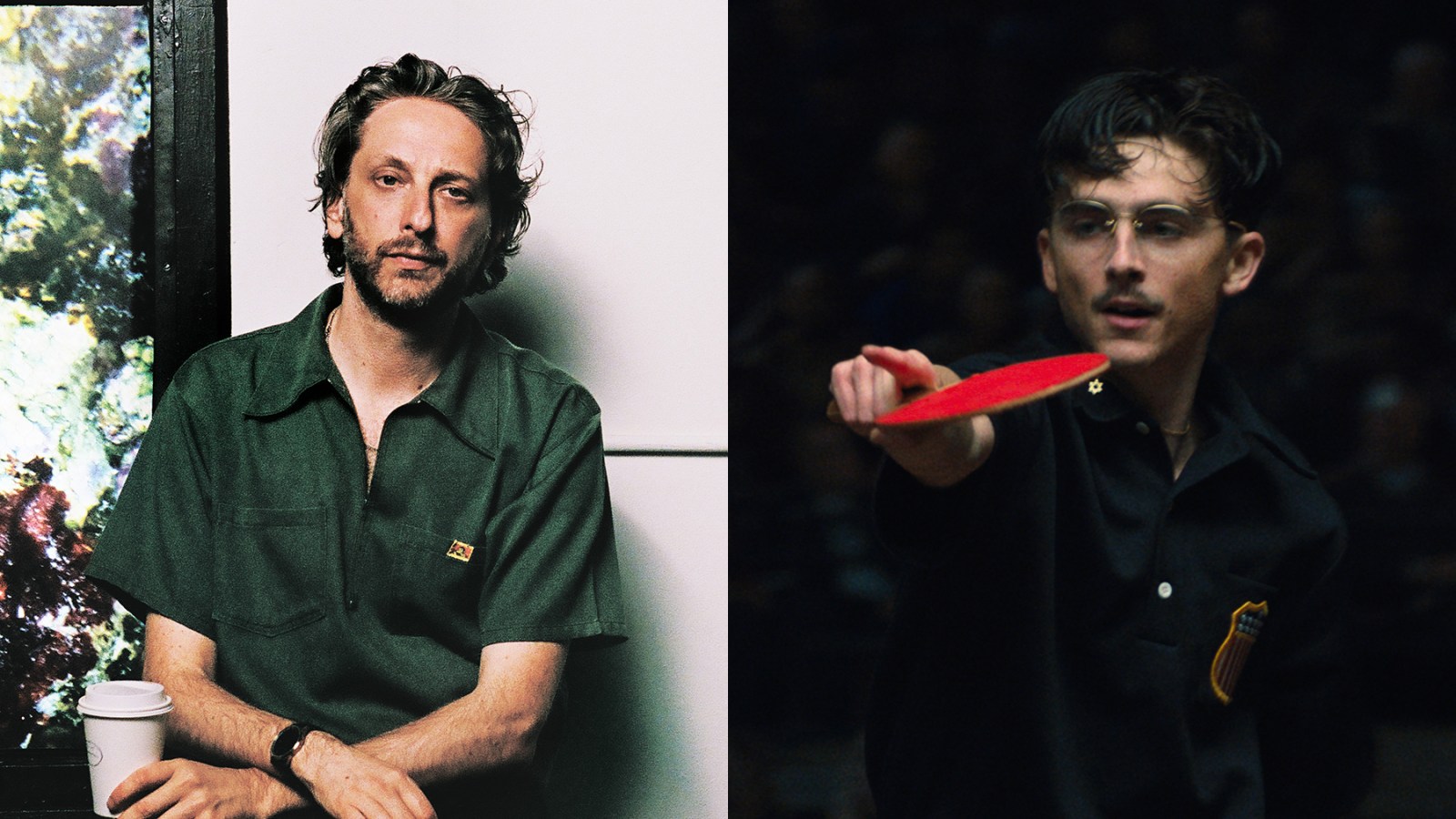

Producer and musician Daniel Lopatin spent his early career traversing underground electronic and noise scenes as Oneohtrix Point Never. As the years went on, his career teetered on the mainstream, opening for Nine Inch Nails on tour and collaborating with FKA Twigs and the Weeknd. But nothing has put him more in the public eye than his work scoring films, particularly with the Safdie brothers.
“We have similar inclinations artistically, but we’re very different people,” Lopatin says over Zoom from his Brooklyn apartment. He first worked with the pair on 2017’s Good Time, followed by 2019’s Uncut Gems. Now, his work on Josh Safdie’s buzzy ping pong blockbuster Marty Supreme has gotten Lopatin shortlisted for an Oscar.
“Josh is not unlike the characters that he draws up,” the musician continues. “He’s unrelenting, and his energy is just at 11 [out of 10] all the time.”
Lopatin describes himself as “a little bit more introverted and shy” but finds that Safdie brings out of him “a certain kind of energy. He likes the part of me that’s more feral and more like ‘Let’s get the combustion going.’”
Lopatin’s work on the Marty Supreme score is as kinetic, rhythmic, and glistening as the film and its big-dreaming antihero, Marty Mauser (Timothée Chalamet). Though the movie is set in the Fifties, the music pulls heavily from the Eighties, both in Lopatin’s original score and in the pop music cues, which feature needle drops from Tears for Fears, Alphaville, and Peter Gabriel. Lopatin hints that there was a time when the script followed Marty’s life into the decade when those songs thrived, an abandoned ending that ended up still informing so much of how he and Safdie shaped the sound.
“It’s like a labyrinth that Marty has to traverse to get to his future, his dream, his vision of himself,” he says. “That’s represented by this music that has yet to exist. It’s not unlike Josh and I to think about the score as having this allegorical thing going on where you can use it to suggest things that aren’t said, intuitions that the main characters in our films are having, or hunches about the universe.”
Lopatin sees certain elements of the score as “wormholes into the psychic realm” of the film. He notes two key scenes on staircases: One features retired actress Kay Stone (Gwyneth Paltrow) ascending a staircase through a crowd to see Marty. The other occurs when Marty descends a staircase in the opulent apartment that Kay shares with her rich husband Milton (Kevin O’Leary).
“In both cases, we played with this motif of ascension,” Lopatin says.
Lopatin produced the Marty Supreme score in the middle of a flurry of other work. He reunited with frequent collaborator the Weeknd on Hurry Up Tomorrow and completed his own new album Tranquilizer, which came out this past fall. On Tranquilizer, OPN pulled from a massive archive of Nineties sample CDs he found online. He had put off finding a use for the samples when he first came across them in 2021, instead focusing on the Weeknd’s Dawn FM and his 2023 OPN album Again. When he came back to the archival site more recently, the samples had been taken down.
“It’s an interesting object lesson,” he says. “I was titillated. I really wanted to [work with these songs] because it’s this thing appearing and then disappearing, and then me having to sort of go on this weird subterranean search to get it back, which was pretty easy.”
After a friend scraped the website and unearthed the sample library, Lopatin got to work. He also cites a formative experience at his dentist’s office: He was looking up at the ceiling during a routine exam and found himself staring at a poster of palm trees pinned up above him. He soon learned that it’s a common decorative choice made by dentists.
“It’s bizarre, since nobody likes dentists,” he says. “You’re trying to make it comfortable, but you’re actually making it more awkward. You’re having me think about this thing, and it’s completely out of reach.”
As he looked up, Lopatin focused on the drop tile the palm trees were covering, noticing its “weird little holes” and perforations. “I was like, ‘This is the record,’” he says.
Over the years, Lopatin has encountered a number of fans who tell them how his music makes them almost “hallucinate images.” He realized he has always been trying to find a way to translate an image to music.
“I know my music can be kind of difficult or obtuse or something like that, but I don’t find that it actually is,” he says. “More and more, I think that people understand it the way that I understand it, which is just a kind of a hallucinatory cartoon of sound.”