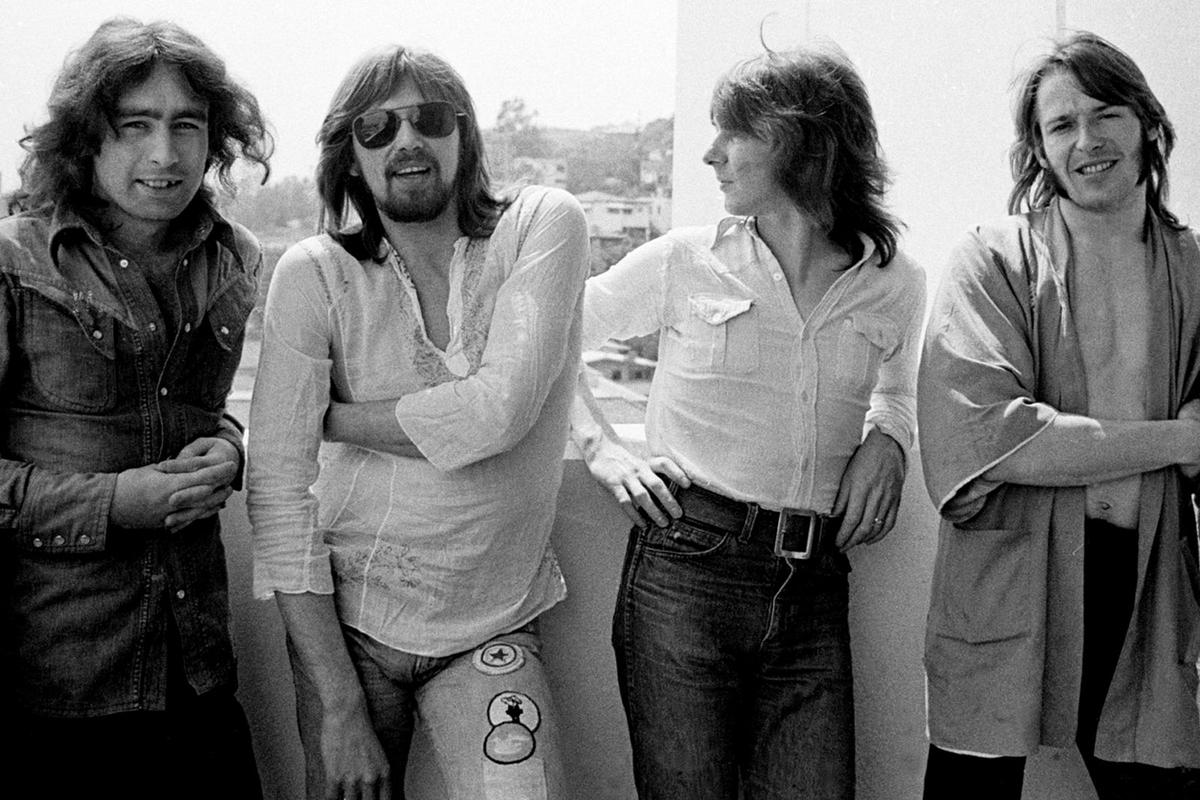

The original Bad Company knew how to start an album, that’s for sure.
The newly minted Rock and Roll Hall of Fame supergroup — Paul Rodgers and Simon Kirke from Free, Mick Ralphs from Mott the Hoople, Boz Burrell from King Crimson — introduced itself to the world in 1974 with the haymaker chords of “Can’t Get Enough,” a song that hit No. 5 on the Billboard Hot 100 (the band’s highest chart position ever) and drove their self-titled debut album to five-times platinum sales.
“Those big power chords were all Mick Ralphs,” Rodgers notes. “He was a master at that.”
Read More: Bad Company Albums Ranked Worst to Best
That mastery would be on display for half of the six albums this version of the band made together, with Rodgers’ more musically ambitious songs leading off the other three.
Most of them charted and could, for the most part, be considered among Bad Company’s A-list, signature songs. Tellingly, subsequent incarnations of the band veered from the strategy; the albums with Brian Howe and Robert Hart got off the big-sounding starts, but the key songs of the band’s CD age often appeared later on in their respective sets, not making nearly the impact the original quartet made sure was delivered with each Side A, Song 1.
Since we, er, can’t get enough of Bad Company these days thanks to its well-overdue Rock Hall induction and those heartwarming speeches by Rodgers and Kirke — coming just four and a half months after Ralphs passed away at the age of 81 — it seemed like the right time for a critical appraisal and ranking of those memorable album-starting tracks…
6. “Electricland” (Rough Diamonds, 1985)
Penned by Rodgers for what would be the original foursome’s final album, “Electricland” is the most restrained of this lot, a loping, moody verse rhythm that led to an explosive chorus. The construct is bluesy, with Kirke and Burrell riding in a deep pocket and Ralphs stretching out on some extended solos, vamping back and for with Rodgers’ vocals in the latter part of the song. The frontman’s piano, meanwhile, provides a spectral tone that makes it wholly unique in Bad Company’s catalog — and easily the most interesting thing on the Rough Diamonds album.
5. “Live For the Music” (Run With the Pack, 1976)
After setting a multi-platinum standard with its first two albums, Bad Company kicked off No. 3 with a big beat, more of Ralph’s muscular power chords and a funky undertone that gave the song a sturdy groove. With its straightforward lyric (the title pretty much says it all) this is one that winds up belonging to Kirke and Burrell, too, as they take the track out with more than a minute and a half of bass and drums jamming. Not released as formal single, it was nevertheless a live staple — a statement of purpose and promise to “give it everything you got.”
4. “Burnin’ Sky” (Burnin’ Sky, 1977)
A clap of thunder heralds the first of the Rodgers-written album openers, a five-minute-plus track with an arrangement that affords the rhythm section plenty of space to push the song forward while Ralphs’ guitar provides accents, sometime sounding like they’re coming from the other side of a wall. The restraint results in an intriguing tension that keeps us paying attention, and Rodgers and Ralphs also use keyboard and accordion to create subtle textures that are heard more than they’re felt.
3. “Good Lovin’ Gone Bad” (Straight Shooter, 1975)
Buoyed by the first album’s success, Bad Company kicks off its second with a punchy boogie swagger and a greater sense of dynamics, pulling back in the bridge to set up the fierce attack of the chorus. It was written by Ralphs but some of the guitar riffs sound positively Free-esque, and parts of the tune sound like a fraternal twin, or at least cousin, of the Rodgers’ “Movin’ on” from the Bad Company album. It’s strong from start to finish, including Ralphs’ sharp mid-song solo, and serves an inarguable notice that the success of band’s first album was no mere fluke.
2. “Rock ‘n’ Roll Fantasy” (Desolation Angels, 1979)
Burnin’ Sky had been a bit of a disappointment — BadCo’s first non-platinum album in the U.S., and its first not to go Top 5 on the Billboard 200. Rodgers’ “Rock ‘n’ Roll Fantasy” signaled a return to form, however, exploding with a fuzz-tone opening created on a guitar synthesizer but sounding as gritty as any live performance.
Kirke gave the song a modern flavor with some electronic tom-toms, and Ralph’s striding solo is among his most memorable. Rodgers’ lyric, meanwhile, is a thoughtful summation of the collision between reality and, yes, fantasy in the music business. Call it a comeback; at No. 13 on the Billboard Hot 100 it was BadCo’s third highest-charting single – and the only one ever certified gold — and drove Desolation Angels back into the Top 5 (No. 3) and to double-platinum status.
1. “Can’t Get Enough” (Bad Company, 1974)
This not only launched BadCo’s first album; it launched the band, period. As Rodgers recalls, “‘Can’t Get Enough’ was written entirely by Mick in his Mott the Hoople days. “Mott’s Ian Hunter did not feel it suited the band’s style, so when Mick played it for me I told Mick that the song was a hit and that I would love to sing it,” Rodgers later explained. “He had ‘Can’t Get Enough,’ I had ‘Rock Steady’ and ‘Bad Company,’ Simon added a couple of lines and we were off to the races for our first album.”
The pent-up frustrations the four members felt in their other bands can be heard in the way this explodes out of the speakers, a Spartan, sinewy energy and coiled arrangement that made it an instant classic from the count-in. It heralds both arrival and the promise of future progress, which the Rodgers-era Bad Company would deliver for the next nine years.
2026’s Biggest Rock Tours
Rock reunions are creating some of the biggest headlines for 2026 – but there are lots of other huge shows on the way.
Gallery Credit: Nick DeRiso