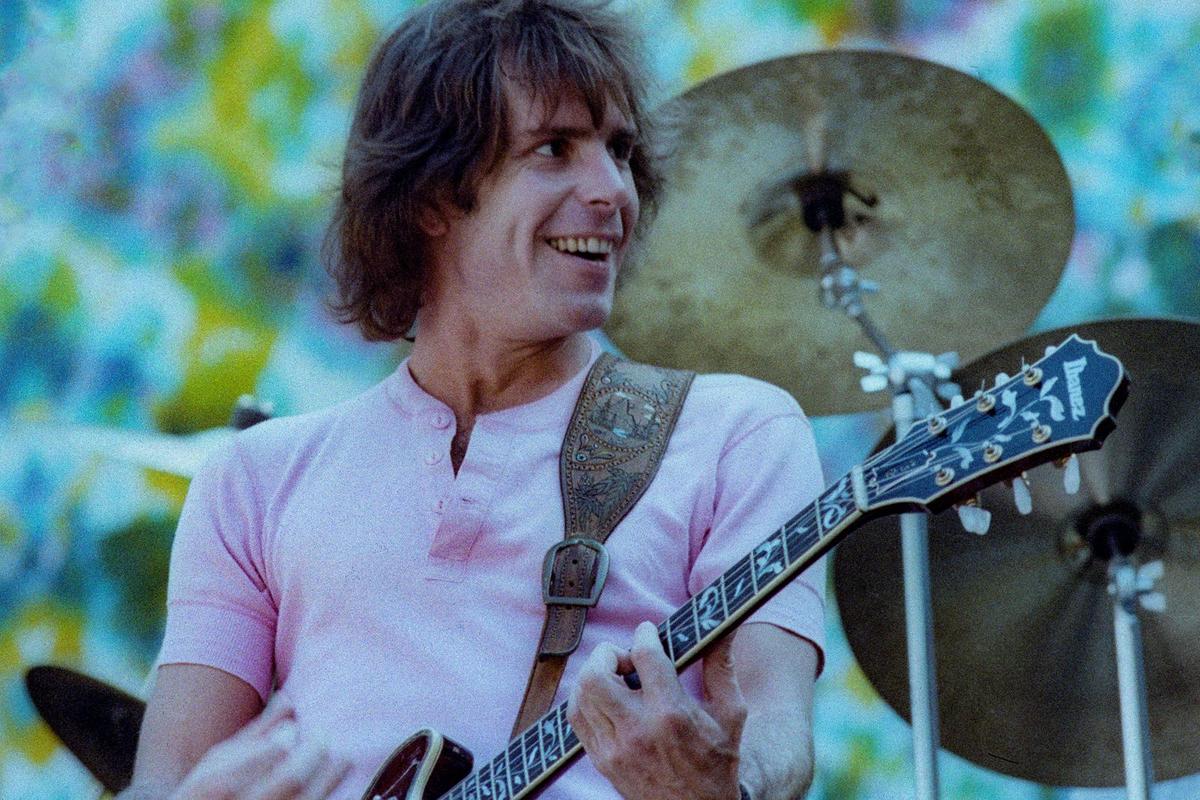

One of Bob Weir‘s best songs — for any of his musical concerns — was “The Music Never Stopped” from the Grateful Dead‘s Blues for Allah album.
But back in 2009, Weir — who died this weekend at the age of 78, from cancer — told us he didn’t necessarily know what would be the case.
“I didn’t think about the future,” he noted. “I don’t think any of us did. We were just playing it as it comes…It’s really been a moment to moment continuum for us.”
That said, Weir certainly did his part to create many magical musical moments during his career — with the Dead and its offshoots (Further, The Other Ones, the Dead, Dead & Company), on his own and with other bands such as Kingfish, Bobby and the Midnites, RatDog and, most recently Wolf Bros.
Read More: Rockers React to Bob Weir’s Death
He, like the other Dead members, spent a lot of time in the late Jerry Garcia‘s shadow, but the San Francisco-born Weir carved out his own niche as a guitar player adept at finding a sweet pocket within the Dead’s maelstrom of sound and as arguably the group’s most consistently melodic songwriter, a rooted presence amidst the psychedelia and as vital to the canon as any of his compatriots.
The Dead was, as we know, a reluctant studio band and not one for hit singles, but some of its top-charting songs came from Weir’s pen — including “Truckin’,” which he co-wrote with Garcia and bassist Phil Lesh for American Beauty in 1970.
“A lot of things come to me in dreams,” Weir said of his process in 2022. “They’re every bit as real when you’re there as when you’re here, and if something strikes you in a dream I think it’s kind of your duty to act on it, and act on it now.”
“(Weir)’s very unique, as a player, a writer, a performer,” Don Was, who played bass in Wolf Bros and was a close friend, tells UCR. “Something I learned from playing with Weir all these years is every night when we go out to play is we don’t know what’s gonna happen.
“You can count on a couple of total train wrecks and a couple moments when you connect with the audience and they feed back energy to you. It’s a cyclical thing that happens that can blow the roof off the place. It’s the most exhilarating feel I know. Once you experience that, you just crave it.”
With that in mind, these are the Weir songs we most remember in the wake of his passing…
10. “My Brother Esau” (1987)
Weir co-wrote this B-side to “Touch of Grey” with lyricist John Perry Barlow, a Grateful Dead rarity and biblical parable that gives us Esau from Jacob’s perspective, observing (and scheming?) watching his high-testosterone hunter brother “shadowboxing the apocalypse and wandering the land.”
It’s a prototypical Weir/Dead tune, wrapped in a tight of groove that puts up some welcome guardrails for the guitars and percussionists to accent but never stray off target. It had been kicking around the set lists for a few years before its release, though it never made it onto an actual Dead album.
9. “Little Star” (1983)
A curio whose history is not particularly well documented, it showed up during three Dead shows in 1983 as an introduction to “The Other One” and later became part of the RatDog repertoire. As much fragment as full-fledged son, some fans dubbed it “Bob Star,” and it certainly captures Weir at his trippiest. Check it out on Dave’s Picks Vol. 39 from Philadelphia.
8. “Estimated Prophet” (1977)
Funk and reggae influences drive this opener to the Terrapin Station album, whose first side was dominated, vocally, by Weir in tandem with Donna Jean Godchaux. Weir’s singing is more authoritative than ever as he delivers Barlow’s lyric, and Tom Scott’s saxophone contributions make this a nice bridge from Blues For Allah into even more pronounced adventures and experiments.
7. “Cassidy” (1972)
This chiming, easygoing lullaby from Weir’s first solo album, Ace, was written by Barlow and references two specific people — Cassidy Law, then a newborn to Dead office manager Eileen Law, and famed Beat fixture Neal Cassady. Godchaux joins Weir on harmonies, and the song’s spirit of optimism and possibility made for euphoric moments at many a Dead concert.
6. “Gonesville” (2016)
There’s a sense of genial moving on in this easygoing, lo-fi, gospel-tinged country tune from Weir’s last solo album, Blue Mountain, that’s a little chilling in the wake of his passing. Sun Records (Elvis Presley, Johnny Cash) was certainly on Weir’s mind as he and Josh Ritter and co-producer Josh Kaufman penned it, and the National`s Aaron Dessner is among the entire album’s highlights. It’s familiar and cozy from the first hint of shuffle, however, and you’ll be feeling delivered as you sing along to the “hey hey, hey hey” refrain that steers it towards the Promised Land.
5. “One More Saturday Night” (1972)
A loud, brash and fun party stomper that turns into a piano-pounding rock ‘n’ roll shuffle in the choruses. It was road-tested with the Dead starting in 1971 before appearing on 1972’s Ace album and the band’s Europe ’72 album the same year. Legend has it that the song was initially Robert Hunter’s but that he and Weir had some disagreement with the lyrics, leading to the tune we know and love. It also provided a title for Al Franken’s 1986 film and Bill Walton’s Sirius radio show.
4. “Throwing Stones” (1987)
Another Weir-Barlow collaboration juxtaposing the “kids” in the crowd who “dance, they shake their bones” against the turmoil of a “whole world full of petty wars” and “the politicians throwing stones.” It’s a biting social commentary that began showing up in Dead sets circa 1982 and accompanies its sentiments in an arrangement full of turmoil; the guitars dance while Mickey Hart and Bill Kreutzmann shift into war drum patterns as Weir declares that “ashes ashes all fall down.” “Hell in a Bucket,” Weir’s other contribution to the In the Dark album, tends to get more attention, but this ride is just a touch more enjoyable.
3. “Playing in the Band” (1971)
Weir teamed with frequent Dead lyricist Robert Hunter, whose poetry was particularly adept at capturing the experience of doing just what the song title says. It first appeared on the Grateful Dead live album in 1971 and later in a studio incarnation on the Ace album in 1972 — with an added songwriting credit for percussionist Mickey Hart. A nearly 47-minute rendition of the song from May 1974 in Seattle is documented as the longest uninterrupted performance of a single Dead song, ever. (Check it out on the limited-edition Pacific Northeast ’73-’74: The Complete Recordings from 2018.
2. “The Music Never Stopped” (1975)
The Dead was deep into Blues For Allah‘s funk mode as Side One wound its way to this high-stepping four-and–a-half minutes of a joyous “rainbow full of sound.” Another song about, yes, playing in the band, this makes it sound like there`s nothing better in the world, right down to Steven Schuster’s saxophone honks, hot guitar solos and Weir’s vocal trade-offs with Godchaux in the choruses. “The music plays the band,” as Weir intones Barlow’s lyric, and you’d be hard-pressed to find a better encapsulation of what it sounds like when that happens.
1. “Truckin'” (1970)
Could Weir’s best be anything but this beauty from American Beauty? The collaborative tune — Weir, Garcia and Lesh with Hunter’s lyrics — could be considered a Grateful Dead microcosm, at least of the rootsy side of the band, with all of the key collaborative elements in place from its muscular shuffle to the rolling thunder of Lesh’s bass and the guitar fills Garcia and Weir found space for in the arrangement.
Just a few years into the band’s history lyricist Hunter captured the “long strange trip” it had been and would become even moreso over another two and a half decades — and beyond.
Grateful Dead Albums Ranked
Even the band’s most ardent supporters admit that making LPs wasn’t one of their strengths.
Gallery Credit: Michael Gallucci