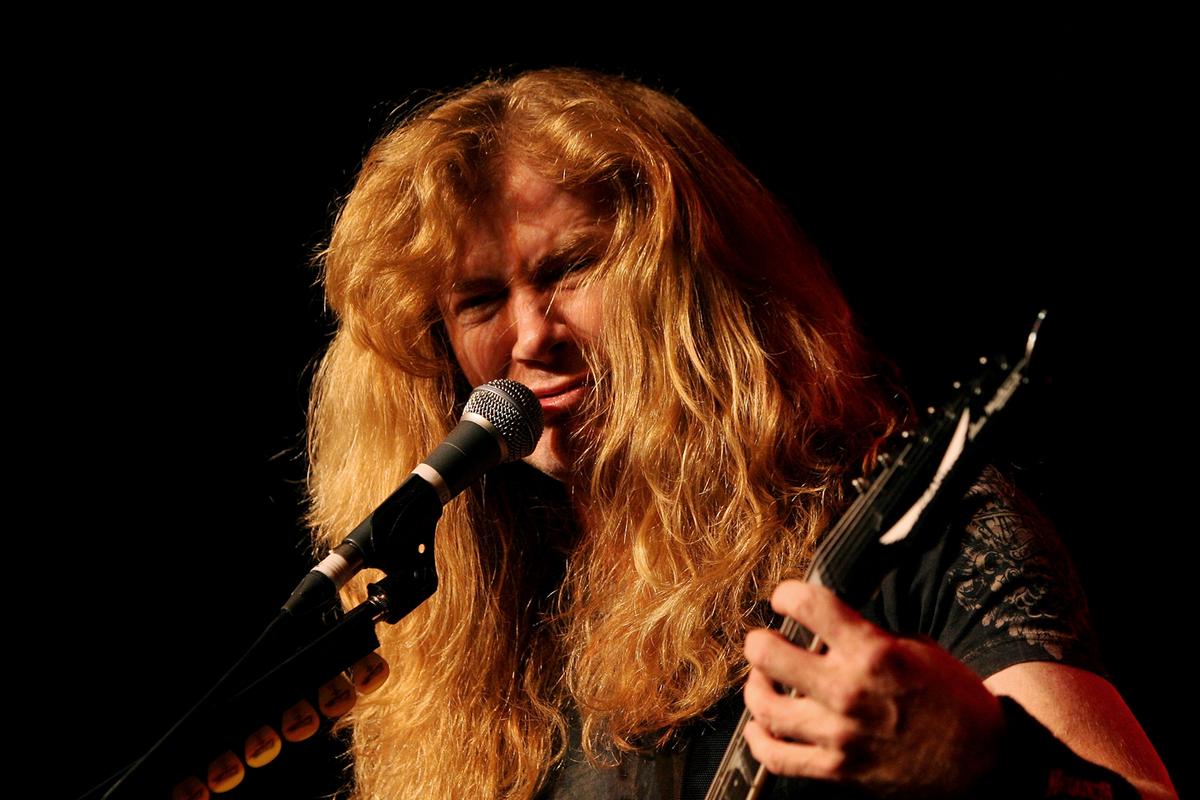

Dave Mustaine has a question. We’re deep into talking about the latest and perhaps final Megadeth album when he unexpectedly turns the tables on me.
“Are you married? You’re married, right?”
Mustaine’s wife, Pam, enters the frame of our Zoom conversation to say goodbye as she heads out the door. It’s a rhetorical question, because earlier, I’d revealed the Megadeth tradition of sorts that I share with my wife. We like to quote that one section of “Sweating Bullets” to each other at random moments. “Hello me/ It’s me again.”
“Oh yeah, people like that part,” he smiles.
It’s an exchange which eventually leads to an interesting discussion of how Mustaine found his own voice in Megadeth, which you’ll read about in our conversation below. But what’s interesting to this writer is how for more than 40 years, he’s remained remarkably consistent when it comes to the albums that he makes with Megadeth.
1999’s Risk was perhaps the most polarizing left turn that most fans will mention (and debate) when it comes to the catalog of work from the thrash metal legends. But outside of that one record, the songwriter, frontman and leader has been fierce with his focus that when you buy an album that says Megadeth on the cover, it’s going to sound like Megadeth.
Dave Mustaine has taken a lot of s–t at times for being Dave Mustaine, but one thing you can say about him that nearly always rings true is that he has had a continual vision and he’s stuck with it.
He’s taking stock of that journey with Megadeth: Behind the Mask, a new documentary which will bring fans together in theaters worldwide starting Thursday evening (Jan. 22) to hear the new Megadeth album on the eve of its release, with track-by-track insights from the metal vocalist and mastermind of the group.
The film also takes a look at the 40+ year history of the group, through footage and interviews with Mustaine. During our conversation about the movie and album, he shared his thoughts on a number of subjects.
I appreciate how you’re positioning what’s going to be the final Megadeth album with this cinematic event. It seems like it’s probably been fun for you to take stock of your career in this way.
Well, you know what? It’s been even more fun to have other people take stock of my career, because I’m able to hear a lot of things that are important to them, and in some instances, stuff I had forgotten about. I forgot about, like the Genesis award from Doris Day for Countdown to Extinction. I forgot about the Cleo award for us having virtual performances on Dystopia a couple records back, so the fans could do the whole Oculus Rift experience.
READ MORE: Top 10 Megadeth Songs
What was personally interesting for you, considering the history and scope of what you’ve done?
That’s a big question, Matty. There was a lot that was interesting about it. You know, if you put the first record and you compare it to the last record, there’s so much similarity to it, but I think that’s because of the rawness and the “I don’t give a s–t” attitude that we [had going] into making this record.
I told Teemu [Mantysaari], I said, ‘Man, we got to make sure that we solo our asses off on this record, because that’s what people are going to expect from this.’ And we did. He was really helpful for me, because, you know, as I’ve said, I’ve been having issues with my hands and there was one part I was having a little bit of [trouble] with.
I was playing it, and I couldn’t get it to stop making noise. Then, all of a sudden, I felt this thing on the headstock, and I looked over, and Teemu had reached over, and he was helping me by holding my guitar. And I went, “You know how long it’s been since I’ve had a guitar partner like that?” It has been a long time now. I’ve had a lot of guitar partners that are great players, and they’re great people, and we had a really great time together, but I can’t remember any person that ever did anything like that for me.
Watch Megadeth’s ‘Tipping Point’ Video
In the film, you said that you think that, “When this record comes out, a lot of people are going to be really happy just to see how we close the circle.” It seems like having that as a narrative, helped to kind of guide you in a certain sense.
Yeah, you know, when you say that, I think of that silly [GPS] and Ozzy [Osbourne’s] voice on it. ‘You’re going the wrong way.’ [Mustaine does Osbourne’s voice in a humorous tone]
It was definitely a motivator. Because, you know, looking at the road map we had left coming up to this, there was quite a lot of definitive moments in guitar playing and and in Megadeth music and for frontmen that sing and play guitar, there’s a lot of challenging parts that have really helped to give birth to great frontmen that play guitar and sing.
And I love that. You know, when I first was asked by the band to sing, it was a New Year’s Eve, many, many, many years ago, and we were trying to audition singers and we just couldn’t do it. Then one night, the band guy said, “Why don’t you try singing?” And I said, “Why don’t you?”
And we kind of dicked around that like that. Then the next thing you know, I’m singing and and the next thing you know after that, I’m the singer, which was a huge paradigm shift for me, because, you know, I’d always thought that frontmen were a different breed. Once I became one, I thought, now I’ve got to make this look cool.
How did you find your voice in a way that felt like it made sense to you? Where you’re like, “Okay, this works for me, being the frontman.”
We were at Indigo Ranch up in Malibu. It was the old Moody Blues studio, We’d gone up there and we had some personnel problems, where the guy we started with as a manager ended up pulling a knife on the band while we were out in New York, and he was also working in a capacity as a producer. So we’d gotten out there and one night, it was really creepy out there. It was sketchy and rumor had it that they had gotten a bunch of foot lockers and filled it full of drugs and s–t and buried them out in the yard out there.
So guess whose band [members were out there trying to get metal detectors? We had a couple guys that were working for us and they’d gone to Hobby Lobby. They got some metal detectors, because they wanted to go out there and see if there was any foot lockers they could find.
Anyway, so I was there and I was singing. I remember when I came up with an idea, and when the idea worked, I felt like I could do this. It was me singing the verses on “Killing Is My Business…And Business is Good,” Because I have a low voice [and] then I do a really high one on top of it. I noticed that when that record came out and I listened to that, I realized very few people did that where they sang unison with themself, but one was an octave lower than the other one. It’s a very different approach. And that’s when I realized that [I could do this]. I had fun doing that too.
Listen to Megadeth’s ‘Killing is My Business…And Business is Good’
How much was there a conceptual element to this new album, with it being the final record?
Zero, because I didn’t have this conversation with management until we were halfway through with the record. Once we were at that point, that’s when I thought I would say something, because I had a really painful stretch of tracking. My hands were hurting really bad and I just said something matter of fact, “You know, I don’t know how much longer I can do this.” And that’s all I said. The conversation turned into a band conversation and then we made the announcement.
READ MORE: Dave Mustaine Has a Painful Hand Condition
How did that turn the tide of where the album was heading?
I’ve been thinking about this for a while because this was a thing that David Ellefson and I used to say, that we were going to go out when it was time and we weren’t going to keep going after it was time. I don’t know how he feels about where he’s at in his journey, but I can tell you if a lot of people out there knew how difficult the decision was, I think they would appreciate coming to that conclusion and how hard we worked on making this record the best record we possibly could make.
Watch Megadeth’s ‘I Don’t Care’ Video
It feels pretty appropriate that you’ve got Anthrax and Exodus on the bill for the upcoming tour.
I think I just get to, again, complete the circle [and] go back out there with my friends. Because I’ve always said I thought that it should be the Big Five.
And that Exodus should be part of that, right?
Yeah, yeah, yeah, I think so, because of where they were. And, you know, what germinated out of that. There was a few times where we would see each other in passing out on the road, and it was always fun. We’d come and we’d hang out and and show support. Because that was what our scene was about, we would always support one another.
I don’t know how strong that is with the new generation of bands, if they do that now, but I know back in the day, that’s what we did. If we ever rolled from Los Angeles up to San Francisco, we would get there a day ahead of time. We’d spend the night at somebody’s house and crash on their floor. And we would go out to the Stone or to the old Mabuhay [Gardens club] or something like that, and then we would play the next night,
We’d spend the night again and sleep on the floor, because, we’d been drinking and we didn’t want to ever drink and drive going home. Plus, there was so much fun to be had in those early days up in San Francisco.
READ MORE: Megadeth Announce 2026 Tour Dates With Fellow Thrash Legends
Watch Megadeth’s ‘Trust’ Video
Outside of perhaps, Risk, you’ve made all of these albums that consistently sound like the Megadeth that people expect. How do you think you pulled that off?
I don’t know. I guess I’ve always been a good listener. There’s a difference between hearing something and listening to it. And I’ve always listened to songs and tried to see, where’s the bone in the fish, you know?
Where is the the melody? What is the hook to the whole thing? It’s really easy for me right now, I guess, at this point in my career, to listen to songs and kind of see why people wrote the way that they did. I can hear a song pretty much by any band and know where they’re going to go next.
Especially with country bands and pop bands. Metal bands. It’s not always as easy as I would think, but yeah, I love listening to song theory. It’s a really neat stage in my life where I’m at, where I can listen to the theory behind the songs.
READ MORE: Megadeth’s Final Album to Feature Cover of Classic Metallica Song
Fans get to hear your version of “Ride the Lightning” on this new album. What did that bring out for you going in and doing that?
The only thing I really wanted to do was do it as good as they did it, and if I did it as good as they did it, or better than [that], you know, hey, amen. I wanted to show respect to Lars [Ulrich] and James [Hetfield], because James is a great guitar player.
You know, one night, I’m playing on the stage at a place called the Whisky and there’s a guy on my right playing guitar and James is in the middle and I’m on the left. And then the next time I’m at rehearsal, the guy on the right ain’t nowhere to be found, and the guy in the middle has a guitar while he’s singing.
And I thought, ‘Wow, James got really f–king good fast, hooray for me and hooray for the band. So, I wanted to just show respect to James and to Lars. You know, Lars is a great songwriter and I did have a lot of fun with those guys. I’m not living in the past, [but it’s] good to do that, to close the circle and I think that’s what we did. It’s kind of my way of saying thanks to everybody from the beginning to right this very second.
Watch Megadeth’s ‘Behind the Mask’ Film Trailer
Top 50 Classic Heavy Metal Albums
We take a look at some of the heaviest, loudest and most awesome records ever made.
Gallery Credit: Eduardo Rivadavia