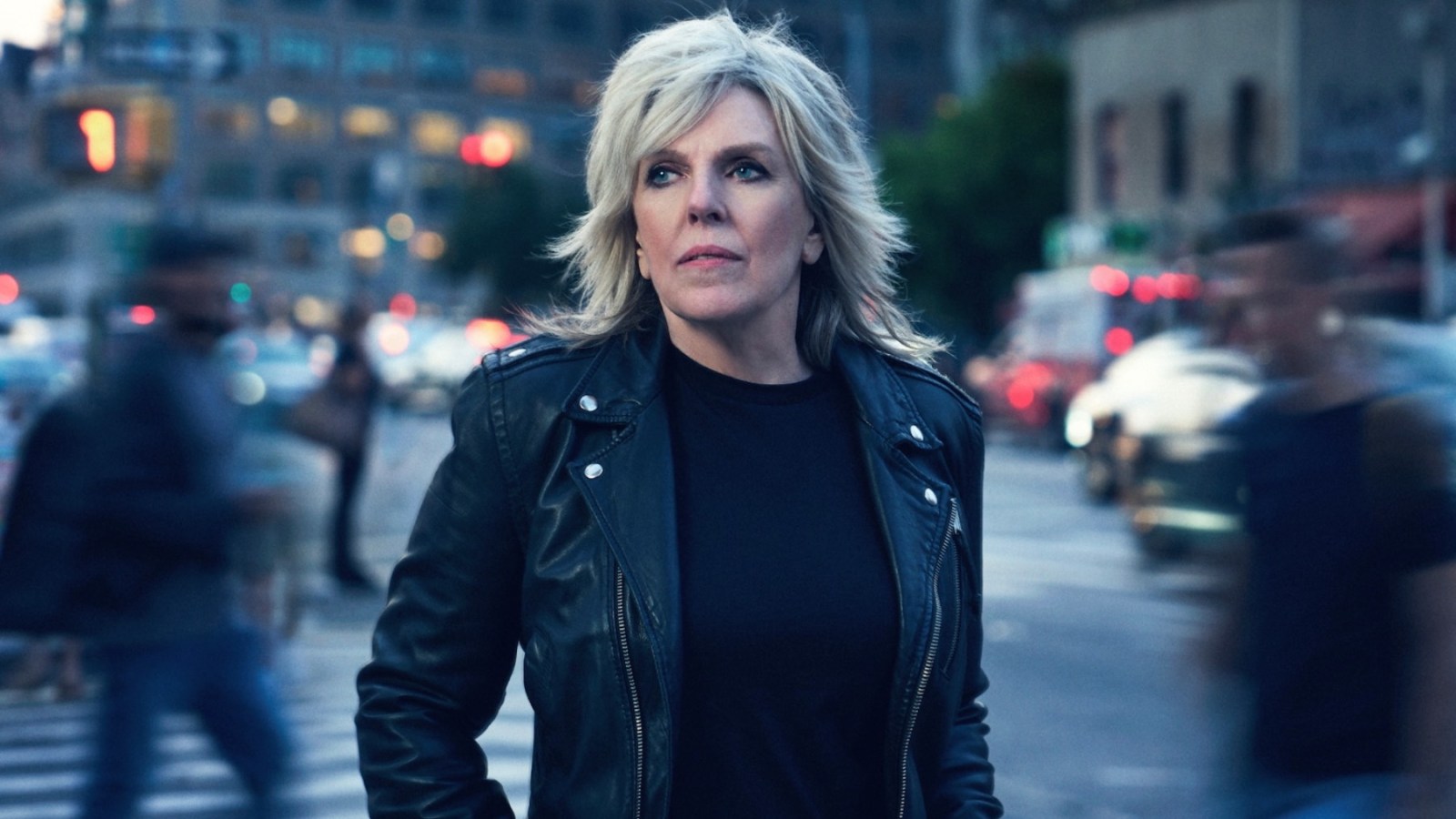

Lucinda Williams has a high bar for topical songs. “I’ve always found it somewhat challenging trying to write a song like that, as opposed to, you know, a love song,” she says. “They have to not sound dated. You don’t want them to sound too precious, or that flowery thing like, ‘let’s all hold hands and be sisters and brothers kind of thing.’”
Those exacting standards may be why it’s taken Williams close to a half-century to release her first album of explicitly political material. Out Friday, World’s Gone Wrong is a determined statement of fiery faith and righteous anger over the current administration. But it’s more than that, a treatise on the current state of the corrupted union Williams calls home, one that grounds the contemporary horrors of America in the country’s long and shameful history of racial terror and violence.
World’s Gone Wrong takes inspiration from Williams’ hero Bob Dylan as well as the Staple Singers. The latter’s spirit can be heard plainly on the album closing highlight, “We’ve Come Too Far to Turn Around,” and the group’s former lead singer Mavis Staples appears on Williams’ cover of Bob Marley’s “So Much Trouble in the World.”
“One of the things I just loved about what they did was, they were doing that gospel blues and soul mixed together, but then they weren’t afraid to step out and do a great topical song,” says Williams, who, in describing the Staple Singers, does a pretty good job of summing up the mix of musical influences that formed her latest work.
The album takes specific aim at President Trump (“How Much Did You Get for Your Soul”) while grounding its critique with allusions to the rich lineage of Black American literature, from Langston Hughes (“Black Tears”) to Jesmyn Ward, whose 2017 novel Sing, Unburied, Sing inspired Williams’ song of the same name.
World’s Gone Wrong arrives at an opportune moment for the 72-year-old, who over the past half-dozen years has emerged as a foremost songwriting influence on a younger generation of artists, from Waxahatchee to Big Thief, the latter of whom co-wrote the album’s standout, “Low Life.” Williams’ 2003 song “Fruits of My Labor” has become something of a modern standard in recent years, and singers of all ages flock to a new venue in New York that bears her name: Lucinda’s. (Earlier this week, Williams herself played a sold-out show there to promote her new record.)
Rolling Stone recently spoke with Williams about singing political music, collaborating with Big Thief, and a recent chat she had with Dylan.
I know this is a political record, but I first want to ask you about one of the only non-topical tunes: “Low Life,” a song you wrote with the band Big Thief. How did that collaboration come to be?
I’m really proud of that song. It’s probably my favorite on the album. Those guys, we did some shows together and we just hit it off, so we decided we should sit around the kitchen table and see what happens. We connected on something. It’s hard to describe, sometimes, but we all knew we were coming from similar places, artistically. When we played a show together in California, Adrienne [Lenker] learned my song “Minneapolis.” Oh my god, it blew my mind. I couldn’t believe it, the way she approached that song. They’d been in and out of Nashville, where I live, so we spent a lot of time sitting around and talking about music. I had this idea brewing for that song, “Low Life,” and somebody turned on the phone recorder. We wanted to record it together, and we tried recording it with them, me singing with them, but then I decided I wanted to cut a version with my band. So, we actually have a few different versions of it, the Big Thief version and my band version. We wanted to keep it lo-fi, that’s what I love about them.
Did you write other songs with Big Thief, or just that one?
“Low Life” was the best one that came out. There was another one, though, that I started working on that I brought to them. We have a recorded version of it somewhere on somebody’s phone.
I love how that song recalls earlier records and songs of yours. It feels almost like a counterpart to “Crescent City,” many decades later.
You’re right. I hadn’t thought of that. I was thinking about…New Orleans when I was writing it. I love doing songs that feel like an earlier, older song, but it’s still fresh enough to sound new.
At the risk of asking an obvious question, what motivated you to write such explicitly topical material for the first time?
Because our world has gone wrong: Insane, crazy, and chaotic. The period these songs were written was when Mr. Trump was first making his big entrance, and there was crazy stuff going on, on a daily basis. I had been wanting to write a good topical song for a while. I was quite the little activist back in the day. As a teenager, I got kicked out of high school for not saying the pledge of allegiance, stuff like that.
One line that sticks out is on your last song: “We are here to bear witness/To this monstrous sickness.” I love how this album places what’s happening right now within the continuum of this country’s awful history.
Many people I’ve been talking to about this album, I don’t know if they’re surprised or if they just sound like it: “Where do these songs come from? Why are you writing all this stuff now?” To me, it seems pretty obvious.
Other people have asked me if I’m afraid to sing these songs: “Why am I not afraid to go onstage?” Or, “Am I afraid?” Or, “I should be afraid.” That surprised me a little, and made me think, of course, should I be afraid? I guess I’m not, because otherwise I wouldn’t get onstage and sing them. But does that make me a fool or an idiot? Now it’s planted in my brain somewhere that some horrible thing could happen.
I’m sorry you’ve been made to feel fearful.
People think the slightest thing is going to cause someone from the FBI to walk onstage and drag me off the stage or something. That would be credible, great coverage and press for the movement! That’s how I would look at it. See! This is who you voted for. Look what’s happening.
I can imagine the headline: “‘Passionate Kisses’ Singer Dragged Offstage.”
That reminds me, one journalist said, “These songs are certainly a far cry from your early songs like ‘Passionate Kisses.’” And I was like, “Yeah, they are…”
This record quotes quite a bit of literature. What are you reading these days?
Right now I’m reading The Autobiography of Alice B. Toklas as seen through the eyes of Gertude Stein. Toklas is talking about hanging out in Paris and the painters that are coming over. Pablo Picasso is just starting out. None of them know how famous or legendary they’re gonna be yet. I remember in the Sixties, [Toklas and Stein] became kind of cultural icons. I kept hearing about them. There was some connection between Toklas and pot brownies, and all the feminists and lesbians were into them. I was like, “Okay, I need to check this out and see what’s going on here.”
You opened for Willie Nelson and Bob Dylan this summer on the Outlaw tour. What was that like?
I mean, great. I got to talk to Bob a little bit.
That’s a rarity.
Right? I know. He wanted to say hi to me. He sent the message. His people talked to my people and said, “Bob would like to say a few words to Lucinda.” It’s funny: At a certain point somebody in the press over the last few years started referring to me as the “female Bob Dylan” and Bob Dylan heard about that. I got the story through Mavis Staples. She and I were on this show together and sitting around just chatting and she had just done something with Bob and said Bob had been going around telling his bandmates and crew guys, “Hey, there’s a female Bob Dylan out there, apparently.” Like he got a big kick out of it.
So, when he came up to say hi, I said, “I know you know about this female Bob Dylan thing.” And he smiles real big and he goes, “Is that you?” I said yes. I was kind of embarrassed, because it’s kind of silly. And then — this is what blew my mind — he goes, “Well, who else would it be?” I thought, “Oh my god, that has to mean he’s heard my stuff before.” I don’t know, I’m still so in awe of him. I’ve been singing his praises since I first discovered his music when I was 12 years old.
So many younger singers these days cite you as a primary inspiration. Do you feel the level of adoration and how much of an influence you’ve become?
I do feel it. It feels very empowering and wonderful. It’s humbling. But I love it. I love searching out and listening to newer artists. I’ve got to know a few of them, like Margo Price, I’m glad to see her out there and getting more recognition.
Waxahatchee’s Katie Crutchfield loves your music so much.
Bless her heart. I love her, she’s a doll. I sat in with them at the Ryman not too long ago. We sang my song “Abandoned.”
What do you hope people take from the messages in these new songs?
I hope they don’t think I’m just sitting here griping and moaning and complaining just to hear myself talk. I’m trying to make a statement about the state of the country. We’re all hearing and seeing the same stuff. I hope I don’t turn people off by it. The majority of feedback I’ve gotten has been very positive, especially from people overseas. They’re seeing all the craziness over here and they want to know what it’s like. I get asked that question constantly: They want to know how we deal with it or why are we dealing with it. Why haven’t we done anything about it?
Are you excited to play these new songs in front of an audience?
I had a discussion with my manager about it, and he goes, “Well you might lose some fans if you keep this up.” And guess what I said: so? I don’t care. I’m going to write this stuff, I’m going to deliver it. People got all up in arms about some of the songs Bob Dylan wrote back in the day, too. That didn’t stop him. That’s the whole point of it. I feel like I have a responsibility to deliver the news, as it were. Somebody said yesterday something about how the songs are like messages, and I’m the messenger. It reminds me of slaves in the cottonfields, they would sing these songs that nobody understood except the other slaves. That’s how they communicated. They couldn’t just say whatever they wanted, because if they were heard saying that they’d get killed. So, they would have these songs as a way of literally communicating with each other. I love that idea, that music could do that.