
As Bad Bunny prepares to headline the 2026 Super Bowl, there’s a lot of speculation about what he might say onstage, and how he might use his platform to speak up about issues he cares about most. That’s because the Puerto Rican superstar has made an art out of finding creative ways to shine a light on his homeland, in particular. He’s doubled music videos as documentaries about the island’s struggles with displacement and power grid failures; he’s used important moments onstage to speak about about femicides and violence against trans women on the archipelago; and his 2025 No Me Quiero Ir de Aquí residency in San Juan was a chance to give Puerto Rico an economic boost while sharing off its culture and traditions to the world.
This has made him a lightning rod: Conservatives have blasted him ahead of the Super Bowl, with Donald Trump going as far as calling him “ridiculous.” On the other side, others have embraced his outspokenness and are hoping he does something big during his performance. Bad Bunny, meanwhile, has kept quiet the entire time, only hinting that his set — which will make history as the first Super Bowl halftime show in Spanish — will show exactly who he is and where he comes from.
The biggest indicator of how political he might get comes from his past efforts and action. Though Bad Bunny has always found ways to weave his opinions into his work since early in his career, there have been several galvanizing moments that led him here. The new book P FKN R: How Bad Bunny Became the Global Voice of Puerto Rican Resistance, by Vanessa Díaz and Petra Rivera-Rideau, is one of the most careful and thorough examinations of Bad Bunny’s political approach — and what it has meant in Puerto Rico and beyond. The book’s authors are also the professors who created the Bad Bunny Syllabus, a free online resource that aims to provide historical context for the superstar’s work and they’ve watched his career since he shot out of Puerto Rico in 2016. (They have also contributed to Rolling Stone in the past.)
In the exclusive book excerpt below, they revisit a crucial turning point in Bad Bunny’s career: when he cut a 2019 tour short to fly to Puerto Rico and join massive protests demanding the resignation of then-Governor Ricardo Rosselló, after offensive texts and evidence of corruption had been leaked to the public. Bad Bunny didn’t just become a participant in the demonstrations; he released the song “Afilando los Cuchillos” with Residente and iLe, solidifying his place as the voice of the people. Below, they outline how it all happened and how it reinforced Bad Bunny’s place as a figure of strength, pride, and resistance.
On July 24, 2019, Puerto Rican Governor Ricardo “Ricky” Rosselló stepped down after ten days of massive protests calling for his resignation. The Puerto Rican people had just forced out the governor.
The immediate impetus for the protests was the release by Puerto Rico’s Center for Investigative Journalism on July 13, 2019 (the day before the protests began), of nearly 900 pages of digital chats between Rosselló and his top aides and cabinet members. The release of the unfiltered chats, which was quickly dubbed “RickyLeaks” and “Chat Gate,” exposed messages mocking those who died as a result of Hurricane María as well as messages containing misogynistic comments, homophobic slurs, racism, and classism. After several years of extreme hardship, the chats pushed Puerto Ricans over the edge.
Bad Bunny decided to interrupt his European tour to return home to Puerto Rico and participate in the protests. “My people need me!!! And I need them,” he declared in the caption for a video he posted on Instagram on July 15, 2019. Later that year, at an event at Harvard University, Bad Bunny said he didn’t think twice about canceling his tour dates to participate in the protests. He felt it was his civic duty as a Puerto Rican and wanted to witness something so historic.
On July 18, in a caption below an Instagram video, he proclaimed: “YOU’RE EITHER WITH THE CORRUPT ABUSIVE GOVERNMENT OR YOU’RE WITH THE PEOPLE!! THERE IS NO IN BETWEEN!!! WE WON’T REST! WE WON’T QUIT! WE CAN’T FORGET! THIS IS NOT JUST ABOUT NOW! THIS IS DECADES! BUT THE ASSHOLE RICKY ROSSELLO [sic] FILLED THE CUP! AND NOW HE WILL FEEL THE FULL FURY OF OUR PEOPLE! THIS IS HISTORIC!” The fury of Bad Bunny and all Puerto Ricans had reached a breaking point. The pride of Puerto Rico was at stake.
“A mí me hizo Puerto Rico,” the artist declared in the accompanying video he posted to Instagram. Puerto Rico made me. “This isn’t about revolutionaries, this is about everybody, all Puerto Ricans, have to go out to the street no matter their race, their religion, their political ideology.”
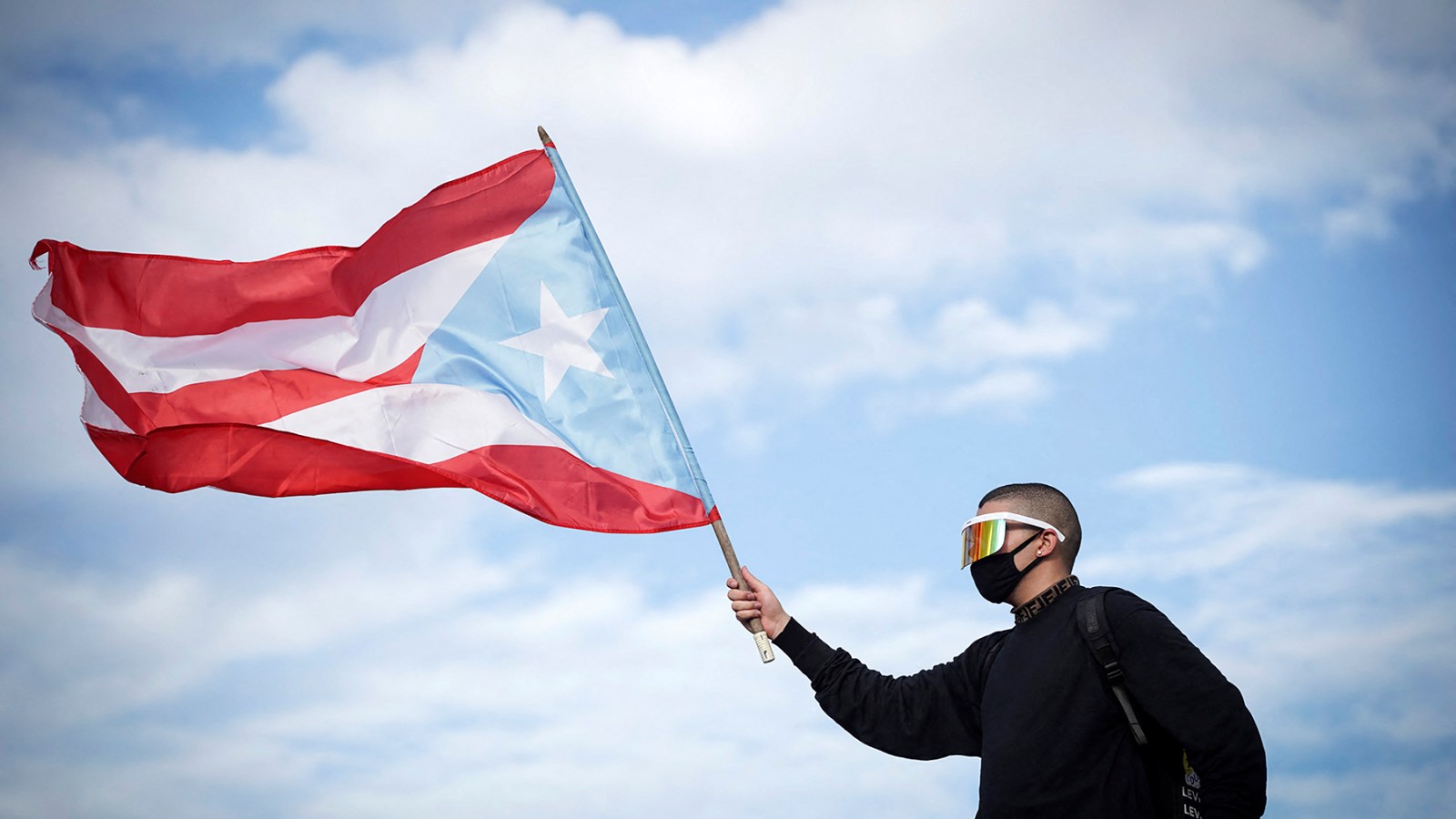
With fists up and flags waving, Bad Bunny, along with Puerto Rican musical artists Residente, iLe, and Ricky Martin, among others, showed their solidarity in the struggle from the back of a white pickup truck that carried a very large amplifier. Dressed all in black with his then-signature (pre-pandemic) mask, Bad Bunny stood atop the amplifier and brandished a Puerto Rican flag that included a light blue triangle, a version widely acknowledged as a pro-independence flag. This image of Bad Bunny became one of the most iconic of the protest and made Bad Bunny the most visible celebrity figure who participated. On July 22, the date of the largest protest that drew nearly one-third of the archipelago’s entire population, Bad Bunny was present again, proudly waving the same flag, alongside Residente, musician Ednita Nazario, boxing champion Tito Trinidad, and other prominent Puerto Rican figures.
The streets of Old San Juan filled with creative hand-painted protest signs, melodic chants simultaneously demanding and celebrating the resignation, and countless mini-concerts and dance parties featuring everything from bomba, to plena, to reggaetón. But there were also vast numbers of police in riot gear who were quick to act aggressively toward the protesters.
Bad Bunny posted to Instagram, “Let’s use this strength that we have taken and fight for what is right! Let us keep removing the corrupted politicians who abuse the people and build a better Puerto Rico! To the politicians you are a witness that the times where the people were blinded by your lies and manipulations have passed!!! […] PUERTO RICO!!! I LOVE YOU!!! I am motherfucking proud of you!!! Of us!!! I believe in my country! I believe in my generation! The generation of: YO NO ME DEJO!!!”
On July 25, 2019, protesters remained in the streets despite the fact that Rosselló had already announced his impending resignation. The protesters sought to keep up the pressure to prevent people intimately involved in Rosselló’s administration from succeeding him. The people did not trust anyone who had participated in Rosselló’s administration. After centuries of struggle and more recent economic and (un)natural disasters, the people had reached a breaking point. This historic summer of 2019 became known as the Verano Boricua, or the Boricua Summer. It was one of the most important mobilizations in Puerto Rican history, and one that would help shape the lives and attitudes of Bad Bunny and others in his generation.
ROSSELLÓ’S OFFENSIVE CHATS were the last straw for Puerto Ricans who endured extreme austerity measures, government incompetence in the wake of Hurricane María, and a series of catastrophic financial deals that made life on the archipelago untenable. In response to Rosselló’s disregard for Puerto Rican citizens prior to the release of the chat, the feminist group La Colectiva Feminista en Construcción (known locally as La Cole) mobilized its members and their collaborators to spark the beginnings of these protests. For several years prior to the Verano Boricua, La Cole had already been organizing around many issues that affected ordinary Puerto Ricans, from the imposition of La Junta to the inadequate government response to Hurricane María, to the devastating impact of gender-based violence on the archipelago.
Members of La Cole are widely recognized as the key organizers who drew the masses to the streets. La Cole spokesperson Zoán Dávila-Roldán told the New York Times that the uprising of 2019 was a “long time coming.” The chats were the final straw in a “culmination of decades of grievances with the island’s leadership.”
Among Puerto Ricans that summer, there was a dramatic sense of pride and indignation, hope and worry. The many crises Puerto Rico has experienced over the last several years all stem from the archipelago’s colonial status. Puerto Rican singer and activist Ileana Cabra Joglar, better known as iLe, told us that the chats made it impossible for people to ignore the corruption that has long plagued Puerto Rico. Puerto Ricans were sick of business as usual, and they were not afraid to take the streets. As iLe recalled, the massive crowds in the Verano Boricua protested in creative and fun ways. From yoga sessions in front of the governor’s mansion, to catchy slogans chanted alongside rhythmic cacerolazos (banging pots and pans), to bomba dancing and drumming, to perreo combativo on the steps of the cathedral in Old San Juan, Puerto Rican protesters utilized innovative tactics as the days of the protest wore on.
Puerto Rican celebrities’ participation gave important visibility to the protests, especially in the US mainstream media. For instance, on that day Puerto Rican journalist Núria Net published an article in Rolling Stone titled “Why Bad Bunny Wants Puerto Rican Youth to Take the Streets.” While the article used Bad Bunny as a hook, the bulk of the reporting was about the protests themselves and the scandals surrounding Rosselló and his administration.
Arguably the hypervisibility of these celebrities overshadowed the work of groups like La Cole, but there is no way to know if the media would have given organizers this attention without celebrity involvement. The artists themselves made it clear that the protests were never about them. Instead, like all the other Puerto Ricans protesting that July, they wanted to bring attention to the injustices Puerto Rico has suffered and to create change collectively. René Pérez Joglar, better known as Residente, told the New York Times, “People are there because they are upset, not because they want to see artists.” Artists helped draw the attention of the international media that, more often than not, otherwise usually ignored Puerto Rican matters; however, in Puerto Rico, the crowds amassed to protest, not to see the celebrities.
Young people, celebrities or not, played a huge role in making the protests successful. This generation—Bad Bunny’s generation—took to the streets to show the government and the world that enough was enough.
INTERESTINGLY, IT WAS music, and reggaetón in particular, that unified Puerto Ricans during the protests. It was profoundly palpable that, on the streets, people necessarily felt frustration, anger, and indignation alongside joy, love, and pleasure, often to the beat or chants of reggaetón hits. In our interview with iLe, she explained the role of music in Puerto Rican culture: “[M]usic in Puerto Rico is an act of resistance and we vent a lot through music, whether it be the movement in dance, but also plena, bomba, those are also our ways of letting off steam and uniting.”
Another thing that these artists contributed was the song that would become the unofficial soundtrack of these historic protests. Released at 9 a.m. on July 17, 2019, “Afilando los Cuchillos” was the piercing musical critique of the Puerto Rican government that the people wanted and needed as the mass protests continued. Whereas songs like “En La Cama” were recycled for the protest, “Afilando los Cuchillos” was created precisely for this moment, documenting not just the artists’ feelings but also what was happening in the streets of Puerto Rico in real time.
In his verse, Bad Bunny directly addresses the chats, calling attention to Rosselló’s mocking of the dead from Hurricane María and his rampant homophobia. Bad Bunny repeatedly calls for Ricky to leave, and notes that the whole world will hear of his corruption and immorality:
Y que se enteren to’s los continente’
Que Ricardo Rosselló es un incompetente
Homofóbico, embustero, delincuente
A ti nadie te quiere, ni tu propia gente
And let all the continents know
That Ricardo Rosselló is incompetent
Homophobic, liar, delinquent
Nobody loves you, not even your own people
Bad Bunny’s lines show that the audience for the rap was not only the Puerto Rican protesters but really the entire world. Like their ability to attract mainstream media coverage, these artists would use their star power to draw global attention to Rosselló’s incompetence and corruption. By expressing the anger and frustration of Puerto Ricans as Bad Bunny did in his bars, the creation of “Afilando los Cuchillos” brought further attention to the protests.
The song eviscerated Rosselló and his administration for its corruption. Residente drew a direct line between Ricky Rosselló’s corruption and that of his father, Pedro Rosselló, “Tú eres hijo del cabrón más corrupto de la historia” (You are the son of the most corrupt bastard in history). In fact, more than eighty people from Pedro Rosselló’s administration faced corruption charges, and many went to prison. Making such an explicit connection between the two Rosselló administrations underscored that the chats were but one incident in a pattern of corruption that began long before 2019.
The call for Rosselló’s ouster was further heightened by iLe’s haunting chorus in “Afilando los Cuchillos,” stating that the people were sharpening their knives so that they could “arrancar la maleza del plantío / pa’ que ninguno se aproveche de lo mío” (pull out the weeds from the crops / so no one can take advantage of what’s mine). “Afilando los Cuchillos” was a warning to would-be Puerto Rican politicians that the people were fed up and would no longer accept the type of corruption and abuses they had experienced before.
The song’s minimalist sound and flow highlighted Residente and Bad Bunny’s rap and lyrical skills, along with iLe’s unique and powerful voice. The song also came together very rapidly and with little time to beef up the production quality or instrumentals. In an episode of Residente’s YouTube show El Influence[R], Residente and Bad Bunny spoke about the writing of the song just a few weeks after the protest. Residente recalled, “Everything was honestly really fast. The song was really what we were feeling in the moment, and we put it out quickly. There was no time to think beyond the fact that we were pissed at what was happening in the country. That night we didn’t sleep.”
Turning to Bad Bunny, Residente said, “You were in Ibiza, and you flew like eight or nine hours to get to Puerto Rico. I was in the US [mainland]. We didn’t know what each of us were going to write. And it was great because we didn’t have any overlap in what we were saying.” Similarly, when we talked with iLe about the process of creating the song, she explained that it was “very spontaneous.” Residente contacted iLe and Bad Bunny to record “Afilando los Cuchillos.” Each of them recorded their parts separately around the theme of “sharpening the knives.” iLe recalled that they hadn’t heard each other’s parts until the song was all put together.
On El Influence[R], Bad Bunny explained that he sent his verse to the producers at “two in the morning, so that [the song] could come out at 9 a.m.” As Residente said in the lyrics of the song, “Esto salió temprano pa’ que te lo desayunes” (the song came out early so that you [referring to Rosselló] could have it for breakfast). Residente, Bad Bunny, and iLe released the track on YouTube, making it accessible for free to anybody anywhere in the world. Then, on the same morning the track debuted, the three hit the streets together, and immediately heard the new song everywhere they went.
Right away, the artists felt the significance and the impact of the song. “Afilando los Cuchillos” amassed more than 2.5 million views within a day of being posted to YouTube. For iLe, hearing their song at the protest affirmed that each artist had effectively used their music to make a mark on the protests in their own way.
Bad Bunny is part of a newer generation of Puerto Ricans who imagine a different kind of future for their homeland. This experience gave us the first glimpse of how Bad Bunny would become an especially forceful voice in contemporary Puerto Rico.
Interestingly, Bad Bunny’s political engagement has actually bolstered his reputation rather than hindered it. Before the Verano Boricua, he had been politically active but in much less conspicuous ways. For example, the year prior, in July 2018, hundreds of Puerto Ricans placed pairs of shoes in front of Puerto Rico’s capitol building to protest the Puerto Rican government’s claim at the time that only sixty-four people had died from Hurricane María. Each pair of shoes represented a deceased loved one. On September 21, 2024, seven years after María, Bad Bunny revealed on X (formerly Twitter) that he, too, had left his own shoes at the memorial:
Wow! For many years, every time I see a photo of this day [of the shoe protest], I look for a while to see if I can find the pair I left there. I never recorded it, nor did I post photos, nor did I publish anything; not even for my own memories. No one noticed nor realized that I went there, nor did I tell anyone. Today I finally found them in this photo. And wow! I got so emotional seeing them and my eyes watered, but more than the significance of the act itself, these [shoes] were really special to me. They were the sneakers I used the first time I was on the stage at El Choli (Farruko’s concert in 2016), a day I’ll never forget. I’ll never stop being grateful to and returning the love that this land has given me. For this reason I will always be here.
Given the massively popular nature of the Ricky Renuncia movement, Bad Bunny’s visibility during the 2019 protests increased his popularity among Puerto Ricans on and off the island. It sealed his position as a spokesperson for the archipelago, even if that was not his goal. The Verano Boricua showed that in many ways Puerto Ricans have long used playfulness and joy as part of their protest traditions. Bad Bunny would marshal this attitude, along with his unique musical fusions and clever lyrics, to continue to push the envelope.
P FKN R: How Bad Bunny Became the Global Voice of Puerto Rican Resistance, by Vanessa Díaz and Petra Rivera-Rideau, published by Duke University Press. Text copyright © Vanessa Díaz and Petra Rivera-Rideau, 2026.