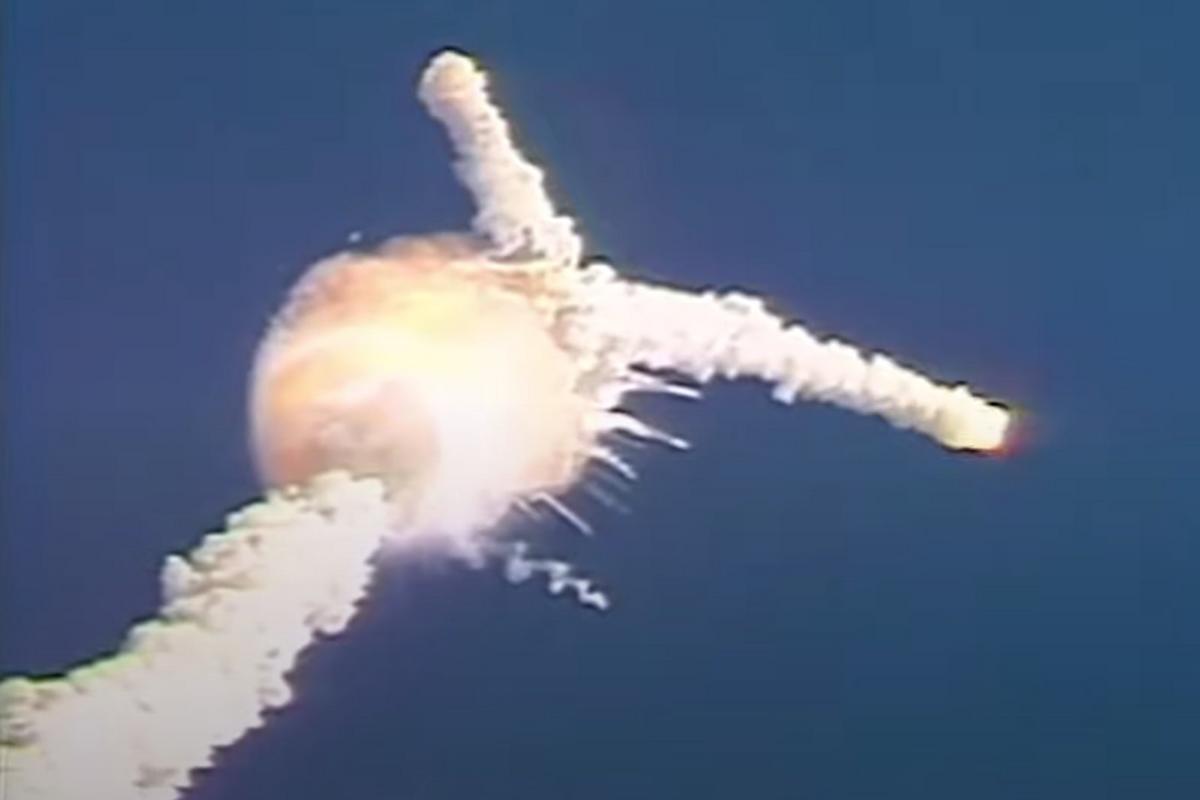

Our collective memory: A nation watched in horror as the space shutter Challenger exploded on Jan. 28, 1986, during a live television broadcast. Reality: No it didn’t, and no it didn’t.
Challenger was the second shuttle to go into space, launching in April 1983 and then completing nine previous missions, logging a little more than 63 days away from Earth. Previous milestones included the first shuttle spacewalk and conveying the first female and Black astronauts (Sally Ride and Guion Bluford, respectively) into orbit.
Ride and Kathryn Sullivan were then part of the initial crew to include two women; Marc Garneau became the first Canadian in space aboard this shuttle, too. Challenger accomplished the program’s first night liftoff and the first operational flight with Spacelab, a European laboratory that conducted experiments in microgravity.
One Challenger Passenger Was Set to Make History
Then came a cold, clear day in early 1986 at the Kennedy Space Center in Cape Canaveral, Fla. Challenger’s 10th launch was set to make history again, as teacher Christa McAuliffe became the first private citizen to go into space. Classrooms across the country set up televisions so students could mark the occasion, while McAuliffe promised to give lessons while in space.
“That in and of itself became a massive PR moment [for NASA],” Stacey Schulman, a media analyst with Katz Television Group, told CBS in 2016. “You had all of these children in school watching this moment live. It was a very defining moment.”
READ MORE: Where 50 Rock Stars Were When We Landed on the Moon
Bob Ebeling led a group of fellow engineers who expressed reservations about the liftoff, pointing to possible issues with seals on the solid-rocket boosters in such low temps. NASA administrators pushed forward, reportedly admonishing Ebeling to “take off your engineering hat and put on your management hat.”
That night, Ebeling told his wife Darlene, “It’s going to blow up.”
Watch CNN’s Live Coverage of Challenger’s Liftoff
How Challenger Became a National Memory
NASA sent the craft hurtling upward at 11:38AM ET. A minute and 13 seconds later, Challenger’s seven crew members were plummeting toward the Atlantic Ocean below.
In truth, however, few people other than interested locals and students watching satellite broadcasts in select schools actually saw this national catastrophe unfold in real time. Much of the adult viewing audience was at work. CNN carried the launch in its entirety, but cable news was still in its nascent era. Some networks cut away before the scope of this horrific day was fully known.
Instead, the images were more typically burned into our collective memory by the wall-to-wall coverage that followed.
Challenger’s crew, including Teacher-in-Space program participant Christa McAuliffe at top, second from left. (NASA, Getty Images)
Why Did the Space Shuttle Challenger Break Apart?
Worried engineers had been right: A seal on Challenger’s right-side rocket booster, designed to prevent scorching exhaust from leaking during liftoff, hardened and then failed in the frigid conditions. Gases began pouring out of the gap, eventually searing a hole in the rapidly breaching external fuel tank.
The right booster then came loose from its strut and crashed into the tank, unleashing a huge fireball as a flood of hydrogen and liquid oxygen escaped. Both of the ship’s boosters emerged amid a grotesque Y-shaped cloud.
“As it got higher and higher, the solid-rocket booster started to veer off,” Carl McNair, brother of Challenger mission specialist Ronald McNair, told the Los Angeles Times in 2011. “I didn’t know how I knew, but I knew they were gone. I stood there with tears streaming down my eyes, saying ‘Oh, my God, oh, my God’ — what so many people were saying in unison around the world.”
Did Challenger’s Passengers Initially Survive?
Many who watched news coverage, and most print accounts, assumed the shuttle itself had exploded. But Challenger instead broke apart amid pitched aerodynamic forces. The crew cabin, located in the forward fuselage, remained intact. The tail section, with a still-burning engine, and one wing of the orbiter were also initially propelled past the smoke.
Without its boosters, the cabin began to arc back from an altitude of 12.3 miles. The cabin held together as it fell, before finally crumpling upon splash down at more than 200 mph. Less than three minutes had passed.
The crew appeared to survive the massive burn off, but what happened next is still an open question. NASA contended that they probably lost consciousness when the compartment depressurized, ultimately dying due to lack of oxygen. Others say there is evidence the astronauts might have held on until impact.
Watch Ronald Reagan’s Address to the Nation
‘We Will Never Forget Them’
President Ronald Reagan was set to give the annual State of the Union address later that night. He scrapped the original speech, instead discussing the Challenger tragedy. “I want to say something to the schoolchildren of America who were watching the live coverage of the shuttle’s takeoff,” Reagan said. “I know it’s hard to understand, but sometimes painful things like this happen. It’s all part of the process of exploration and discovery. It’s all part of taking a chance and expanding man’s horizon.”
Reagan concluded the quickly assembled 650-word address with a quote from “High Flight,” a poem by the late World War II-era pilot John McGee Jr.: “We will never forget them,” he said of the Challenger astronauts, “nor the last time we saw them this morning, as they prepared for their journey and waved goodbye and ‘slipped the surly bonds of earth’ to ‘touch the face of God.'”
READ MORE: When Brian May Teamed With 10cc’s Graham Gouldman on Space-Inspired Song
Salvage operations began the next day, as hundreds of pounds of shuttle debris were carefully brought up from the sea floor. Recovered material was sealed and buried in nearby abandoned Minuteman missile silos, but most of the shuttle is still below the surface. Only crucial pieces needed for research of the disaster were retrieved. The crew cabin wasn’t recovered until March 1986, in 100 feet of water. Identifiable remains were returned to the astronaut’s families, while the rest was buried that May inside a Challenger monument at Arlington National Cemetery.
A Reagan-appointed commission investigated, leading to changes in the way NASA handled safety issues. The deadly mishap also shelved plans for further civilian flights. Every part of the shuttle project was recertified over a period years before the program returned.
A section of Challenger’s left solid rocket booster retrieved in March 1986 from the Atlantic Ocean. (NASA, Keystone/Hulton Photos, Getty Images)
Where Is the Rest of the Space Shuttle Challenger?
Thoughts of the Challenger eventually faded, aside from anniversary remembrances. Then, more than a decade after the tragedy, two barnacle-covered items washed ashore in the Cocoa Beach surf some 20 miles south of the launch site. NASA said the fragments came from the shuttle’s left-wing flap.
“It’s like a ghost came back,” Mike Stevens, head of Kennedy Space Center security investigations, told the Orlando Sentinel.
One scrap measured 6-feet wide by 13-feet long, and had presumably been inched ashore by the tides. They joined the rest of some 5,000 pieces of debris in the silos at Cape Canaveral Air Force Station, which collectively weigh in at 250,000 tons.
Flights were limited to professional astronauts until 2007, when former elementary school teacher Barbara Morgan completed a circle aboard the space shuttle Endeavor. She’d been McAuliffe’s backup 22 years before.
Music’s Worst Concert Accidents and Tragedies
The possibility for danger always lurks whenever large groups of people get together, and that’s especially true at concerts and festivals.
Gallery Credit: UCR Staff