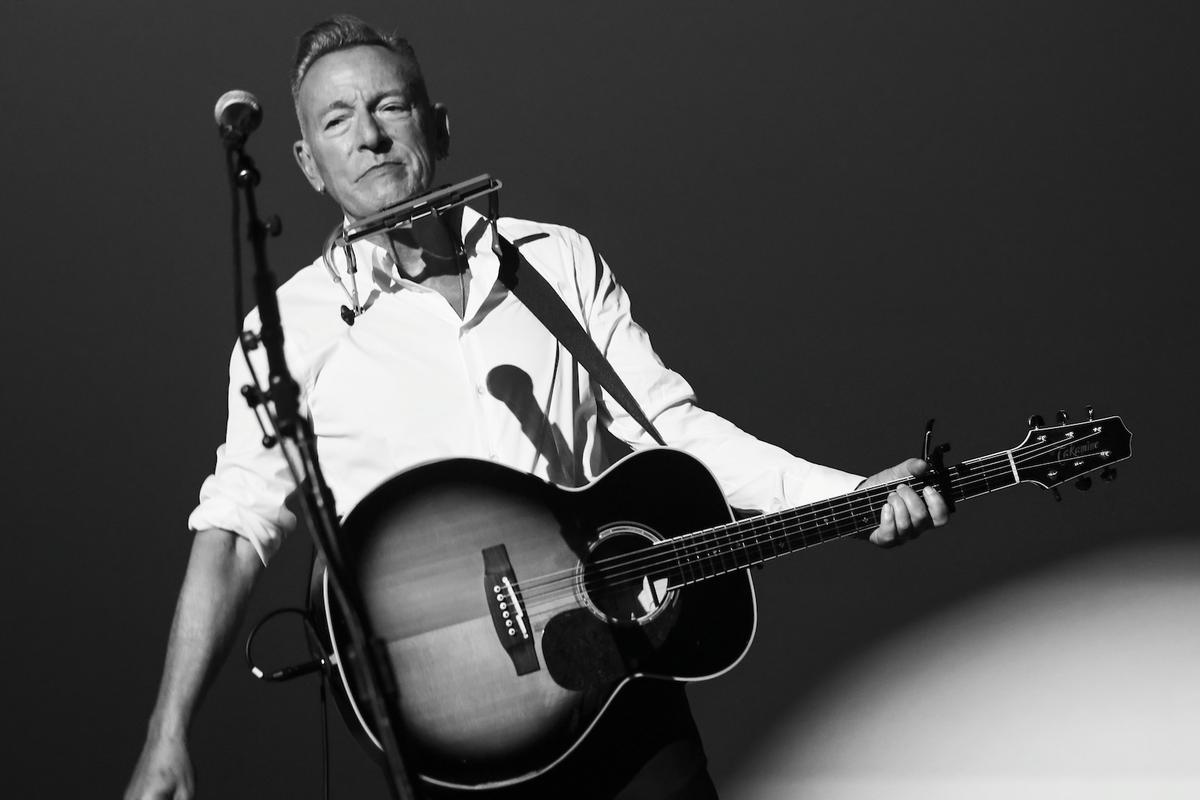

In November of 2025, Bruce Springsteen spoke at the New York Public Library’s annual gala, where he expressed a resolution: write more politcal songs.
“The writer is always at his best when he has something to push up against,” he said then (via njarts.net). “And these days there’s a lot for an American writer to push up against in this country, so that’s what I’m inspired to do in the future.”
Not long after that, Springsteen made good on his word by releasing “Streets of Minneapolis,” a new song inspired by the deaths of two local residents at the hands of United States Immigration and Customs Enforcement agents, commonly referred to as ICE.
“It’s dedicated to the people of Minneapolis, our innocent immigrant neighbors and in memory of Alex Pretti and Renee Good,” he said in a statement. “Stay free, Bruce Springsteen.”
But anyone who has been listening to Springsteen over the years knows that he’s never been the sort to shy away from politcal songwriting, having grown up admiring the work of Woody Guthrie, Pete Seeger, Bob Dylan and others.
Of course, there is no one definition when it comes to this kind of music — you know it when you hear it, usually — and there’s plenty of Springsteen songs that, depending on interpretation, could be considered political. In the chronological list below, we’ve rounded up 10 of Bruce Springsteen’s Strongest Political Songs, and there’s no denying what these are.
1. “Lost in the Flood”
From: Greetings From Asbury Park N.J. (1973)
We’re going to get to Springsteen’s most famous song about a Vietnam War veteran in just a moment, but actually he started writing about the subject back on his debut album, 1973’s Greetings From Asbury Park N.J. When Springsteen was 19, he failed the physical examination required for the draft, on account of a head injury he’d sustained in a motorcycle accident two years prior. Still, Springsteen clearly saw the impact the war had on his surrounding community, how it made people “dull-eyed and empty-faced,” as he put it in “Lost in the Flood.” But this song also nods to issues of drug addiction and religious conflict.
2. “Born in the U.S.A.”
From: Born in the U.S.A. (1984)
In some crowds, “Born in the U.S.A” is played as a sort of patriotic anthem — this was never Springsteen’s intent. Here is a story of another Vietnam veteran who saw extreme violence overseas, only to return to a homeland that seems to have no interest in helping him get back on his feet. “I think why the song has been appropriated: One is because it was so powerful; two is because its imagery was so fundamentally American,” Springsteen said in 2021 “But it did demand of you to hold two contradictory ideas in your mind at one time: that you could both be very critical of your nation and very prideful of your nation simultaneously. And that is something that you see argued about to this very day.”
3. “Roulette”
From: 1988 B-side
Springsteen recorded “Roulette” during sessions for 1980’s The River, an album he started working on in the studio in March of 1979. It was that same month that the worst nuclear accident in American history happened when the Three Mile Island Nuclear Generating Station in Pennsylvania partially melted down. Fortunately, no deaths or injuries occurred, but the messaging from local officials was confusing, leading to a panicked, distrustful community. Many fled the area entirely. Springsteen wrote “Roulette” in response, which did not make the final cut for The River, and was instead released as a B-side in 1988.
4. “The Ghost of Tom Joad”
From: The Ghost of Tom Joad (1995)
The title track to 1995’s The Ghost of Tom Joad draws inspiration from two main sources: The Grapes of Wrath by John Steinbeck and “The Ballad of Tom Joad” by Woody Guthrie. So yes, it invokes themes of the Dust Bowl era — railroad tracks and such — but Springsteen’s song moves the needle forward by taking place in the present day at the time of its writing. Here, hungry people sleep in cars while the police lead with violence.
5. “Youngstown”
From: The Ghost of Tom Joad (1995)
Also on The Ghost of Tom Joad is “Youngstown,” a song that takes an overarching historical approach. The narrative begins with a “Rust Belt” family that sees its way through the rise and fall of the steel industry, plus their men heading off to various wars. There’s a sense of strength through the song, an acknowledgement of human resiliency, but that’s not the main message. All the back-breaking work and cruel combat — where does it get a man? “Now sir, you tell me the world’s changed,” Springsteen sings. “Once I made you rich enough / Rich enough to forget my name.”
READ MORE: Bruce Springsteen Album Opening Songs Ranked |
6. “American Skin (41 Shots)
From: Live in New York City (2001)
For decades, there has been a tragic pattern in American society that involves brutal, often fatal confrontation between authoritative powers and people of color — and artists have been writing about it for just as long. In 2001, Springsteen debuted a new song called “American Skin (41 Shots),” written about the police shooting and death of a 23-year old unarmed man named Amadou Diallo by four NYPD police officers who were ultimately acquitted of all charges. The song chronicled that particular incident, but spoke to the broader issue of police brutality against people of color, which, it can be argued, has only continued to fester in the years since.
7. “Long Walk Home”
From: Magic (2007)
It wouldn’t be inaccurate to say that Springsteen’s entire 2007 album Magic is a political one — there’s a general feeling of disillusionment through the whole thing, stoked, Springsteen said to The New York Times then, by his feelings during the administration of George W. Bush. But a few tracks stand out, including “Long Walk Home.” “In that particular song a guy comes back to his town and recognizes nothing and is recognized by nothing,” he explained then. “The singer in ‘Long Walk Home,’ that’s his experience. His world has changed. The things that he thought he knew, the people who he thought he knew, whose ideals he had something in common with, are like strangers. The world that he knew feels totally alien. I think that’s what’s happened in this country in the past six years.”
8. “Jack of All Trades”
From: Wrecking Ball (2012)
If it wasn’t already evident by this list, Springsteen has always written about the plight of the common working man, even after he became a global star himself. Probably because history repeats itself, or as he put it in “Jack of All Trades”: “The banker man grows fat, the working man grows thin / It’s all happened before, and it’ll happen again.” Springsteen wrote this song not long after the 2008 financial crisis in America, which tanked hundreds of thousands of jobs. “My work has always been about judging the distance between American reality and the American Dream,” Springsteen said at the time of the album’s release, “[and] how far [apart they are] at any given moment.”
9. “We Take Care of Our Own”
From: Wrecking Ball (2012)
“We Take Care of Our Own” is another Springsteen songs that points to the idea that all that glitters is not gold in America, and one cannot always trust the powers that be to support the way they ought to. That burden often falls on the shoulders of the hard-working, underappreciated community. “There ain’t no help the cavalry’s stayed home / There ain’t no-one hearing the bugle blown,” he sings here.
10. “Death to My Hometown”
From: Wrecking Ball (2012)
“Death to My Hometown” continues the themes Springsteen presented on “We Take Care of Our Own.” This one however drives home the violence, with imagery of bombs falling from the sky and blood soaking the soil, but literal war isn’t Springsteen’s primary subject here. (Though yes, the song could certainly be interpreted that way.) Instead, the chaos and destruction serve as a metaphor for economic failure — the kind that ruins families, small business and general lives — plus a lack of accountability where it matters.
Bruce Springsteen Albums Ranked
From scrappy Dylan disciple to one of the leading singer-songwriters of his generation, the Boss’ catalog includes both big and small statements of purpose.
Gallery Credit: Michael Gallucci