
Y
ou shouldn’t know Reshona Landfair’s name.
It may have rung a bell in the 1990s if you were a fan of Chicago hip-hop group 4 the Cause, where Landfair was the spunky, pint-sized rapper of the cousin quartet. They found modest fame overseas by performing hip-hop covers of songs like “Stand by Me” and “Ain’t No Sunshine,” but were unable to translate their European success stateside.
Music ran in her family’s blood. Her aunt Sparkle was a rising R&B star who had connections to major industry players. Landfair’s father was a professional guitarist, and her mother had been part of a local gospel group with her siblings. As the sweet-voiced tween grew older, Landfair could have continued pursuing music, or forged ahead with her dreams of becoming a preschool teacher. Instead, she became known for something entirely devastating.
For the past 25 years, Landfair has lived with the painful aftermath of her name lingering in the public domain without her consent — going so far to shorten her name to “Chon” when meeting new acquaintances. As a teenager, she had her privacy ripped away when she was thrust into the national spotlight, not for her musical talents, but for the perversions of a man deemed a musical genius. Landfair became known as the 14-year-old girl in a sickening R. Kelly videotape, a documented encounter of child pornography filmed by the man she called her godfather.
Now in her early forties, Landfair still resembles the baby-faced girl who radiated joy as she performed on international stages. Standing around five-foot nothing, even in platform Uggs, her childhood nickname “Shorty” still fits. Friendly and composed, Landfair perches herself on a bouclé-covered chair in a bright studio on Chicago’s Lower West Side for what will be her first-ever interview. Pushing past any lingering feelings of self-blame, she is determined to take back ownership of her story and her name with the release of her poignant and beautifully written memoir Who’s Watching Shorty? Reclaiming Myself from the Shame of R. Kelly’s Abuse, out Tuesday.
Landfair doesn’t shy away from much in the memoir, although she’s clear this is not a tell-all or exposé. Across 240 pages, Landfair describes how she became ensnared in Kelly’s web and how the singer kept her trapped there for more than a decade through a persistent and dizzying combination of love-bombing, control, secrecy, and abuse. There were punishments, too, leaving scars and black eyes. Kelly recorded himself sadistically spanking Landfair, to the point that she would bleed. She reveals she was still a virgin in the infamous tape, her mind “soupy” from the Cristal champagne Kelly continued to feed her.
For years, Landfair had refused to watch the tape, only doing so when she agreed to testify at Kelly’s 2022 criminal trial in Chicago. She expresses her hurt, frustration and anger over how so many people and institutions failed her, including members of her own family. Landfair is incredulous how society allowed a child victim to be turned into a punchline and comedy skits. But there’s no axe to grind, no palpable feelings of hatred on the pages, even towards Kelly. This memoir is an act of purging. Of Landfair unburdeneding herself of the anchor that came with saying her name aloud. A final step in her healing.
“There’s no job that I can apply for where this isn’t the forefront of my life. There’s no relationship I could be in where this isn’t the forefront of my life,” Landfair tells Rolling Stone. “[I felt] like I was losing power. I came to a conclusion one day, and I said, ‘If I just lay all of this out, I no longer have to explain myself. I no longer have to fear the whispers about me at the table, ‘Oh, you know who that is?’ … Once I realized that I didn’t have peace or privacy [by hiding], I had to take ownership.”
Kelly’s crimes have been well documented through several trials, investigative reports, and the pivotal Surviving R. Kelly docuseries. Together, they shed light on how the 59-year-old methodically leveraged his star power to pursue underage girls for sex over decades, often videotaping the encounters. As Kelly quietly paid off victims with six-figure settlements and escaped accountability, his means of control escalated. He began cultivating a harem-like dynamic, where teens and grown women were instructed to call him “Daddy” and had to seek his permission to eat and use the bathroom. In 2021 and 2022, Kelly was convicted in two separate federal trials in New York and Illinois, respectively, on charges of racketeering, sex trafficking, producing child sexual abuse imagery, and coercing minors into sex acts. He is currently serving concurrent 20-year and 30-year sentences at a medium-security facility on the outskirts of Durham, North Carolina.
At the center of it all was Landfair. It was the illegal video of her at 14 years old that found its way to Jim DeRogatis, the Chicago Sun-Times music critic who published damning reports on the singer that helped launch the first child pornography case against Kelly. (Kelly was acquitted in the first trial.) And yet, she’s never publicly told her story until now. “There was no logic in the now. It was just my final chapter of letting this situation go, releasing myself of it, my family, and not having to play in the shadows of Robert any longer,” Landfair explains. “I just really wanted to capture the fact that I was a human being. I had dreams and aspirations. I was not just the ‘R. Kelly girl.’”
In a statement provided to Rolling Stone on behalf of Kelly, the singer’s attorney, Beau Brindley, says that “Mr. Kelly wishes Ms. Landfair all the best in life.” “At a young age, Ms. Landfair was unfairly forced into the public eye against her will by people that were intent on destroying the reputation of R. Kelly. She did not deserve that,” Brindley adds. “Mr. Kelly has no negative comments to make about her. He hopes she finds success and peace.”
So where does Landfair want to start? At the beginning.
“Once I realized that I didn’t have peace or privacy [by hiding], I had to take ownership.”
AN EARLY SCENE IN LANDFAIR’S BOOK begins with her eavesdropping on a conversation among older family members in her grandparents’ home. “R. Kelly has made us his family. And I’m grateful!” Landfair recalls her mother declaring. “That’s God! I don’t care what nobody says!”
If the whispers of Kelly’s proclivity for young girls reached the Landfairs at that time, it would have been easy to wave them off, as so many did, as salacious and unfounded gossip. “I thought he was safe,” Landfair explains. “The way he presented himself to people, especially my parents. They thought he was safe.” At the time, Kelly was putting distance between his “Bump N’ Grind” persona by embracing gospel music, releasing the soulful “I Believe I Can Fly” and publicly devoting his life to Christ. In reality, he was a wolf in sheep’s clothing, with a cross around his neck.
Kelly entered the Landfairs’ lives through Reshona’s aunt Sparkle after he took the newcomer R&B singer under his wing as his protégée. It marked the start of Kelly’s growing influence over the wider Landfair family. He subtly zeroed in on a young Reshona after meeting at a 4 the Cause performance, taking an interest in her hobbies while simultaneously ingratiating himself into her family’s life. He courted the family’s trust with generosity and opportunity. An impromptu meal at the Cheesecake Factory was the multi-millionaire’s treat. Landfair’s father, Greg, was offered steady work as a studio musician for Kelly, credited on nearly a dozen Kelly tracks from 1999 to 2010.
Excited and awed by Kelly’s celebrity, a 12-year-old Landfair began spending more time around Kelly at his recording studio and tagging along to group outings with Sparkle. When Sparkle encouraged Landfair to ask Kelly to be her godfather, it seemed like a natural progression of the close bond the family was developing with Kelly. After Landfair climbed into Kelly’s lap and rubbed his head — following the precise instructions Sparkle had given her — Kelly eagerly accepted her innocent request.
Though her parents tried their best, Landfair writes, she says they stood no chance against Kelly, a master manipulator who methodically groomed figures in Landfair’s life before he turned his focus and true intentions on her. Under the noses of her family, Kelly’s business team, and the revolving door of yes-people in his recording studio and homes, the book details how Kelly stealthily groomed the middle-schooler in plain sight. It started with secret, sexually charged phone calls and insisting that Landfair call him “Daddy” in private moments. Landfair says she initially thought of Kelly as her boyfriend, though as the abuse escalated, the term paled when trying to label the all-encompassing role Kelly played in her life. “He was always ‘Daddy,’” she says. He slowly pushed her boundaries, Landfair writes, played mind games, and convinced the teen they were desperately in love.
“Robert knowingly victimized me as a child. I was brainwashed by Robert and a sex slave,” Landfair writes. “Robert made me suicidal as a young adult. It is awful being me. I gave up my family for him. Nothing else mattered back then. And I still don’t know why … by the time I was 16, 17 years of age, the only thing that mattered was him. I was manipulated, and independence didn’t seem like an option. Robert shattered me.”
The role Landfair’s family members, including Sparkle, played in fostering her relationship with Kelly, even as whispers of their relationship became screams, is difficult to reckon with. Landfair does not excuse her family’s decisions; instead, she contextualizes them, laying out a dangerous combination of willful ignorance, financial dependence, and shame. “I think the first stages of my parents was utter, naive denial,” Landfair says.
There were points Landfair wishes her parents could have had the discernment to intervene. In one passage, she writes about her father praying over her, rebuking “every spirit of perversion and deception” that their family might encounter, not yet knowing it had already arrived at their doorstep. “I wish your intuition had kicked in when I seemed uncomfortable and would refuse to speak to or even acknowledge any man who was not you or Robert,” Landfair writes. “I wish you had been suspicious enough to catch Robert in the act of making sneaky sexual gestures toward me while I fidgeted, unable to respond and afraid someone might see.”
By the late 1990s, Sparkle began ringing the alarm bell. “Your Aunt Stephanie has been in touch with the Illinois Department of Children and Family Services,” Landfair writes of her parents confronting her for the first time about her relationship with Kelly. “They’ve launched an investigation. Seems she thinks you may be involved in some indecent sexual activity at Robert’s studio and that it’s with Robert. What do you have to say about that?”
Kelly had been preparing her for this moment. Landfair describes in the book the extensive coaching he’d put her through, drilling her like a military sergeant until she could smoothly lie about aspects of their relationship. “It was long days of rehearsals, it was long days of grooming,” she says. “It was until you got it right. Until he felt like you could walk out the door and represent it the way he translated it. It would take that long.”
Her parents accepted Landfair’s rehearsed denial. But when given undeniable proof of Landfair’s relationship with Kelly a few years later with the emergence of the videotape, they were in a nightmare scenario. Both Kelly and Landfair were adamant about their love, and a 17-year-old Landfair was so deep under her abuser’s spell that her parents had no hope of successfully luring her away from Kelly. Instead, they knuckled down and tolerated the situation, which neither parent fully understood the scope and depravity of.
“I’m not saying my parents did not have shortcomings,” Landfair says. “However, if you weren’t the parent of a Reshona and in that position to have to choose … my dad did not want to be the person that we saw on Lifetime, banging on windows and throwing rocks and trying to get his daughter back. He was my security blanket, if you want me to be honest.”
“I just really wanted to capture the fact that I was a human being. I had dreams and aspirations. I was not just the ‘R. Kelly girl.’”
Whatever protection her parents tried to offer existed inside a reality Kelly controlled. As Landfair details in the book for the first time, the years between 2002 – when Kelly was arrested on a 21-count indictment pertaining to child pornography charges – and his 2008 acquittal were spent under a fog, with Kelly keeping Landfair under his thumb even more than before.
In the book, Landfair likens the isolating period to being under house arrest, though that’s arguably too forgiving a description given the hostage-like conditions she writes about living under. Paranoid that Landfair might turn on him, Kelly tightly controlled who she could see. He bounced Landfair between various locations, including his tour bus, recording studios, and cramped office spaces. “None of which were bedrooms,” Landfair clarifies. “There were times where I would be sleeping on a chiropractor table. There were times when I would be sleeping in the closet.” Kelly’s lackeys dropped off meals, often delivered with a specific code knock on the door. Even going to the bathroom required Kelly’s or someone else’s approval.
And yet, despite the supposed secrecy of her whereabouts, Landfair was never truly hidden. Kelly would host parties at these spaces, and a confined Landfair would listen from wherever she was being kept. Her father would secretly steal away and knock on her door. “Everyone knew how he operated, so it feels worse than what he made it look,” Landfair explains. “You might see me in a different space or [Kelly] might have me come out, so that it looks a little bit more normal, but I’m living in the garage where the gym is built at a point. I’m living in the office space in the house with just a couch and a little handy chair. I’m just listening to music, I’m sitting at a desk, I’m in here really pretending, trying to figure out if it’s daylight, if it’s sunlight.”
Not testifying in the 2008 trial has left Landfair with obvious regrets. Succumbing to Kelly’s demands, sick with shame, and fearful that she’d be the person held responsible for sending Kelly to prison, Landfair swore under oath to a grand jury that the girl in the video wasn’t her. As Kelly’s team weaponized Landfair’s refusal to testify, she writes that she was just outside the courthouse, kept in a bedroom on Kelly’s parked tour bus.
“I didn’t have the TV on, of course,” Landfair writes of her spending her time in the small space aimlessly waiting for Kelly. “Robert wouldn’t let me follow the trial, just like he’d forbidden me from watching his televised BET interview with Ed Gordon or listening to his radio interviews since his indictment six years before. I wasn’t allowed to watch, listen to, or read anything that could make me question things: not the news or trending social media stories. So, even though I was two hundred feet from Robert, I might as well have been two thousand miles away.”
Although more than a dozen witnesses, including some of Landfair’s relatives and friends, testified that it was her on the “hateful” tape, jurors would cite her looming absence as a major factor in acquitting Kelly. (Three of Landfair’s relatives testified in Kelly’s defense, claiming they didn’t recognize the girl on the tape as Landfair.) Nearly 20 years later, it still weighs heavily on Landfair. “I must live with the choices my parents and I made, and with Robert’s abuse of other women and girls who met him after he was acquitted,” Landfair writes. “I’m not saying we did the right thing. And I regret that so many more people were hurt by Robert because he wasn’t stopped in 2008.”
Landfair likens Kelly’s control over her life and decisions to “brainwashing.” His wants suddenly became her desires, too. The weight of Kelly’s control over Landfair’s life was absolute. She sacrificed everything for him. Tears spring to her eyes when asked if she had regrets about quitting 4 the Cause at Kelly’s behest. “That was the last part of me that went; that was the last thing I had,” she says. “School was already done, I was not doing basketball anymore, not going to proms, so 4 the Cause was the last thing to go. That was the one thing that was good about me that I could always resort to, and it was a tug of war. That was probably the first time I can remember challenging him, because I did not want to do that.” Being in the studio to record the audiobook version of her memoir brought that dormant spark back to life. “I definitely miss music,” Landfair says. “I don’t know where I would fit into it at this point, but I do.”
BY THE TIME LANDFAIR was 26 years old, she had managed to untangle herself from Kelly’s grip, though there were strings like his limited financial support still attached. Then there was the fear. Landfair remained paranoid that any new friends or colleagues would recognize her name and whisper behind her back about the unnamed trauma she was just beginning to unpack.
“With every job I applied for, friend I made, and date I went on, I was always plagued with worry,” she writes. “Did they know? Would they judge me? I was tired of living in the shadow of Robert’s secret that had become mine. I had to purge.”
When the Lifetime docuseries Surviving R. Kelly premiered in January 2019, she was blindsided. She had only heard fleeting talk of some project in the weeks leading up to a trailer dropping online. Seeing Sparkle cry about Landfair’s experience — something that Landfair hadn’t fully come to terms with — was discombobulating and infuriating.
In a state of panic, Landfair admits she reached out to Kelly for answers, only to receive sneers and deflection. She was more taken aback by the response from Derrel McDavid, Kelly’s longtime business manager and accountant. “Don’t hurt him,” McDavid reportedly begged her. “Don’t hurt Robert. I know there were a lot of things that happened that, you know, shouldn’t have or that could have been avoided. But don’t hurt him.”
The irony of McDavid’s plea to Landfair was astounding. This was the same man who was accused of helping coordinate payoffs to Kelly’s accusers ahead of the 2008 trial. He had served as a mediator in a meeting between Kelly and Landfair’s father, where the singer confessed to secretly having a relationship with an underage Landfair for the past three-plus years. Don’t hurt Kelly? What about the hurt already caused to her? “Nobody ever considered me,” Landfair says matter-of-factly. “Robert was the more valuable person in the equation.”
There are only a few moments during the 90-minute conversation when Landfair becomes emotional: Discussing memories of her father, who died in 2021, a year-long estrangement from her mother mandated by Kelly, and mourning having to walk away from her early music career. When the topic turns to the 2008 criminal trial, her tears come hot and fast. Her voice cracks in pain, anger, and heartbreak at how thoroughly the system and those around her failed her.

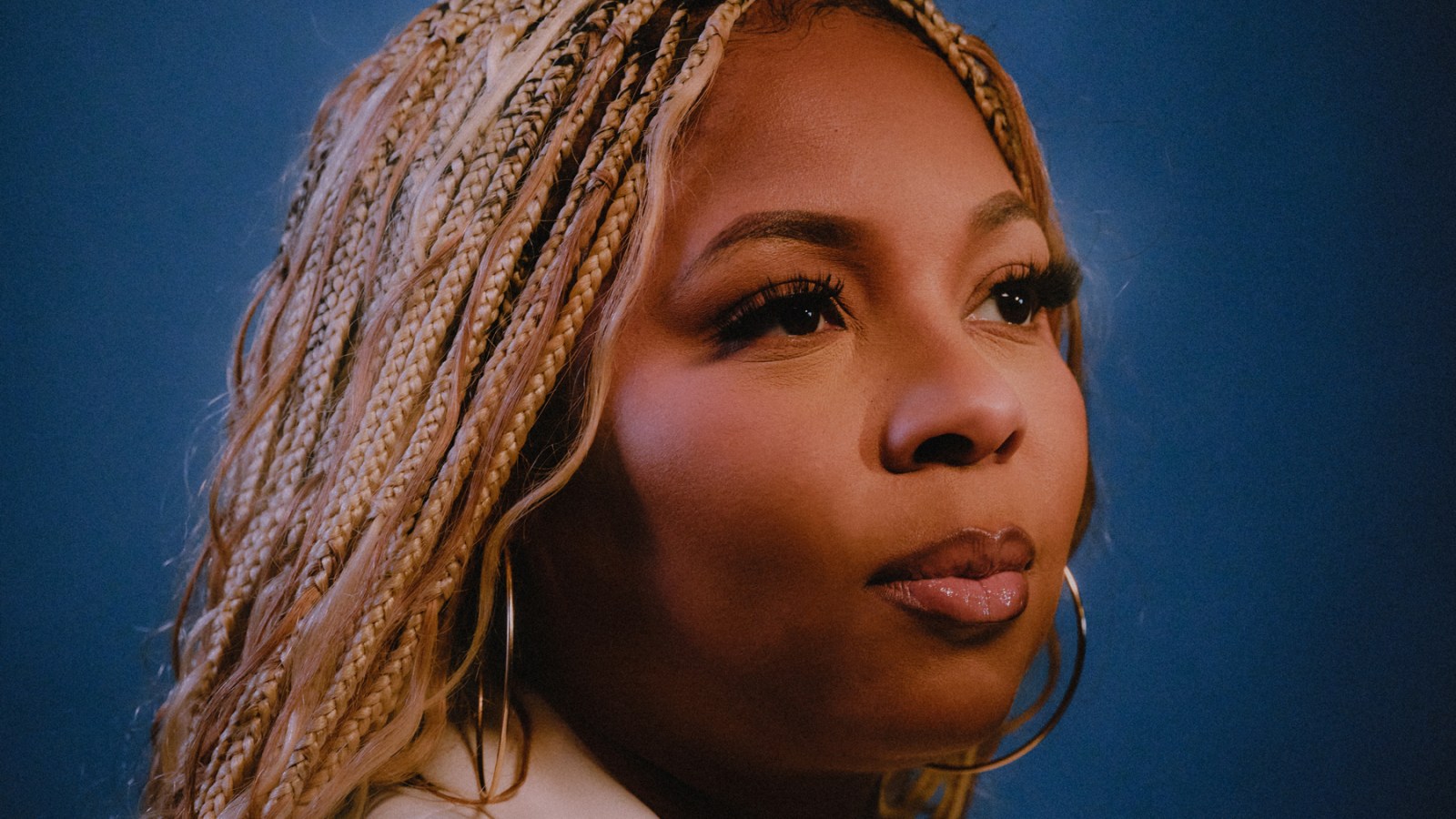
Reshona Landfair in Chicago, January 2026.
Akilah Townsend for Rolling Stone
In hindsight, it’s unfathomable how widely unprotected Landfair was. Community-held stigmas around Black girls being “too fast” or “foolish” when predatory older men took advantage of their innocence made Landfair believe Kelly’s pedophilia was something she was responsible for, keeping her silent. When bootlegged videotapes of her abuse were being sold on street corners for $10 a copy. When national newspapers bypassed the now-standard journalistic standards not to disclose the names of sexual abuse victims or minors and used her full name — often misspelled — in their reports. And when Chicago’s Cook County prosecutors failed to protect Landfair as a victim, choosing to show her face in open court as they played the explicit and degrading 26-minute tape numerous times.
“If I were a Caucasian girl who got peed on, there would have been a different outcome. Everybody would have looked at things completely different,” Landfair says. “It wouldn’t have been no showing her body in a courtroom. It wouldn’t have been the skits and being the mockery of the town …. I’m not here to pull a race card or anything like that. I’m just speaking from my heart. And Black girls, we develop fast. We’re a little bit curvier, we wear our hair differently, and that becomes our fault if something like this happens. For so long, …I believed it was something I did. The entire time, nobody treated me the way I was supposed to be treated. To the public, I was a mockery. I was never a victim, so I never saw myself as a victim.”
But when Kelly was indicted again in 2019, Landfair was ready. Testifying under a Jane Doe pseudonym at the Chicago trial in August 2022, Landfair willed herself to look directly at Kelly. “He gave me a nasty look,” Landfair recalls, still in slight disbelief. “When he gave me that look, it was confirmation that I was sitting in the right place. I felt like, ‘the nerve of you to hear all of these things that you have taken somebody through, and for you to still feel like I owe you something, or I’m disloyal? …That’s what made it easy for me, because I’m like, ‘You don’t get it. You think you’re untouchable. You’re still lying.’
“I pray that now that he’s had some time to think, that he sees his actions as wrong,” Landfair adds. “I really think that, in his mind, he’s looking at it like, “You wanted me to do this. You allowed me to do that. I didn’t force you.’ Well, actually, you did.”
“Nobody ever considered me. Robert was the more valuable person in the equation.”
CHICAGO WAS KELLY’S UNCHECKED playground. He was a local hero, one of the most successful artists to emerge from the city at a time when only icons like Sam Cooke, Curtis Mayfield, Nat King Cole, Quincy Jones, and Chaka Khan rivaled him in fame and accolades. Kelly firmly rooted himself in the community. He could be spotted playing pick-up basketball, attending local high school games, or just hanging out with his entourage at the Rock ‘N’ Roll McDonald’s. And even now, four years after juries across two states confirmed the testimonies from survivors by finding Kelly guilty on a range of heinous charges, Kelly’s presence looms over his hometown.
Minutes before my interview with Landfair, a Lyft driver pulls up to an icy curb to take me to the studio where we are scheduled to meet. Kelly’s 2000 song “Bad Man” confronted me as I buckled myself into the rear seat. As Kelly belted out the chorus, the oblivious driver made easy conversation about his lunch plans, calling in a hibachi order mid-ride. The song wasn’t an intentional choice; it was part of the Chicago-themed playlist pumping from the radio system, but the casualness of Kelly’s music still being part of people’s everyday lives was a jolting wake-up call for someone who was passing through.
Landfair is unfazed when I mention the interaction. Instead, she nods knowingly. “It’s everywhere I go,” she says. “I work in a high school, and when I walk into work every morning, R. Kelly is playing on a loudspeaker before I get my day started. I just go into my little shell, and eventually it passes. That’s just how I handle it.” Landfair understands fans who can’t easily write off Kelly’s music in the wake of his conviction. “The music itself is his gift,” she explains. “That’s the good part of him. That’s the creative side of him. So, I can’t take away a fan’s memory of what they felt when that song came out.”
There have been moments when Landfair contemplated moving away from Chicago, putting physical distance between a city that still openly supports Kelly and is ground zero for some of her most painful memories. For now, she’s firmly planted in a place she genuinely loves. It’s where she was born and raised. It’s where her family is. It’s the home she’s created for herself and her son. Why let Kelly claim anything else in her life? “I’m still here,” she says. “I still walk with my head held high.”
In the years after removing herself from Kelly’s orbit, Landfair has rebuilt her life. She lights up while highlighting her job at a school-based health center, and describing the next steps for the non-profit she founded, Project Refine, a mentor program for young women. “This is the beginning of my freedom officially,” Landfair exhales. “Through this book, I feel like I’m a channel. I’m looking forward to sharing my healing process and my testimony and letting that be freeing for somebody else.”
The nerves that Landfair had been suppressing only show as the interview winds down, letting out a relieved and shaky breath after answering the last question. It’s been a long, hard-fought road to where she feels emboldened to step past the shame and self-blame of being in Kelly’s shadow. “I was afraid to say my own name and be who I really was to work, to friends,” she says. “I created Chon, and that’s what I’ve been going by.”
She doesn’t hesitate as she continues her train of thought, though a smile creeps into her voice. “But,” Landfair adds, “I’m here today as Reshona.”