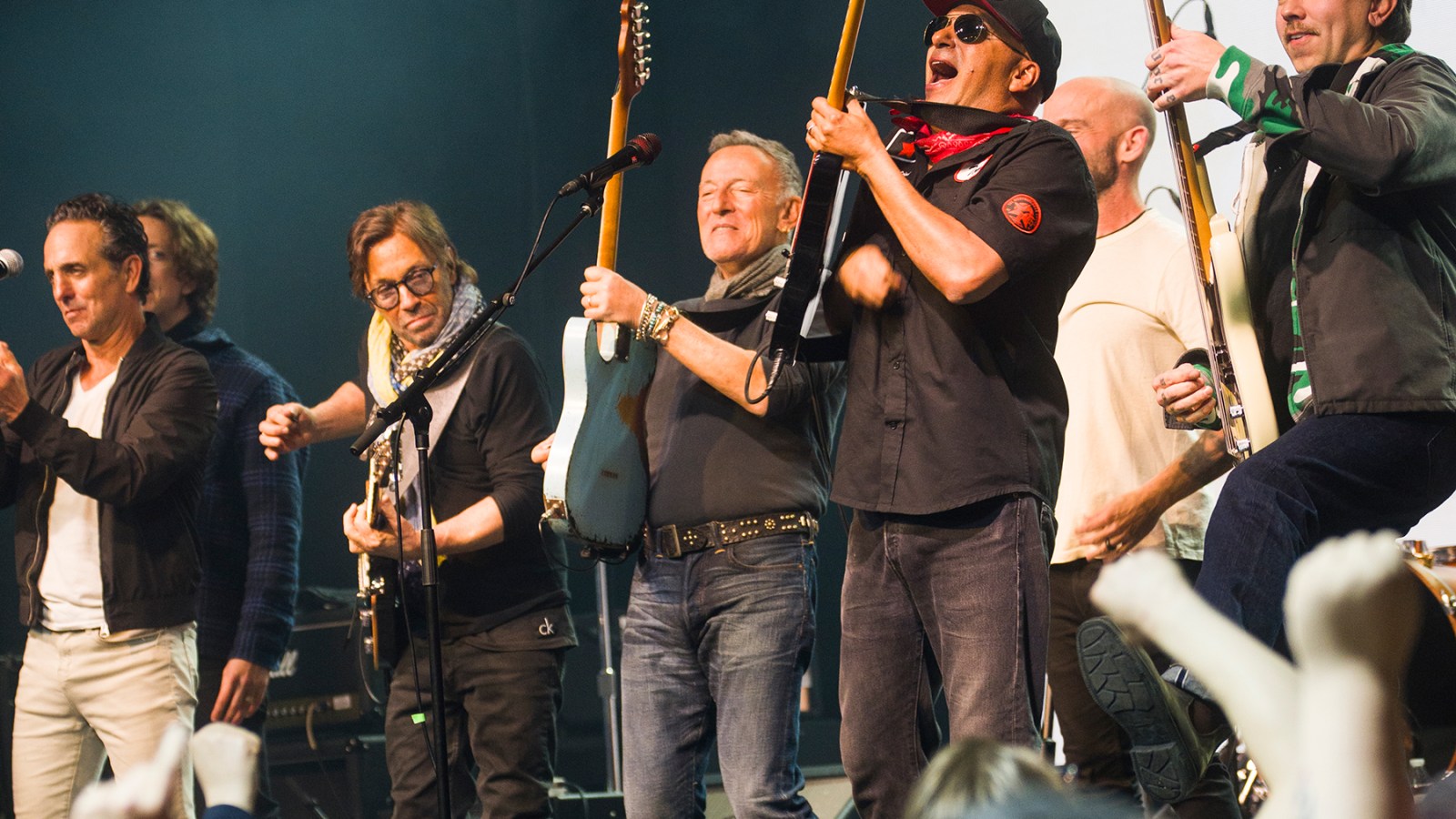

Federal officers killed 37-year-old ICU nurse Alex Pretti in Minnesota early on Jan. 25, and that same afternoon, Bruce Springsteen sat down in Colts Neck, New Jersey and wrote a furious response, “Streets of Minneapolis.” He recorded the song the next day, got it out to the world almost instantly, and was onstage in Minneapolis performing it with Tom Morello by the end of the week. He wasn’t alone, either. Just as Springsteen’s song dropped, Billy Bragg released “City of Heroes,” and soon after, NOFX came out of retirement to drop “Minnesota Nazis,” reworking their earlier “Huntington Beach Nazis.”
On the latest episode of Rolling Stone Music Now, we talk about Springsteen’s song and the other Minneapolis responses, and look back at the long history of instant-reaction protest songs. To hear the podcast episode, listen on Apple Podcasts or Spotify, or just press play above. Here are some of the other songs discussed in the episode:
“Deportee (Plane Wreck at Los Gatos)” — Woody Guthrie (1948) When a plane carrying migrant farm workers being deported from California to Mexico crashed in January 1948, news coverage listed the U.S. crew members by name but referred to the 28 Mexican passengers only as “deportees.” Guthrie instantly wrote his response, insisting on the humanity of the immigrant victims, and Pete Seeger helped bring the song to full fruition a decade later.
“Mississippi Goddam” — Nina Simone (1963) After the 16th Street Baptist Church bombing killed four young Black girls in Birmingham, Alabama in September 1963, just months after the assassination of Medgar Evers, Simone said she considered picking up a gun. Instead, she sat down and wrote this classic in under an hour. Its unnervingly jaunty melody pushes against devastating lyrics, and Simone kept updating its verses as new American horrors demanded acknowledgment.
“Only a Pawn in Their Game” — Bob Dylan (1963) Dylan wrote this song within days of Medgar Evers’ murder in June 1963, and performed it at the March on Washington that August, just before Martin Luther King Jr.’s “I Have a Dream” speech. The lyrics went beyond Evers’ white-supremacist killer, indicting an entire system that brainwashed poor white Southerners into hatred.
“For What It’s Worth” — Buffalo Springfield (1966) Stephen Stills wrote this song right after the Sunset Strip curfew riots, and managed to capture something larger in that moment, channeling an entire generation’s emerging sense of itself.
“Ohio” — Crosby, Stills, Nash & Young (1970) After National Guardsmen shot and killed four unarmed students at Kent State on May 4, 1970, Neil Young saw a Life magazine photo of a teenage girl screaming over one of the bodies and immediately wrote this song. CSNY recorded it within days, and it was on the radio within a week, helping galvanize a nation’s fury against Nixon and the Vietnam War.
“Abraham, Martin and John” — Dion (1968) Songwriter Dick Holler wrote the track in ten minutes after Robert Kennedy’s assassination in June 1968, connecting that murder to the recent killing of Martin Luther King Jr. and reaching back to JFK and Lincoln. The doo-wop legend Dion recorded the definitive version, but it was covered by artists from Marvin Gaye to Whitney Houston.
“Be Free” — J. Cole (2014) Just six days after officer Darren Wilson shot and killed unarmed teenager Michael Brown in Ferguson, Missouri, J. Cole released this raw, emotional track.
“Afilando Los Cuchillos” — Bad Bunny, Residente & iLe (2019) When leaked messages revealed Puerto Rico’s governor, Ricardo Rosselló, making homophobic slurs and joking about Hurricane Maria victims, Bad Bunny, Residente, and iLe wrote and recorded this bilious track in a single day. Rosselló resigned a week later.
“The Bigger Picture” — Lil Baby (2020) Lil Baby released this track shortly after the death of George Floyd: “I find it crazy the police’ll shoot you and know that you dead, but still tell you to freeze.” From a street rapper not known for overt political statements, it landed hard, debuting at No. 3.
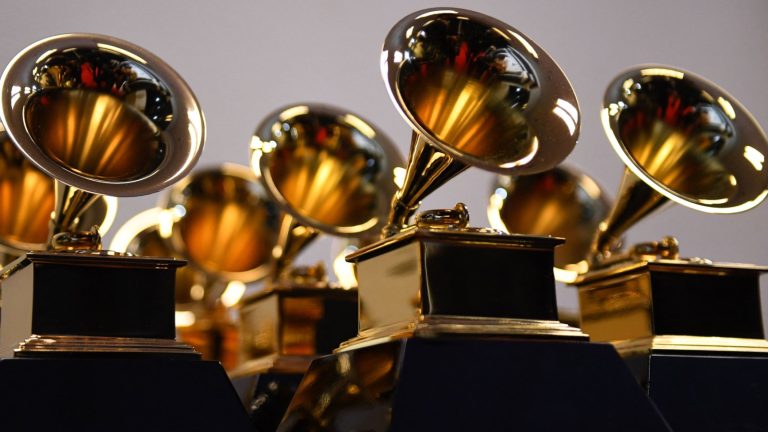
“I Can’t Breathe” — H.E.R. (2020) The multi-instrumentalist released this song in the wake of George Floyd’s death taking those three devastating words as her title and tracing Black suffering all the way back to slavery. It won Song of the Year at the Grammys.
Download and subscribe to Rolling Stone‘s weekly podcast, Rolling Stone Music Now, hosted by Brian Hiatt, on Apple Podcasts or Spotify. Check out nine years’ worth of episodes in the archive, including in-depth interviews with artists including Mariah Carey, Bruce Springsteen, Questlove, Halsey, Missy Elliott, Dua Lipa, Neil Young, Snoop Dogg, Brandi Carlile, Phoebe Bridgers, Yungblud, Rick Ross, Alicia Keys, the National, Brian May, Roger Taylor, Ice Cube, Taylor Hawkins, Willow, Keith Richards, Robert Plant, Killer Mike, Julian Casablancas, Sheryl Crow, Johnny Marr, Scott Weiland, Liam Gallagher, Alice Cooper, Fleetwood Mac, Elvis Costello, John Legend, Donald Fagen, Charlie Puth, Phil Collins, Justin Townes Earle, Stephen Malkmus, Sebastian Bach, Tom Petty, Eddie Van Halen, Kelly Clarkson, Pete Townshend, Bob Seger, the Zombies, and Gary Clark Jr. And look for dozens of episodes featuring genre-spanning discussions, debates, and explainers with Rolling Stone’s critics and reporters.