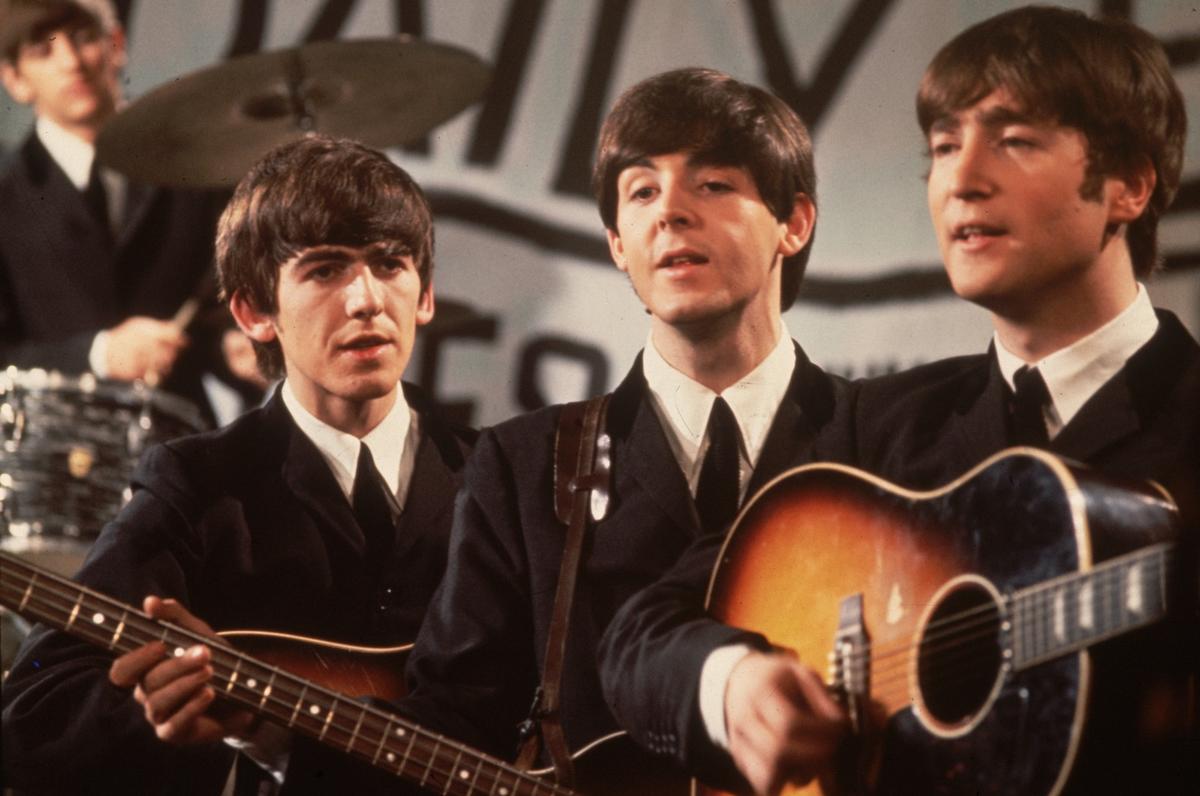

The Beatles‘ penchant for rock is baked right into their winkingly rhythmic name. Still, they were already unplugging for rootsy acoustic songs while Beatlemania was still raging in 1964.
John Lennon, Paul McCartney and George Harrison would continue exploring these quieter creative spaces throughout their time together in the Beatles – and beyond. The following list of top 20 acoustic Beatles songs spans the gamut from Hard Day’s Night and Rubber Soul through the White Album and Let It Be.
As their imaginations took flight, the Beatles wound up combining acoustic elements with influences ranging from classical flourishes to exotic world music. We stayed away from songs that weren’t strictly acoustic like “Here Comes the Sun” from Abbey Road, the White Album’s “Mother Nature’s Son” and “Across the Universe” in both of its released forms.
What are the Top Acoustic Beatles Songs?
“Here Comes the Sun” certainly starts off as an acoustic Beatles song, before Harrison adds a turn on an embryonic synth and producer George Martin surrounds it all with violas, cellos, flutes and clarinets. The Beatles similarly embellished “Mother Nature’s Son” and “Across the Universe.” “Yesterday,” on the other hand, gets a pass because it’s all strings.
READ MORE: 20 Beatles Songs That John Lennon Hated
We also limited our rankings to original songs and complete takes. So, despite Harrison’s deft acoustic turn, “Til There Was You” from With The Beatles was left off because it’s actually a cover from the stage production of The Music Man. “Anna (Got to Him)” from Please Please Me was also a cover song, written by Arthur Alexander.
John Lennon tunes an acoustic guitar for an early-era Beatles performance. (Max Scheler / Redferns, Getty Images)
Don’t bother looking for throwaway snippets like “Her Majesty” from Abbey Road and “Maggie May” from Let It Be, though other songs from those LPs made the cut. Our countdown of top 20 acoustic Beatles songs also includes favorites from Beatles for Sale, Help!, Revolver and various stand-alone singles.
No. 20. “Michelle”
From: Rubber Soul (1965)
This finger-picking Chet Atkins-influenced song was one of the first ever written by Paul McCartney, who originally played it upside down on his first guitar since it wasn’t left-handed. McCartney had been pretending to speak French to pick up girls at parties since his school days. Same thing here. That is, until the wife of a friend of John Lennon’s who actually worked as a French instructor helped McCartney with the lyric.
No. 19. “Long, Long, Long”
From: White Album (1968)
Sparked by Bob Dylan‘s “Sad Eyed Lady of the Lowlands,” George Harrison created a quietly involving musical dreamscape. The rest, however, is a mystery: Is he in love with some girl? Has he found God? Why won’t he speak up? It’s easy to imagine the Beatles placing this song between “Helter Skelter” and “Revolution 1” to provide a moment of calm. But then Ringo Starr‘s eruptive fills shake us all awake.
No. 18. “Yes It Is”
From: B-side (1965)
John Lennon’s anguished cries give away more than this simple ballad ever could. There’s a depthless darkness in his voice. Still, “Yes It Is” gets docked several spots because it’s basically a rewrite of “This Boy,” a track with the same 12/8 time signature found later in our list of Top 20 Acoustic Beatles Songs. Harrison also happily explores a new volume-pedal guitar effect that he’ll put to even better use on “I Need You.”
No. 17. “I’ll Follow the Sun”
From: Beatles for Sale (1964)
Turns out, he’d be following for almost four and a half years. McCartney began sketching out this song as early as 1958. Actual bootleg recordings with the Quarrymen, Lennon’s pre-Beatles group, date back to April 1960. But “I’ll Follow the Sun” wouldn’t be released until they started desperately casting about for material to complete an album amid the flurry of activity surrounding Beatlemania.
No. 16. “For You Blue”
From: Let It Be (1970)
Harrison once accurately described this blues-based paean to then-wife Pattie Boyd as “a simple 12-bar song following all the normal 12-bar principles – except that it’s happy-go-lucky!” Same with the solo, provided by Lennon and memorably encouraged (“go Johnny, go!”) by Harrison. Lennon used a shotgun shell on a lap-steel guitar to get the song’s rootsy wobble just right.
No. 15. “I Will”
From: White Album (1968)
It somehow took McCartney, Lennon and Starr 67 takes to nail “I Will,” one of this LP’s simplest-sounding tracks. McCartney had actually arrived at the studio with two song ideas. The other was informally called “Can You Take Me Back,” and would eventually find a home on the White Album as a heavily edited untitled coda for “Cry Baby Cry.” They share the same gentle vocal style, offhanded percussion and warm guitar.
No. 14. “Things We Said Today”
From: Hard Day’s Night (1964)
McCartney started writing this during a vacation in the Virgin Islands with then-girlfriend Jane Asher, Starr and his future wife Maureen. Problem: He was down below during a voyage onboard a yacht called “Happy Days,” and found himself nearly overcome amid the ocean swells and engine smells. McCartney finished “Things We Said Today” back up top in the sun, though the mostly minor chords belie darker emotions.
No. 13. “Girl”
From: Rubber Soul (1965)
Lennon allows himself to experience both the pleasure and the pain of love, exhaling with a barely contained sense of sexual anticipation. (The sighs were dubbed separately.) McCartney added an exotic musical flourish that dated back to a 1963 trip to Greece. But there’s also some embedded locker-room humor: Lennon later revealed that the insistent “tit-tit-tit-tit” backing vocals were not placed there by accident.
No. 12. “Here, There and Everywhere”
From: Revolver (1966)
McCartney has admitted that “if pushed” to pick his favorite Beatles song, he’d select “Here, There and Everywhere.” He had two unlikely inspirations: McCartney wrote it in the style of Fred Astaire and sang it like Marianne Faithfull. “I was a big fan of Fred Astaire,” he admitted on the iHeart podcast McCartney: A Life in Lyrics. “I still am.” They only needed four takes to get the basic track down.
No. 11. “This Boy”
From: B-side (1963)
Lennon was trying for a harmony piece, in the style of Motown’s Smokey Robinson. The lyrics, written in another of the anonymous hotel rooms on another of their endless tours, are nothing special. But Lennon brings a twilight complexity to it all with a vocal that plumbs then-new depths. Nobody in mainstream pop was singing like this, and Lennon was just getting started.
No. 10. “And I Love Her”
From: Hard Day’s Night (1964)
Written in the basement music room at the London home of Jane Asher’s parents, “And I Love Her” later became a featured song in the studio performance sequence of the Beatles’ debut film, A Hard Day’s Night. “I consider it his first ‘Yesterday,'” said an admiring Lennon, who claimed to have helped with the bridge. (McCartney disagreed.) The inventive title didn’t arrive until the second verse – and it’s never heard again.
No. 9. “I Need You”
From: Help! (1965)
One of Harrison’s first songs laid bare his feelings in a way few others ever did – with or without the Beatles. As a group, they’d finally begun exploring deeper adult emotions like doubt, sexual yearning and alienation, but Harrison would soon veer away with a head-long dive into Indian philosophy and sounds. That changed his narrative outlook forever, reserving a special place for the starkly longing “I Need You.”
No. 8. “Two of Us”
From: Let It Be (1970)
Everything you know about the first track on Let It Be is probably wrong. The warm camaraderie heard with Lennon on the duet “Two of Us” doesn’t reflect its genesis as a McCartney song about wandering Sunday drives in an Aston Martin with his new wife Linda. Lennon’s spoken-word “Charles Hawtrey” introduction also wasn’t recorded at the same time, and didn’t originally introduce this song.
No. 7. “Julia”
From: White Album (1968)
Remarkably, this is the only solo Lennon song in the entire Beatles discography. He utilizes a striking gift for turning phrases, but this time in the most personal of ways. Lennon had always seemed to disappear inside his then-recent psychedelic triumphs. Not here, as “Julia” becomes a naked plea for a mother who Lennon lost as a youngster to a road accident. It wouldn’t be the last.
No. 6. “Yesterday”
From: Help! (1965)
McCartney always said this melody came to him in a dream. “My dad used to know a lot of old jazz tunes,” he later mused. “I thought maybe I’d just remembered it from the past.” The lyrics started in a very different place. McCartney used “Scrambled Eggs” as the demo’s working title, and had “oh my baby, how I love your legs” as the second line. After a few smart tweaks, “Yesterday” became the most-covered Beatles song.
No. 4. “You’ve Got to Hide Your Love Away”
From: Help! (1965)
Ironically, Lennon began to more clearly distinguish himself within his own group in part by trying out a Bob Dylan persona. (This song’s opening lines recall “I Don’t Believe You [She Acts Like We Have Never Met]” from his 1964 album Another Side of Bob Dylan.) This period didn’t last long, but then again it didn’t need to. Filled here with crushing self doubt, Lennon was already something else entirely.
No. 5. “No Reply”
From: Beatles for Sale (1964)
An early glimpse of pain that had been obscured up until this point by Beatlemania. Lennon wanted to sing the high harmony, handled here by McCartney, but couldn’t because of wear and tear from their excessive touring schedule. This sad and special gem was better for it. “No Reply” became a key initial step down a path of personal revelation and unbridled honesty that peaked six years later on Plastic Ono Band.
No. 3. “We Can Work It Out”
From: Single (1965)
“We Can Work It Out” very much lived up to its title, even though it thrust listeners into the middle of a romantic disentanglement. McCartney, Lennon and Harrison each made key contributions. This could also be seen as a dividing line: Lennon wanted “Day Tripper” as the A-side instead. The band’s divergent creative directions, and the internal tensions that came with them, would only become more pronounced.
No. 2. “Blackbird”
From: White Album (1968)
McCartney actually debuted “Blackbird” for fans who’d congregated outside his London apartment. (Unbeknownst to them, this was the first night his future wife Linda spent the night.) McCartney said the music was inspired by Bach’s Bourree in E minor, a movement from a larger suite that he and Harrison learned as kids. The lyrics, however, were rooted in the here-and-now of the Civil Rights movement.
No. 1. “Norwegian Wood (This Bird Has Flown)”
From: Rubber Soul (1965)
This lyric had to have been special to outshine the first appearance of a sitar in a Western pop song. But Lennon’s narrative gifts were rapidly developing, and he was bold enough to use an affair being held behind then-wife Cynthia’s back as fodder for a Beatles song. At the end, Lennon had the main character burn down the house around him. He’d only just begun to do the same, over and over, in service of his muse.
Beatles Albums Ranked
From the cheery ‘Please Please Me’ to the kinda dreary ‘Let It Be,’ we rank all of the group’s studio LPs.
Gallery Credit: Michael Gallucci
You Think You Know the Beatles?