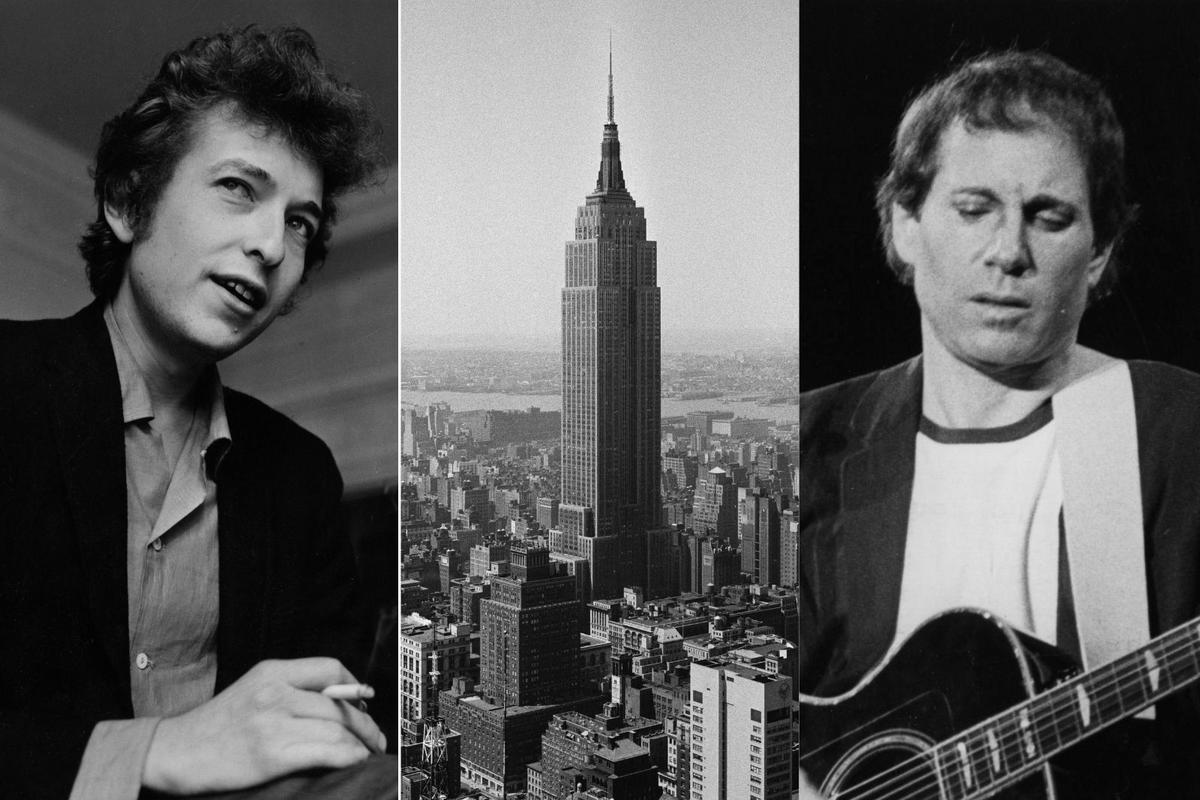

You know what they say about New York City: if you can make it here, you can make it anywhere.
Of course, the definition of “making it” is broad and means different things to different people, but if there is a singular truth about New York, it’s that people from all walks of life have always flocked to it in hopes of something better and truer to themselves. (Full disclosure: this writer is one of them.) For decades, it has been a beacon for immigrants, writers, artists, actors, activists, entrepreneurs and general dreamers seeking a greater version of their lives, whatever that means to each individual.
As John Lennon, who moved to NYC in the summer of 1971 to escape the pressures of his high-profile existence, once put it: “I can be a human being in New York which I can’t be in many other cities.”
The ’60s in particular were a time of considerable artistic growth in New York. Creative people from all over the world traveled there to stake their claim. Some stayed for decades, and some moved on within a few years. Others hailed from New York City themselves and found their own backyard to be the perfect place to launch a career in the arts.
Whole books have been written about this era of New York City’s history, including ones about all the musicians who made an impact on both local communities and national stages. But below, we’ve selected the people we consider to be the “Big 4,” an exclusive group without whom the musical landscape of New York City would not have been the same.
1. Carole King
One of the single most important musical institutions in America is the Brill Building, located at Broadway and 49th Street in Midtown Manhattan. Back in the early ’60s, it was the epicenter for hit songwriting and Carole King, a native New Yorker, was one of its brightest stars.
Working often with her lyricist husband Gerry Goffin, King wrote countless hits for some of the top acts of the day. To name just a few: “Will You Love Me Tomorrow” (The Shirelles, 1960), “The Loco-Motion” (Little Eva, 1962), “Up on the Roof” (The Drifters, 1962), “One Fine Day” (The Chiffons, 1963) and “(You Make Me Feel Like) A Natural Woman” (Aretha Franklin, 1967). (Below is “It Might as Well Rain Until September,” a hit song King recorded herself in 1962.)
“Every day we squeezed into our respective cubby holes with just enough room for a piano, a bench, and maybe a chair for the lyricist if you were lucky,” King later recalled in Simon Frith’s book The Sociology of Rock (via The Guardian). “You’d sit there and write and you could hear someone in the next cubby hole composing a song exactly like yours. The pressure in the Brill Building was really terrific—because Donny [Kirshner] would play one songwriter against another. He’d say: ‘We need a new smash hit’—and we’d all go back and write a song and the next day we’d each audition for Bobby Vee’s producer.”
It’s important to remember this was an era in which women still didn’t have full access to the same financial rights as men, much less held jobs in prestigious environments like a writer’s room in the Brill Building. King easily disproved any kind of preconception that women were best suited to performance only, incapable of writing successful songs. If a Billboard hit came out of New York City in the ’60s, the chances of King being its writer were extremely high.
2. Bob Dylan
If there was one person who was practically synonymous with the musical world of New York City in the 1960s, it was Bob Dylan. He arrived in January of 1961 as a baby-faced, 19-year-old, unsure of exactly what would happen.
At that point, Dylan was still mainly singing old folk songs, or at the very least songs not written by himself. This wasn’t unusual as plenty of other folk singers were roaming around Greenwich Village, performing traditional tunes in coffee houses trying to make just enough money for rent and food. Among them was Judy Collins, Joan Baez, Pete Seeger, Joni Mitchell, Phil Ochs, Peter Paul & Mary and many more. But it did not take terribly long for Dylan to emerge as possibly the most unique figure of them all. He began writing his own songs, drawing inspiration from folk legends like Woody Guthrie and writers like the French Symbolist Arthur Rimbaud, as well as the general whirring atmosphere of New York City and the shadow of the ongoing civil rights movement. (Quite a few of Dylan’s early songs shed light on hate crimes against Black people, and he performed at the March on Washington in 1963.)
“Mr. Dylan’s highly personalized approach toward folk song is still evolving,” Robert Shelton of The New York Times said of Dylan in a 1961 article. “He has been sopping up influences like a sponge. At times, the drama he aims at is off-target melodrama and his stylization threatens to topple over as a mannered excess. But if not for every taste, his music-making has the mark of originality and inspiration, all the more noteworthy for his youth. Mr. Dylan is vague about his antecedents and birthplace, but it matters less where he has been than where he is going, and that would seem to be straight up.”
Dylan left New York before the decade was out, but his picture still lines the walls of various West Village venues and his impact has never lifted. In hardly any time at all, he embodied an incredibly crucial theme of ’60s New York: the past and the future go hand in hand.
3. Simon & Garfunkel
It is purely fate that brought Paul Simon and Art Garfunkel together — they met as schoolchildren in Queens, where they first learned to harmonize. Within ten years, they put out their debut album, Wednesday Morning, 3 A.M., a commercial failure at the time, but one that would come back around.
In 1965, a year after that album was released, a remixed version of one of its songs went to No. 1 on the Billboard Hot 100. That was “The Sound of Silence,” with lyrics about subway walls and tenement halls. Before long, Simon & Garfunkel were huge radio stars and regular performers on college campuses across America. The Sounds of Silence, the 1966 album, went to the Top 15 in both the U.S. and U.K. More hits followed as the decade progressed: “Homeward Bound,” “I Am a Rock,” etc. In 1969, “Mrs. Robinson” became the first ever rock and roll song to receive Record of the Year at the Grammys. Simon & Garfunkel appeared to have it all — lyrical songwriting chops comparable to Dylan’s, vocal harmonies like the Everly Brothers and a keen knack for melody.
As with many deeply talented duos, Simon and Garfunkel had their differences, which ultimately led to them splitting up in 1970. But New Yorkers never let go of their music. At each of their reunions, thousands of people turned up. In 1981, when they reunited for a concert in Central Park, over 500,000 people showed up, the largest ever concert attendance at that time.
4. The Velvet Underground
One thing that really can’t be overlooked when it comes to ’60s music in New York was its overlap with the world of visual art and the general avant-garde atmosphere. The Velvet Underground were leaders in this sense. Without them, it is unclear what the path of art rock, punk and New Wave might have looked like in subsequent decades.
The Velvet Underground did not officially solidify their name until 1965, and through the whole decade, only released three albums: The Velvet Underground & Nico (1967), White Light/White Heat (1968) and The Velvet Underground (1969). None of them were very successful back then, yet in the end they were some of the most important albums to come out of New York City, in particular the first one. Brian Eno famously quipped in 1982 that even though The Velvet Underground & Nico only sold 30,000 copies in its first five years, “everyone who bought one of those 30,000 copies started a band.”
What made the Velvet Underground special was, in many ways, what made New York City special. They did not fit an exact mold with Lou Reed at the helm, part poet, part beatnik and all around artist, plus John Cale at his side, a Welshman and child prodigy with a background in orchestral composition. Where else but 1960s New York could this group have come from?