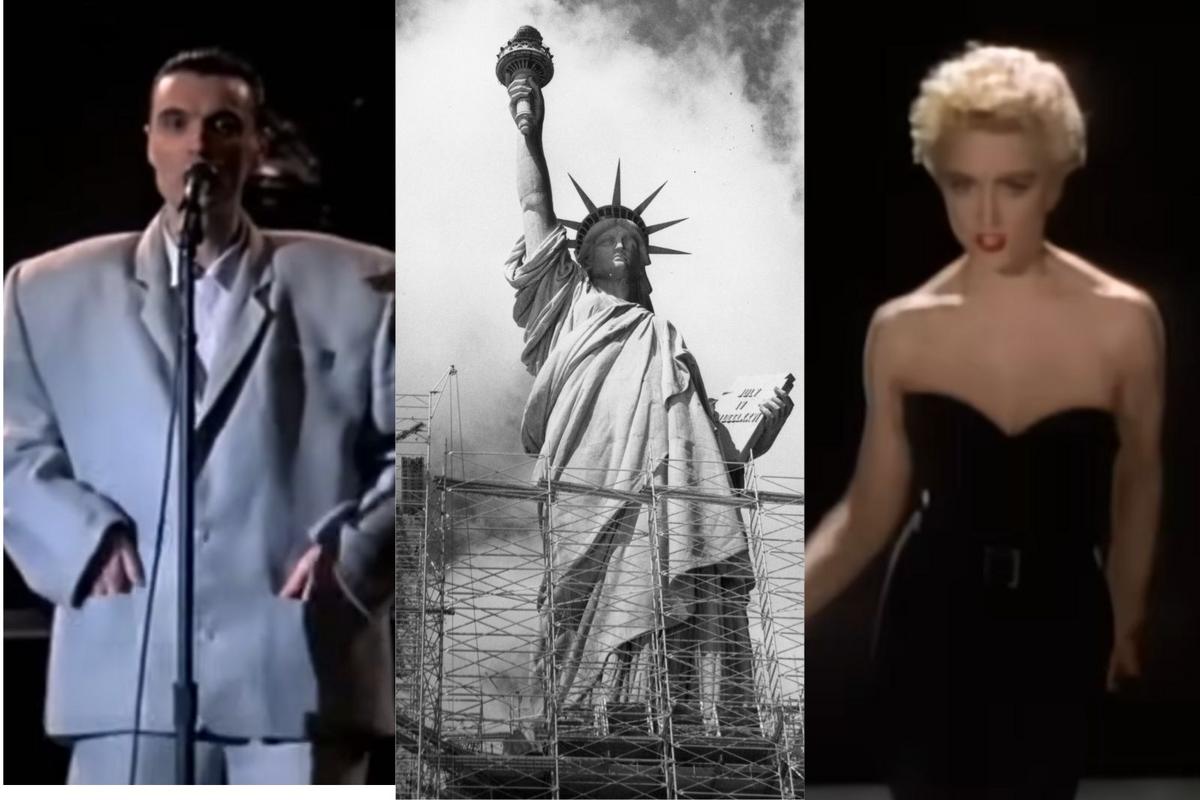

New York City in the 1980s was not necessarily a beacon of hope.
By then, the crack cocaine epidemic had fully sunk its teeth in, with homicide rates reaching rates that had never been seen before, much of it drug related. In 1984, a man named Bernhard Goetz shot four young men on a subway train who he claimed were trying to rob him. (Goetz, wildly enough, is one of just three people mentioned in Billy Joel‘s “We Didn’t Start the Fire” that are still living at the time of this writing.) In 1989, a 28-year-old woman, Trisha Meili, was raped and beaten while out jogging in Central Park. Five teenagers were convicted of the crime and spent years in prison before it was ultimately learned that another man was responsible, but not before the incident became a national rallying cry around racial profiling, discrimination and violence against women.
“New York is a long way from being perfect,” New York City Mayor Ed Koch said at his third inauguration speech in January of 1986. “This is not a place of carefree quietude. Our city is not a tranquil refuge from reality. New York today is what it has always been: it’s the world’s No. 1 arena for genius, it’s the battleground of new ideas. New York is the city where the future comes to rehearse, where the best come to get better. We’re the leading city because we are the city of leaders. If you’re trying for the top, you cannot top New York.”
He was right. For all of the conflict and cruelty, NYC in the ’80s remained a petri dish for creativity and new ways of making art. In the below list, we’ve chosen four of the most important.
1. Talking Heads
It’s true that Talking Heads, a band of former art school students, gained a fair amount of momentum in the ’70s, but the ’80s is where they really stood out.
At the very beginning of the decade, they released Remain in Light, an album that clearly drew from hip-hop, funk and world music, and yet sounded entirely new. Remain in Light was a hit in and of itself, landing at No. 19 on the Billboard 200, and also yielded the hit single “Once in a Lifetime.” An even bigger success came in 1983 in the form of “Burning Down the House” from Speaking in Tongues. (Several songs from this era were not majorly popular at the time, but have become so in subsequent years, including “Girlfriend Is Better,” “And She Was” and “This Must Be the Place (Naive Melody).”)
Talking Heads set themselves apart from other bands of this era, both nationally and in their primary location of New York City. Here was a group led by an eccentric, inquisitive artist, David Byrne, whose approach to writing songs was angular, ironic and anxious in all the best ways. At his side was a deeply gifted arranger in Jerry Harrison, and the husband-wife rhythm section of Chris Frantz and Tina Weymouth. All together it made for a highly danceable style of music that pulled from punk, new wave, art rock and international instrumentation.
2. Madonna
Madonna moved to New York City in 1978, marking the first time she’d ever flown on a plane. Immediately, she began working whatever odd jobs she could, taking dance classes and generally absorbing the community around her. In 1982, she had managed to land herself in enough prominent industry company to sign a deal with Sire Records and from there, it was off to the races.
Her self-titled debut came out in 1983, and it was instantly obvious this young woman from Michigan had star quality about her. Every one of her albums from the ’80s was a hit, each bearing multiple successful singles. She was one of the best-selling artists of the entire decade, but beyond her chart domination, Madonna made clear that the element of performance should not ever be overlooked. Moving to New York City had revealed to her that one need not be boxed in by a single definition — painters could also be singers, actresses could also be dancers and so forth. This, in effect, set the template for the modern day pop star.
“I think people misunderstood and resented her — you hear all the time ‘She’s not a good singer.’ Well, she’s not a singer,” Madonna’s biographer Mary Gabriel explained to Variety in 2023. “She’s a performance artist. She’s a visual artist. She’s a songwriter. She’s a producer. And in the world she came from, you could be all of those things and you didn’t have to apologize for it.”
3. Run-DMC
You can’t have a conversation about ’80s music in NYC without talking about the rise of hip-hop, and Run-DMC from Queens were pioneers of it.
Their debut album, 1984’s Run-D.M.C., made them the first hip-hop group to achieve a gold record. They followed that up with 1985’s King of Rock, which made them the first hip-hop group to go platinum. And then there was 1986’s Raising Hell, the first multi-platinum hip-hop record, and their collaboration with Aerosmith, “Walk This Way,” which charted higher than the original version of the song. They appeared on MTV frequently, showing viewers something they likely had never seen before.
Run-DMC — Joseph “Run” Simmons, Jason “Jam Master Jay” Mizell and Darryl “D.M.C.” McDaniels – represented a totally new era of music. They piggy-backed off the older generations of DJs, R&B singers and disco artists to help create what became known as new-school hip-hop, a genre that utilized big drum machine sounds, assertive, “rap” style lyrical delivery and an overall cool attitude. Sampling was often involved, too, long before it became common. Run-DMC walked that way so that people like Jay-Z, Kendrick Lamar and Drake could run, both puns fully intended.
And for anyone who criticized Run-DMC for not playing their own instruments, or leaning too heavily on samples, they knew it was all part of the bigger picture.
“We wasn’t making our own music, but the white people that we were stealing the beats from, like Aerosmith, Rush, Bob Dylan and all of those cats — they protected us,” McDaniels recalled to njarts.net in 2020. “Lou Reed said, ‘I respect Run-DMC because when they came out, they reminded me of me when I was a young musician in my garage beating on pots and pans to everyone’s music.’ The Black musicians didn’t like us because we were getting a thousand dollars a night, which was a lot of money back then. A thousand dollars just to play some damn records! But the rock dudes loved us and our socially conscious attitude. We was rebellious, just like rock ‘n’ roll. We had the anti-everything attitude that they had.”
4. Beastie Boys
The Beastie Boys, a three-piece that formed in 1981 featuring Adam “Ad-Rock” Horovitz, Adam “MCA” Yauch and Michael “Mike D” Diamond, somehow managed to bridge the gap between punk rock and hip-hop in the ’80s in a way that really no other band did.
What began as a group of friends making some relatively inconsequential music in New York’s Lower East Side, turned into something much bigger. Once the Beastie Boys got their hands on a drum machine, it didn’t take them very long to translate their local success into the bigger kind — their debut album, 1986’s Licensed to Ill, was the first rap album to top the Billboard 200 chart, helped a bit by their producer, a young DJ named Rick Rubin. Their 1989 album Paul’s Boutique wasn’t quite as commercially successful, but it further emphasized that hip-hop music, like rock ‘n’ roll, could take on many forms and employ many influences — some called Paul’s Boutique the “Sgt. Pepper of hip-hop.” Sampling, as a practice, became even more mainstream thanks to the Beastie Boys.
The members of the Beastie Boys grew up in New York City, soaking in all its influences and sounds to make something that people like Eminem, Rage Against the Machine, Blur and others would draw from in future decades. And by the way, if you ever find yourself on the corner of 14th Street and Avenue A in Manhattan’s East Village, make sure to look up — there’s an enormous mural of the Beastie Boys to see there, a tribute to some hometown hip-hop legends.
Rock’s Best ’70s to ’80s Reinventions
Whether by choice or by force, these rockers soared to new heights thanks to crucial changes.
Gallery Credit: Bryan Rolli