
Jonathan Cain arrival coincided with Journey‘s early-’80s transformation from sturdy hitmakers to stadium-filling superstars. He’s typically credited with unlocking the soaring balladry of the Steve Perry era.
But Cain has been part of three big-selling bands, while also maintaining a solo career that more recently has focused on faith music. In their own ways, all of these eras overlap.
A Chicago native who survived a horrifying school fire as a youngster, Cain’s early years were marked by more promise than success. He made it to television pioneer Dick Clark’s American Bandstand as an embryonic solo act, but Cain’s yacht rock-ish 1977 debut album went nowhere. Cain joined the Babys later the next year as they rebuilt the lineup around frontman John Waite.
How Jonathan Cain Connects the Babys and Journey
Their next album, 1980’s Union Jacks, nearly cracked the Top 40 while its best single “Back on My Feet Again” reached No. 33. The Babys’ follow-up, On the Edge, didn’t fare as well. “Turn and Walk Away” stalled out at No. 42, but by then Cain had already impressed his next bandmates.
The Babys opened for Journey on their 1980 tour in support of Departure, which became co-founding keyboardist Gregg Rolie‘s last LP with the group. They’d added Perry two albums earlier, and he finally led Journey to the Billboard charts and platinum sales. Cain helped them to the next level with a then-new synth sound – and his now-legendary penchant for romantic songs.
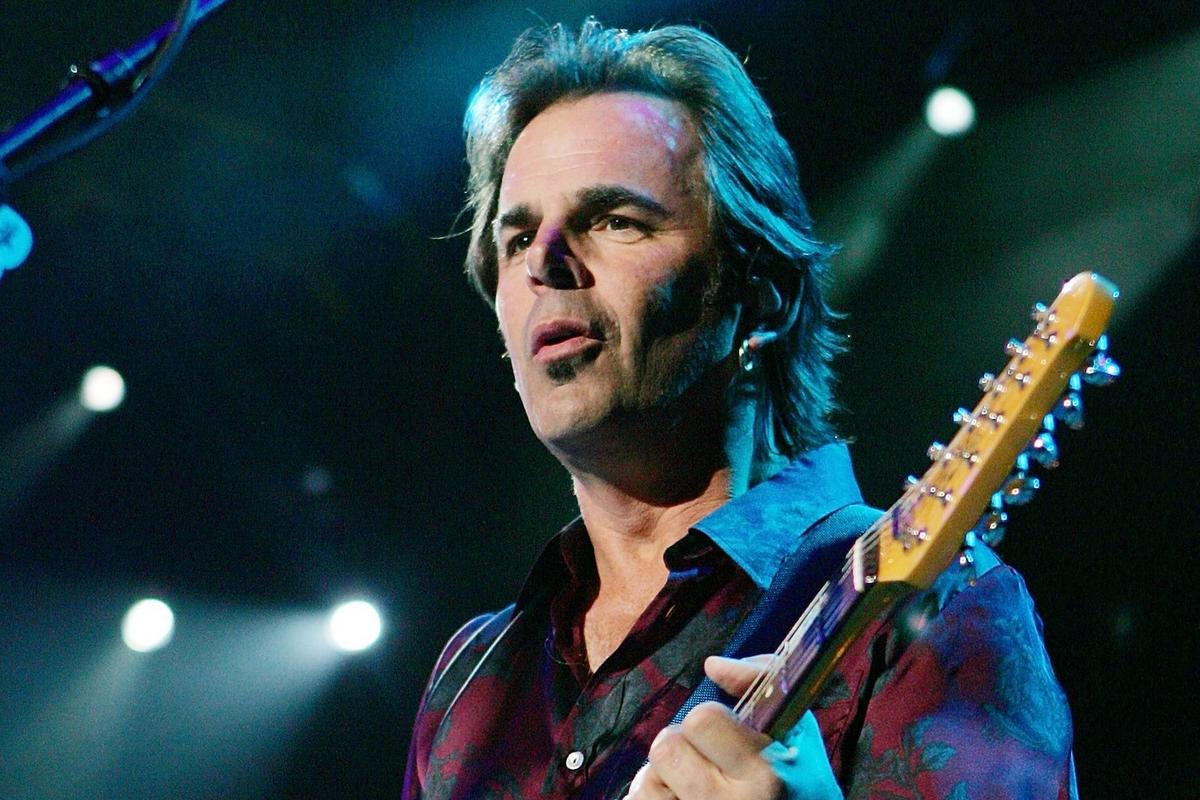
Jonathan Cain with longtime frontman Arnel Pineda during a Journey concert. (Paras Griffin, Getty Images)
This new alchemy with Perry produced immediate results. Journey next album, 1981’s 10-times-platinum Escape, sold more than all of Journey’s earlier LPs combined. Their next two studio projects, 1983’s Frontiers and 1986’s Raised on Radio, moved more than eight million units in the U.S. alone. Then Journey went on a rather inexplicable hiatus.
Recalling the Babys’ last Top 40 single, Cain landed on his feet again. Bad English emerged in the late-’80s with a hybrid lineup that combined members his two earlier groups. Journey co-founder Neal Schon and their future drummer Deen Castronovo were joined by former Babys members John Waite and Ricky Phillips.
Why Did Jonathan Cain Leave Journey?
Bad English immediately scored a chart-topping hit with “When I See You Smile,” kicking off a two-album run with 1989’s platinum-certified self-titled debut. Cain then returned to Journey for 1996’s million-selling Trial By Fire, home to the Grammy-nominated hit ballad “When You Love a Woman.” At that point, every Journey album with Cain had reached the U.S. Top 5.
Perry quickly bowed out of the lineup, however, while Cain remained. Journey would see plenty of highs (2008’s Revelation, another platinum Top 5 hit) but also their share of lows: After 2001’s Arrival, Journey was dropped from Columbia Records, the only label they’d ever known. Cain later jumpstarted his solo career with 2016’s What God Wants to Hear, but then began having public disputes with Schon.
READ MORE: Top 35 Journey Videos – Together and Apart
They somehow soldiered on, with a nearly continuous touring schedule amid 2022’s lockdown-produced Freedom. Cain finally announced his exit in 2025, but only following an open-ended series of farewell dates. He promised to continue releasing songs that explored his faith.
This turn toward religion may have seemed out of nowhere, but Cain had actually dropped hints. He co-wrote “Jesus, Are You There?” for the Babys’ Union Jacks. The title track from Journey’s Trial by Fire was inspired by a biblical theme. Something else intriguing happened along the way: Cain, the deeply emotional balladeer, played a key role in more than his fair share of fist-pumping rockers.
Here’s a ranked look back Jonathan Cain’s 20 best songs with the Babys, Journey and Bad English.
No. 20. “Trial by Fire”
From: Journey’s Trial by Fire (1996)
This track made direct reference to verses in 2 Corinthians, as Jonathan Cain’s then-dormant songwriting partnership with Perry was reborn through a shared interest in scripture. “It was refreshing,” Cain later recalled. “We wrote about ‘treasures in jars of clay, let the light shine in the darkness.’ I thought, ‘This was fresh.’ That was my first encounter with scripture and music, and I have been a believer all my life.” Cain began more deeply exploring the theme with 2016’s What God Wants to Hear, kicking off a series of faith-based solo albums.
No. 19. “Turn and Walk Away”
From: The Babys’ On the Edge (1980)
The only song to chart from Cain’s final album with the Babys, this No. 42 single opened On the Edge with a bit of attitude. “Turn and Walk Away” is a long way from the Babys’ embryonic pub rock days – thanks in no small way to their newly added keyboardist. But this album-opening pop rocker may have had throwback roots, as frontman John Waite was reportedly inspired by a late-night conversation in a London bar. “Turn and Walk Away” became this studio project’s first-completed song, with a Wally Stocker guitar solo said to have been completed in a single take.
No. 18. “When I Think of You”
From: Journey’s Trial by Fire (1996)
Finished with a key assist from Cain, “When I Think of You” appeared on Journey’s Steve Perry-curated Greatest Hits 2 not because of its chart history, but because of what it meant to him. Perry was initially inspired after his late mother appeared, happy and healthy, in a particularly vivid dream. “‘When I Think of You’ is so pretty and tender,” Cain said in Journey: Worlds Apart. “You know, we wrote it for Steve’s mom, and I just think the melody is so good – and he sang it so well.” It’s a song of remembrance, a song of goodbyes. Steve Perry would soon be saying them to Journey, too.
No. 17. “Forget Me Not”
From: Bad English’s Bad English (1989)
Bad English included three former members of the Babys, the doomed opening act that provided a tour-long audition for future Journey cornerstone Jonathan Cain. Bad English would suffer a similar fate, hinted at during the official video for their failed debut single by the way John Waite and Neal Schon push each other around. Cain helped Waite with the decidedly stalker-ish lyrics. “‘Forget Me Not’ was very much a dominant, sexual, ‘I will be your keeper’-type male,” Cain added. “That was about possession, with all of the sexual innuendos that John loves to deliver.”
No. 16. “Where Did I Lose Your Love”
From: Journey’s Revelation (2008)
This was then-new frontman Arnel Pineda’s version of Journey’s familiar arena-ballad sound. Deen Castronovo and Cain, who co-wrote this track with Neal Schon, even close things out with a fierce entanglement that must’ve brought older fans right back to “Separate Ways.” But Pineda adds a few new vocal wrinkles and that helps him move past the easy comparisons to Perry. Pineda’s predecessor Steve Augeri passed the same audition some seven years earlier with “All the Way” from Arrival. Neither turned out to be a big hit, but they showed Journey could still be Journey even without their famous former frontman.
No. 15. “When You Love a Woman”
From: Journey’s Trial by Fire (1996)
Perry had been away for a long time, and principal collaborator Jonathan Cain took note of the changes. “When we got back together, I could tell he was in a fragile place,” Cain later recalled. “Physically, he was starting to get aches and pains. His voice wasn’t quite where it was years ago.” Their first single after reuniting was suitably staid. The accompanying video was staid, even co-writer Neal Schon’s guitar solo was staid. The results perhaps inevitably topped the adult contemporary chart for an entire month, while also making the case for a different kind of Journey that was much, much quieter. Even so, it was all too much for Perry and they split when he didn’t take part in an expected comeback tour. He’d never work with Cain again.
No. 14. “Price of Love”
From: Bad English’s Bad English (1989)
On the other hand, there a good bit more edge to “Price of Love,” the only Bad English song credited solely to Cain and Waite. The timing was no accident: They’d whiffed on an introductory rocker, then topped the charts with Diane Warren’s power ballad “When I See You Smile.” Guess what Bad English’s next single sounded like? Yep: “Price of Love” went to No. 5, though it’s somehow became largely forgotten.
No. 13. “Why Can’t This Night Go on Forever”
From: Journey’s Raised on Radio (1986)
Written in tribute to their fans, “Why Can’t This Night Go on Forever” becomes such an obvious attempt to replicate the emotional sweep of “Open Arms” or “Faithfully” that its impact is blunted. The song is saved by the strength of the band’s performances, particularly Perry and Schon. Journey’s appropriately wistful clip-file video puts everything in context for a group that’s about to grind to their first sudden halt.
No. 12. “Midnight Rendezvous”
From: The Babys’ Union Jacks (1980)
The boldly salacious “Midnight Rendezvous” offers its own primer on the difference between Cain songs for John Waite and Steve Perry. With Perry, “you’ve got the boy next door who’s shy and hasn’t fallen in love yet. He’s still looking for the girl,” Cain said in Journey: Worlds Apart. “Then you have John Waite, who’s Vampire Lestat. … ‘The dress you’re wearing is way past your knees?’ Come on!”
No. 11. “Make Love Last”
From: Bad English’s Backlash (1991)
This mashup of Journey and the Babys still knew its way around a power ballad. In fact, “Make Love Last” was a far better song than “When I See You Smile.” But only one of them had spent two weeks at No. 1 on the Hot 100. Times were changing at the dawn of the grunge and gangster rap era – and Waite was eager to return to his solo career, which included its own chart-topping single. “I think I was the odd man out,” Waite said in Journey: Worlds Apart. “An old girlfriend of mine once told me backstage at a Bad English concert: I was the guy that didn’t fit – and I was glad. I’m still glad.”
No. 10. “Suzanne”
From: Journey’s Raised on Radio (1986)
The first of three songs on Raised on Radio that Cain co-wrote with Perry, “Suzanne” can be very much of its time. Cain is actually listed in the credits as a “programmer,” a nod to work done on his Oberheim DMX drum machine before Journey brought in the late sessions ace Larrie Londin to complete the track. Still, its larger theme – about the ecstasy and torment of seeing a long-ago crush years later projected on a movie-theater screen – recalled the best of this duo’s reliably lovestruck sentimentality.
No. 9. “I’ll Be Alright Without You”
From: Journey’s Raised on Radio (1986)
Cain, like Perry, was going through a breakup – and “I’ll Be Alright Without You” became a form of therapy. (Cain later described this song as the other half of the emotions expressed in “Once You Love Somebody” elsewhere on the album.) Schon, who earned a co-writing credit with Cain and Perry, tried out a then-new guitar in search of a distinct sound. The results became Journey’s penultimate Top 20 hit, followed by 1996’s “When You Love a Woman.” Points given in the official video for the new on-stage accapella ending. Points taken away for Randy Jackson’s polka-dotted bass.
No. 8. “Darker Side of Town”
From: The Babys’ On the Edge (1980)
Cain’s connection to Waite seemed to be strengthening on their second LP together with the Babys. Cain ended up contributing to more than half of the 10 songs from On the Edge – including “Darker Side of Town,” the first of two co-writes with Waite. It’s easily one of the most ruminative moments in all of Cain’s discography, as a heartbroken Waite dives into the bottom of a brown bottle against a searching keyboard line. “That’s another one that still haunts me,” Cain told UCR, “because it’s got a real moody feel to it.” Then, in a fateful turn, the Babys’ tour behind On the Edge included support dates with Journey. The Babys blew apart when Cain was invited to replace their departing co-founder Gregg Rolie.
No. 7. “After the Fall”
From: Journey’s Frontiers (1983)
Every song Cain wrote with Perry on Side 1 on Frontiers charted, and there were three of them. The emotionally complex, finely wrought “After the Fall” is easily the most underrated. Perry actually began the song on the bass, perhaps an early indication of the changes in store for Journey. By the time they released Raised on Radio, original bassist Ross Valory had been replaced by Randy Jackson, later a member of the Freedom-era lineup. Drummer Steve Smith departed too, but not before proving himself utterly invaluable here. By the time “After the Fall” was completed, Cain had proved he was just as adept with the darker hues of heartbreak as he’d been at conveying soaring passion.
No. 6. “Open Arms”
From: Journey’s Escape (1981)
Cain had auditioned an early version of “Open Arm” while he was with the Babys, but frontman John Waite turned him down. Steve Perry had a completely different reaction. In Cain, the frustrated balladeer had finally found a new ally. Together, they were such tacticians that they could narrow focus to a single phrase – notably, “wanting you near” – to make sure it carried an emotional punch. It didn’t sound much like Journey, at least not until that point, but “Open Arms” clearly resonated well outside of Cain’s first writing sessions with Perry. Journey’s highest-charting single finished at No. 2 on the Hot 100, becoming their third consecutive Top 10 hit from Escape. Before Cain’s arrival, they’d only ever reached the Top 20 once.
No. 5. “Who’s Crying Now”
From: Journey’s Escape (1981)
The first of two songs on Escape written solely by Cain and Perry, “Who’s Crying Now” perfectly illustrates how Jonathan Cain’s new presence changed Perry’s writing style, then forever changed Journey. The first inklings of this No. 4 hit came to Perry as he was driving up to San Francisco on Route 99. But “Who’s Crying Now” was a song with no real direction until Cain suggested the title. “He helped me go to another place as a writer,” Perry later gushed in the Time3 notes. Cain led the way on a cool b-section featuring only voice and keyboard, and his very first co-written composition with Perry was completed.
No. 4. “Separate Ways (Worlds Apart)”
From: Journey’s Frontiers (1983)
This now-ubiquitous rocker begins with Schon’s grinding guitar, but “Separate Ways” was also written solely by Cain and Perry. They took inspiration this time from the others, as both Valory and Schon endured painful divorces. Released as the lead single from Frontiers, “Separate Ways” became a multi-week Top 10 smash. Then they released a much-mocked accompanying video that inadvertently set the stage for future solo success. Perry brought then-girlfriend Sherrie Swafford to the set, and she reportedly became jealous of the featured model. That left Perry to openly wonder if he’d have to write her a song to smooth things over. “And so he did,” Cain later admitted with a laugh.
No. 3. “Send Her My Love”
From: Journey’s Frontiers (1983)
One of four Top 40 hits found on Frontiers, this lonesome No. 23 anthem is notable for an ambient turn by Schon (he used a high-end Lexicon 480L echo unit) and perhaps the most intriguing drumming contribution on Journey’s string of familiar ballads from Steve Smith. (A jazz lover who later founded his own combo, Smith added a slyly involving polyrhythm lifted from Miles Davis’ “In a Silent Way.”) But it all started with the kind of interior emotion that was so easy for Cain to convey. He was reminiscing about a long-ago girlfriend backstage with a mutual acquaintance when he said, “Send her my love.” Cain had already walked away when he had a sudden revelation: “Wait a minute, that’s a song!”
No. 2. “Don’t Stop Believin'”
From: Journey’s Escape (1981)
Jonathan Cain had been carrying around a song scrap for ages. Really, it was just a turn of phrase, scribbled down after a moment of encouragement from his father during a particularly low point in Cain’s nascent musical career. That was five years before he joined Journey. When they needed one more song for Escape, Cain remembered his old notebook. Neal Schon’s early staccato lines on guitar got Cain to thinking about trains. Soon, Cain and Perry had created this entire world around a pair of star-crossed lovers. “Don’t Stop Believin'” only reached No. 8 at the time, but its intriguing song structure and unfettered optimism continued to resonate across generations. “I think it’s a certain song in uncertain times,” Cain said in Journey: Worlds Apart. “It speaks to hope. I think people are looking for hope.”
No. 1. “Faithfully”
From: Journey’s Frontiers (1983)
A solo composition completed by Journey, “Faithfully” was meant to frame a married musician’s struggles with life on the road. Cain said the lyrics came from nowhere – literally. He was looking up at the moon while the band bus was winding its way to a gig in New York. Cain made a perhaps unintentionally savvy move by writing this No. 12 power ballad in his own key, since that allowed Perry to explore a different vocal timbre. (He asked to be alone in the studio to record the vocal.) They finished the song by conjuring an ending dance between Perry’s “whoa whoa whoa” and Neal Schon’s guitar that was completely unrehearsed. The result isn’t the best song Jonathan Cain has ever been associated with, but “Faithfully” still ranks first on this list because it’s such a personal triumph.
Journey Albums Ranked
Some Journey lineups were respected but low-selling, while others were bestsellers who got critically ignored. But which one was best?
Gallery Credit: UCR Staff
You Think You Know Journey?