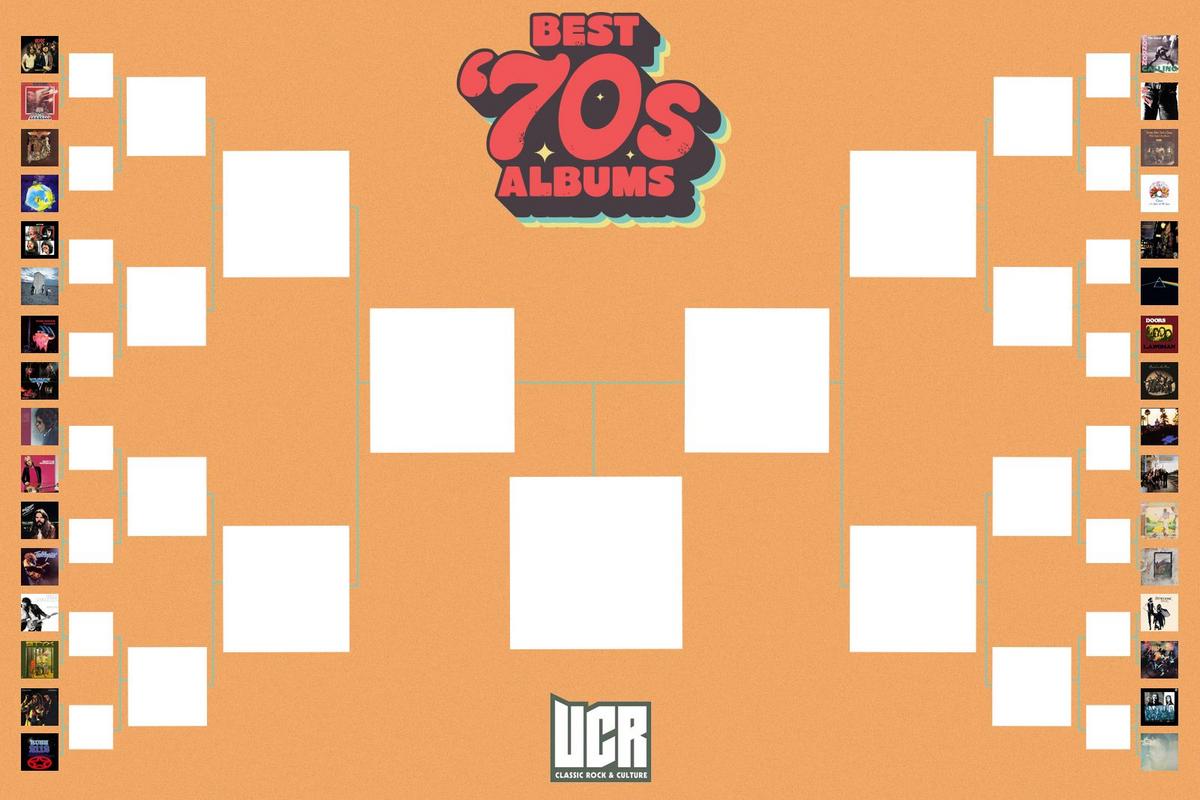

What is the greatest rock album of the ’70s? You can help decide with UCR’s 2026 March Madness bracket.
Last year we got a great response to our Best ’80s Album bracket, which ended with AC/DC’s Back in Black defeating Van Halen’s 1984. Both of those bands are back with their most popular ’70s records, competing against 30 more of the most famous albums of the ’70s.
The 32 contenders have been seeded into our bracket alphabetically, then paired off into 16 first round battles. You can vote below for your favorite albums – once an hour between now and Sunday, March 15 at 11:59PM EST.
The 16 winners will move on to the second round beginning Monday, March 16.
Adrian Borromeo, UCR
AC/DC’s Highway to Hell vs. ZZ Top’s Deguello
As mentioned above, AC/DC won last year’s contest with 1980’s Back in Black. We’re going back just one year for our ’70s bracket, to their big 1979 Bon Scott-fronted commercial breakthrough Highway to Hell.
They’re up against ZZ Top‘s Deguello, which was released the same year and marked the beginning of the innovations and explorations with which the Texas trio would fine multi-platinum success in the early ’80s.
Aerosmith’s Toys in the Attic vs. Yes’ Fragile
Aerosmith‘s 1975 masterpiece Toys in the Attic, home to “Sweet Emotion,” “Walk This Way” and much much more, goes up against Yes‘ 1971 breakthrough Fragile, home to “Roundabout” and “Long Distance Runaround,” among others.
The Beatles’ Let It Be vs. The Who’s Who’s Next
1970’s Let It Be, the last album released by the Beatles, and home to the title track and “Get Back,” faces off against the Who‘s best-ever studio album, 1971’s Who’s Next, famous for songs such as “Baba O’Riley” and “Behind Blue Eyes.”
Black Sabbath’s Paranoid vs. Van Halen’s Van Halen
Uh-oh, some idiot paired off two genre-defining albums in the first round. Black Sabbath‘s 1971 masterwork Paranoid and Van Halen’s world-changing 1978 debut could both easily be finals contenders. Instead, you have to decide which one of them goes home way too early. My bad!
Adrian Borromeo, UCR
Bob Dylan’s Blood on the Tracks vs. Tom Petty’s Damn the Torpedoes
Two Traveling Wilburys stars are forced to fight each other for the right to move onto the second round. Will you vote for Bob Dylan‘s Blood on the Tracks (most famous for “Tangled Up in Blue”) or Tom Petty and the Heartbreakers’ Damn the Torpedoes, which features “Don’t Do Me Like That” and many others?
Bob Seger’s Stranger in Town or Ted Nugent’s Ted Nugent
Two of Detroit’s finest square off in this battle. Ted Nugent hit it out of the park with his self-titled 1975 debut, which contains “Stranglehold” and “Motor City Madhouse,” an ode to his hometown. He’s up against Bob Seger and his hit-packed (“Hollywood Nights,” Old Time Rock and Roll”) 1978 album Stranger in Town.
Bruce Springsteen’s Born to Run or Styx’s The Grand Illusion
Two career-making albums face off in this battle. The third time was the charm for Bruce Springsteen, whose 1975 album Born to Run made him famous enough to be on the covers of Time and Newsweek the same week. Two years later Styx had their own breakthrough with The Grand Illusion, which featured the future radio classics “Come Sail Away” and “Fooling Yourself.”
Cheap Trick’s At Budokan or Rush’s 2112
The final first round region two battle is a study of opposites. Rush broke through with studio wizardry and an album side-long song suite on 1976’s 2112, while Cheap Trick used short, catchy pop-friendly rock songs and the power of their live show to make the whole world fall in love with them for the first time with 1978’s At Budokan.
Adrian Borromeo, UCR
The Clash’s London Calling or The Rolling Stones’ Sticky Fingers
It’s pretty wild to think that these two albums came out in the same decade. Both came from bands born in London, too. In 1971 the Rolling Stones released Sticky Fingers – home to “Brown Sugar,” “Wild Horses” and more – in the middle of one of the most impressive album hot streaks in rock history.
Eight years later, the Clash peaked with their sprawling but never lagging double album London Calling, home to the title track, “Clampdown” and rock’s most famous last-minute addition, “Train in Vain.”
(We almost chose Exile on Main St. for the Stones, in which case we’d have double albums going head to head too..)
CSNY’s Deja Vu or Queen’s A Night at the Opera
Here are two albums that prove there’s no such thing as overdoing it – if you have great taste. Crosby, Stills and Nash took a risk by adding Neil Young to their already successful formula, but it paid off big-time with 1970s Deja Vu.
In the other corner, it’s hard to find a better example of successful excess than Queen, who reportedly packed 180 overdubs into the climactic section of “Bohemian Rhapsody,” the centerpiece of their 1975 classic A Night at the Opera.
David Bowie’s The Rise and Fall of Ziggy... vs. Pink Floyd’s The Dark Side of the Moon
In a battle of legendary concept albums with long titles, David Bowie‘s 1972 classic The Rise and Fall of Ziggy Stardust and the Spiders from Mars is matched up against Pink Floyd‘s 1973 landmark The Dark Side of the Moon. It’s a good thing there isn’t much left to say about either of these albums because we’ve run out of room.
The Doors’ L.A. Woman vs. Paul McCartney’s Band on the Run
1971’s L.A. Woman was Jim Morrison‘s last stand, as he helped the Doors deliver one more classic album – this one particularly and prophetically dark and stormy – just three months before his untimely death.
On the flip side, after failing to set the world on fire with the first two albums featuring his post-Beatles band Wings, Paul McCartney finally broke through big-time with 1973’s Band on the Run.
Adrian Borromeo, UCR
Eagles’ Hotel California vs. Lynyrd Skynyrd’s Pronounced ‘Leh-Nerd Skin-Nerd’
Lynyrd Skynyrd‘s 1973 debut packed a career’s worth of classic songs – including “Free Bird,” “Tuesday’s Gone” and “Gimme Three Stpes” – into one album.
Three years later, the Eagles made their grandest album-length statement to date with Hotel California, which surrounded the epic title track with classics such as “New Kid in Town” and “Life in the Fast Lane.”
Elton John’s Goodbye Yelllow Brick Road vs. Led Zeppelin’s IV
How is it that music’s greatest stars seem to know exactly the right time to release a double album? Elton John certainly didn’t waste anybody’s time with 1973’s Goodbye Yellow Brick Road, which covers a staggering amount of creative ground and contains too many hits to list here.
Led Zeppelin kept things a bit more focused on their untitled 1971 fourth album, boiling down and improving everything that was great about their first three albums into one concise and masterful statement.
Fleetwood Mac’s Rumours vs. Kiss’ Alive!
After nearly a decade of shifting lineups and sounds, Fleetwood Mac hit the jackpot with 1977’s Rumours, an impeccable album that chronicles the spiders web of real-life romantic entanglements the band members had gotten themselves into.
With their label on the verge of bankruptcy, Kiss had their own very much needed commercial breakthrough in 1975 with the double-live album Alive!, which captured the energy and excitement that had been missing from their first three studio albums.
Foreigner’s Double Vision vs. John Lennon’s Imagine
A battle of sophomore albums concludes our first round. Foreigner proved the success of their 1977 debut album was no fluke with the following year’s Double Vision, which included the hit title track and “Hot Blooded.”
With 1971’s Imagine, his second post-Beatles effort, John Lennon reclaimed by leaving the raw and primal sounds the previous year’s John Lennon / Plastic Ono Band behind in favor of more expansive and pop-friendly songs.
Top 100 ’70s Rock Albums
From AC/DC to ZZ Top, from ‘Bridge Over Troubled Water’ to ‘London Calling,’ they’re all here.
Gallery Credit: UCR Staff