
On Aug. 4, 1979, the Grateful Dead performed a stellar 21-song set at the Oakland City Auditorium in California. It marked their first-ever performance of “Althea,” Jerry Garcia’s latest collaboration with lyricist Robert Hunter, that would soon become a Dead staple. He played it on his brand new instrument, onstage with him for the very first time: a 13.5 pound custom-made guitar named Tiger.
Garcia instructed the creator, Alembic Guitars luthier Doug Irwin, not to hold back when making the instrument. The result was a gorgeously ornate solid-body guitar, featuring the titular animal under the bridge in mother-of-pearl. The instrument is built in the “hippie sandwich” tradition, in which layers of wood — cocobolo, maple, and padauk — are laminated together. Tiger would become Garcia’s go-to instrument for the next decade. “I’m not analytical about guitars, but I know what I like,” he once said. “And when I picked up that guitar, I’d never felt anything before, or since, that my hand likes better.”
Garcia paid Irwin $5,800 for Tiger. Forty-six years and six months later, it sold for $11.56 million on March 12, 2026. It was purchased at Christie’s in New York City on Thursday, as part of the Jim Irsay Collection, a multi-day auction featuring hundreds of the prized possessions — from pop culture artifacts to legendary guitars — of the late Indianapolis Colts owner, who died in May 2025.
Jerry Garcia of the Grateful Dead performs at the Greek Theatre on August 29, 1989 in Berkeley, California. (Photo by Tim Mosenfelder/Getty Images)
Getty Images
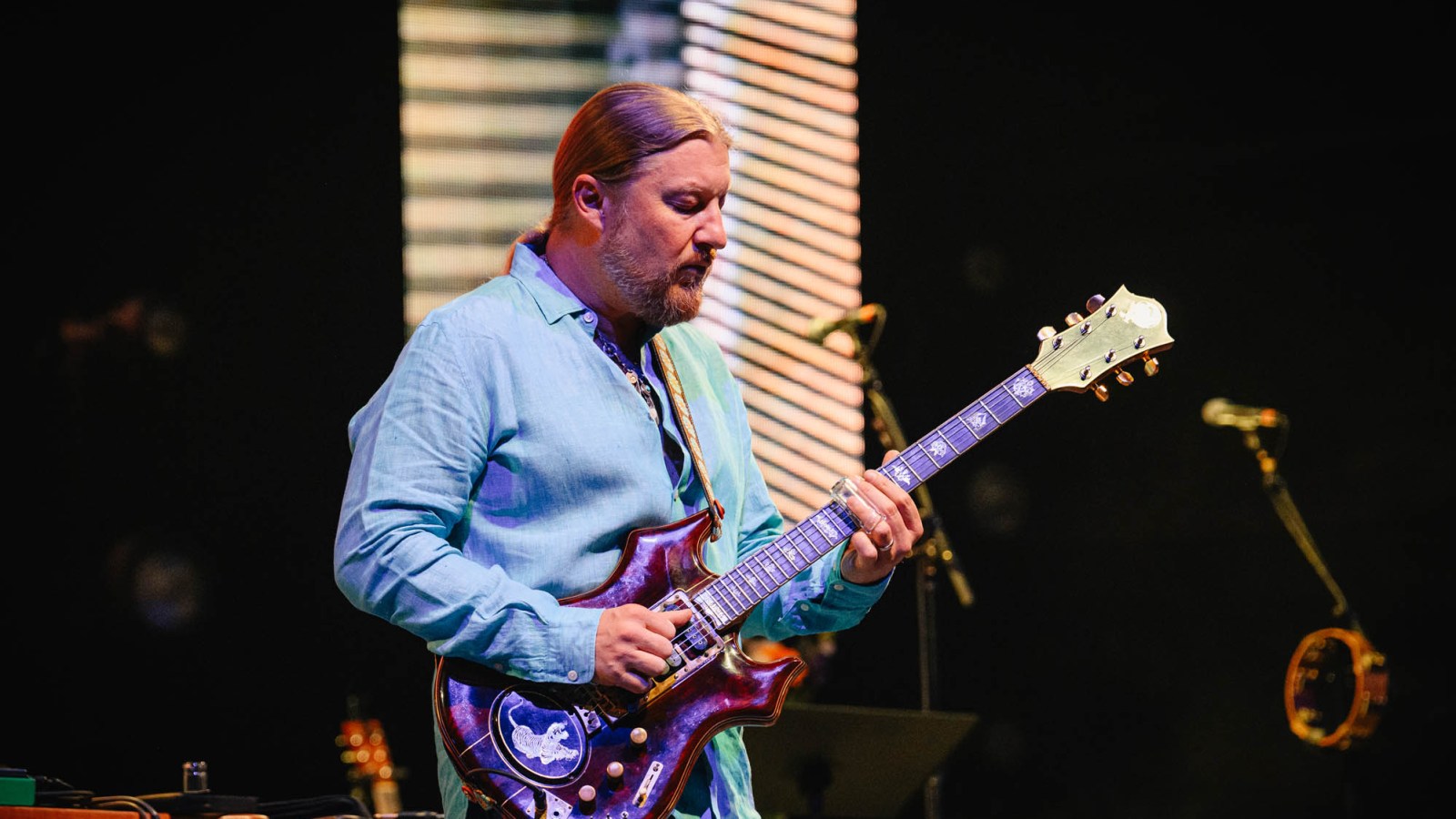
The next two evenings, Derek Trucks played the guitar just 24 blocks away at the Beacon Theatre. He’s currently in the middle of performing a 10-night residency there with Tedeschi Trucks Band, which he fronts with his wife, singer-guitarist Susan Tedeschi (the band is about to release their excellent new album, Future Soul). “There are instruments where you look at it and go, ‘Holy shit, what has this thing seen?’” Trucks tells Rolling Stone. “Just imagining Garcia in his dressing room, fucking playing the thing. Instruments carry a spirit.”
Before Trucks brought out Tiger onstage, he was spotted at the auction on that rainy Thursday afternoon (six feet tall with a long blonde ponytail at the nape of his neck, the 46-year-old guitar prodigy is hard to miss). Countless Deadheads began to speculate online if he was the purchaser, especially when the gavel went down and he cracked open a bottle of 20-year-old whiskey (his very own brand, Ass Pocket Whiskey) to celebrate.
But as Rolling Stone can confirm, Tiger does not belong to Trucks. “There’s some people very close to me that thought that,” Trucks says with a laugh. “I was like, ‘I appreciate that you think I have that kind of walking around scratch.’” He cites a text from his friend, David Hidalgo of Los Lobos (Hidalgo was once gifted a late-Fifties Stratocaster from Garcia). “He was like, ‘Fuck, bro, when can I play it?’” Trucks says. “I didn’t tell him that it wasn’t mine. He’ll figure it out.”
It’s Saturday afternoon, and I’m backstage at the Beacon with Trucks and the new owner of Tiger: 44-year-old Chicagoan Bobby Tseitlin, co-founder of Family Guitars, a company that collects historic instruments. He has a family business in jewelry wholesale, but for the last 20 years, guitar collecting has been his passion project. And though he jokes that his guitar skills are mediocre, he says he collects as well as Trucks plays. Judging by the fact that Tseitlin now owns three Garcia guitars — Tiger, the Travis Bean TB500 from the late Seventies, and his Modulus Blackknife guitar from the mid-Eighties — he’s absolutely right.

Derek Trucks and Bobby Tseitlin with Jerry Garcia’s beloved guitar, Tiger.
Bradley Strickland*
Located in a private studio in a penthouse that overlooks Lake Michigan, Family Guitars is not a museum. Tseitlin and his partner have no interest in their guitars being “safe queens,” locked away collecting dust. “We don’t want them behind glass,” he says. “We want them to live and breathe. And that’s why we wanted Tiger. We knew that if Tiger went somewhere else, it was most likely going to be left behind glass. Or if it goes overseas — because I’ve seen a lot of instruments disappear overseas — you won’t see them again. It’s just terrible. They deserve to be out there, and people want to hear them. Those guitars bring out something in players.”
Irsay felt the same way. After he purchased Tiger for $850,000 in 2002, he’d occasionally loan it out, like to Warren Haynes, who played it on the Jerry Garcia Symphonic Celebration tour in 2016. “Because [Garcia’s] music lives on, there’s a need to preserve the instruments that created the sound,” Isray told Rolling Stone in 2016. “Tiger needs to be available for future generations to see and hear. I know this instrument, in the right hands, can produce sound capable of moving the human spirit to dance, to tears, and every emotion in between.”
Tiger was in the right hands at the Beacon, where Trucks shredded to the Allman Brothers’ “Statesboro Blues,” Garcia’s “Sugaree” and others on Friday night, and took it for another spin on Saturday evening. “It’s funny, you walk on stage with that guitar and the audience is like, ‘Oh shit!’” he says. “There’s this New York Grateful Dead energy that’s very unique.”
“It’s a really heavy guitar, but it’s really articulate when you play it,” he adds. “So there’s no hiding anywhere. You’re going to hear all of it, every note. It almost speaks like a piano in some ways, where everything’s clean and even. It’s not for the faint of heart. You need to know what you’re doing to play that guitar. I wasn’t worried about hurting that thing. It’s a big old heavy beast, and he can handle it.”
The nephew of Allman Brothers’ drummer Butch Trucks, Trucks joined his uncle’s band in 1999. That same year, he got a call from Phil Lesh to replace guitarist Steve Kimock in Phil Lesh and Friends. “That was really my jump into the deep end,” Trucks says. “I told Phil, ‘I’ll come do it, but I got to be honest, I don’t know any Grateful Dead material. I’ll do my homework.’ And he’s like, ‘Perfect! That’s how we like it.’ The music was always around in the Allman Brothers world, so it was already in the bloodstream. I just didn’t know it.”
BECAUSE TRUCKS HAD the day off from the Beacon residency, he was able to attend the auction on Thursday and offer Tseitlin some “emotional support” (Tseitlin is also a partner of Ass Pocket Whiskey). “We were looking people off in the room,” Trucks jokes. “’Stop bidding!’”
The Irsay Collection contains more than 400 items, from the first fight robe Cassius Clay wore as Muhammed Ali in 1965 to the original scroll for Jack Kerouac’s On the Road (purchased by Zach Bryan for $12.1 million). But a majority of the items are rock & roll memorabilia, like Ringo Starr’s blue sapphire pinky ring (purchased for $120,650) and Jim Morrison’s 1969 notebook ($266,700).
But the auctioning of legendary guitars brought the most money — and swear-inducing, nail-biting stress — to the event. David Gilmour’s “Black Strat” sold for $14.55 million, breaking the record for the most expensive guitar ever sold. It was an incredibly tense few minutes, as two bidders went head-to-head for the guitar that birthed the “Comfortably Numb” solo.
Derek Trucks with Tiger
Bradley Strickland*
That was Lot 24, just three items ahead of Tiger, and I ask Tseitlin how he felt in that moment. “I was like, I hope the guy who didn’t win is like, ‘All right, now I’m going after Tiger,’” he says. “Because there were a few people that I knew that were going after things and that was their strategy. If they weren’t going to get this, then they might go after that. [But] it didn’t matter if it went to that number. We were willing to exceed that. Tiger’s very important to us, so we were willing to go.”
Tseitlin isn’t certain of the maximum amount he would have paid, but nothing was going to stop him from owning what he describes as the most iconic guitar of all time (and now the second-most expensive). Tseitlin also won Garcia’s 1973 McIntosh MC2300 amplifier, and briefly bid on Eric Clapton’s “The Fool” Gibson SG. It wound up selling for $3 million. “The Clapton market is a little weird right now, just because of the political side of things, and it fully affected ‘The Fool’ at the auction,” Tseitlin says.
It was often thought that Garcia played Tiger at his final show, before his death in August 1995, but that has recently been debunked. But that doesn’t diminish its significance. “You spend a decade with something, your DNA’s in it,” says Trucks. “I never got to meet Jerry, I never got to be around him. But he’s such a huge presence in this whole scene, and every venue we’ve ever played. He’s hanging in the air, just like Duane Allman. In some way, the instruments keep the thread connected.”