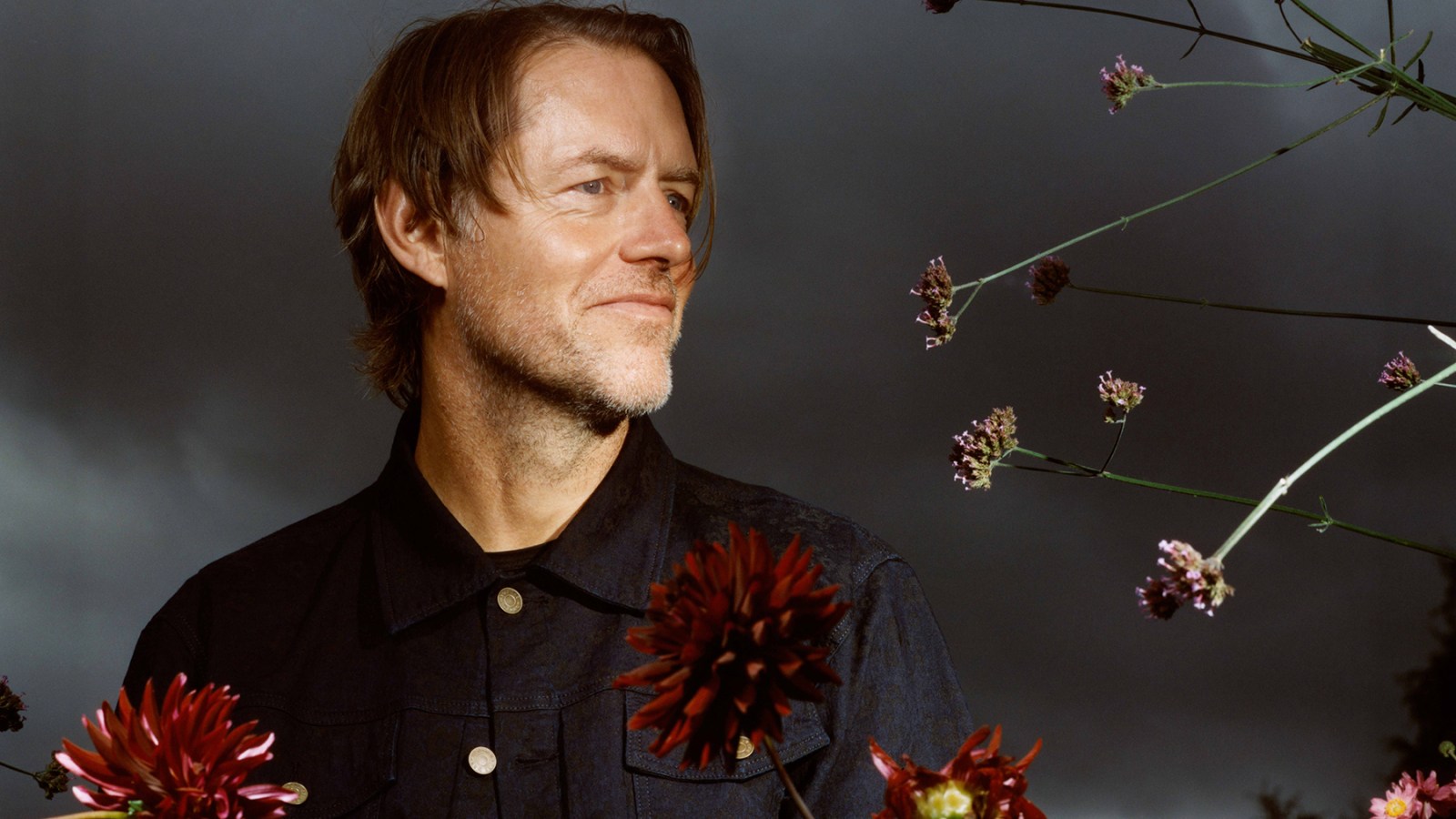

Ed O’Brien is just getting back from a post-dinner stroll near his home in Wales when he logs onto Zoom. “It’s a very dark, still night,” he says. “Went for a lovely walk as the light faded in the Welsh hills.” Around this time of year, as winter turns toward spring, it tends to get muddy, but he doesn’t mind. “It’s earthy,” he adds. “There’s healing in this land.”
O’Brien, 57, speaks with the same calm warmth and sense of hidden depths that he has brought to Radiohead’s music for decades. As a founding member of the acclaimed British band, he’s made crucial contributions on guitar and backing vocals to songs from “Street Spirit (Fade Out)” to “Weird Fishes/Arpeggi” and beyond, more than earning his place in the Rock and Roll Hall of Fame, Rolling Stone’s list of the Greatest Guitarists of All Time, and millions of fans’ hearts. But he’s never opened up the way he does on Blue Morpho, the solo album he’s preparing to release on May 22.
Blue Morpho is technically the second album O’Brien has released outside Radiohead, coming after 2020’s Earth, which he presented to the world under the name EOB, but in many ways its strikingly personal tone and daring creative risks make it feel like a debut. The story of its creation, which he’s discussing for the first time in this candid hour-plus conversation, is one of equally profound sadness and renewal. Listening back to the album recently, he felt good about what he’d done. “It felt honest,” he says, “and at the end of the day, that’s the most important thing for me.”
O’Brien spent more than four years making Blue Morpho, starting not long after the April 2020 release of Earth. As the world shut down and panicked in those early weeks of the pandemic, he and his family were comfortably ensconced at home in Wales. “It was spring, it was summer, it was novelty,” he says. But by the following year, after a second lockdown that the family spent in London, he was feeling unmoored. He refers to the period that followed alternately as a “midlife crisis” or “my dark night of the soul,” alluding to the 16th-century Spanish mystic St. John of the Cross. Whatever you call it, it’s clear that this was a painful time for him.
“I went into a deep depression,” he says frankly. “It was the first time in my life that I had to stop. And what I realized was that I’d been keeping busy, like a lot of people do, running from these ghosts of my past, particularly from my childhood.”
O’Brien was just 17 years old in 1985, when he and four classmates at a boys’ school in Oxfordshire started the band that became Radiohead. By their mid-twenties, they were one of the hottest groups in the U.K., and their career gained momentum at a dizzying rate from there. “From 1990 or ’91 through to 2018, when we stopped touring and went on hiatus, it was pretty much nonstop,” he says. “It’s all-encompassing and it demands your full attention, and it’s addictive in that way. But it’s not necessarily healthy, because you just keep going, keep going, keep going. And then when you stop, suddenly the ghosts catch up.”
Steve Gullick*
With endless time on his hands, he found himself remembering what it was like to grow up in the Britain of the late 1970s, a generation removed from the end of the Second World War. “There was no therapy for children. Emotions weren’t talked about,” he says. “My parents split up when I was young, and it was good that they did split up, but no one ever asked my sister and I, ‘How are you?’ No one ever said, ‘Are you OK?’”
Years later, in 2021, O’Brien was aware that he’d led a very lucky life as a member of what is quite plausibly the greatest rock band of the modern era. “I know I’ve won the fucking golden ticket,” O’Brien says. “If you told my 14-year-old self, ‘You’re going to be in this band with these incredible people and you’re going to make this music’ — it does not get better than that. So how come I felt like that wasn’t enough?”
A phrase that he’d often seen on his report cards as a kid kept coming to mind: “Could do better.” “It’s great when you’re younger, because it spurs you on,” he says. “It’s like a rocket up your arse. ‘OK, we’ve made OK Computer. What are we going to make next?’ Bang, bang. The problem is, when you get into your fifties, it’s fucking unsustainable.”
AS HE SAT WITH these thoughts and the months stretched on, he sank into a gloom that, at its worst, felt like it would never lift. “It was really hard,” O’Brien says. “Some days you just didn’t want to get out of bed. I thought, ‘Will this be with me forever?’”
He wasn’t interested in medication or traditional therapy. Instead, he found solace in working on new music without any set goal in mind, playing guitar for a good chunk of every day. “My therapy was literally locking myself in a room for three hours in the morning whilst the kids were homeschooling and my wife was working,” he says. “I was in such a dark place, but I knew that I had to get up each day, get out of bed, and do this thing.”
The other key to his emotional recovery was getting back in touch with nature, a process he describes as “a deep spiritual awakening” rooted in the ancient landscape of Wales. “I’d take our dog, Ziggy, and we’d go off and walk,” he says. “There are a lot of places of spiritual significance in this land, whether it’s an old monastery or abbey, or a mountain or a waterfall. I was drawn to these places, and through that, I healed.”
He found that those hills were filled with echoes of Led Zeppelin and The Lord of the Rings. “It’s uncanny,” he says. “When you come to this land, you can hear ‘Misty Mountain Hop.’ You can hear ‘Stairway.’” (Indeed, he adds, Robert Plant once lived on the other side of the nearest mountain, and J.R.R. Tolkien used to vacation in the region.) He thought about Kate Bush, too. He started to invite his friend Luke Mullen, a keyboardist, over to his music room to see what transpired: “Me on guitar, him on Rhodes. We’d light a fire and just play and jam.”
Soon O’Brien was feeling lighter, less burdened, more engaged. “The most challenging bit, and the bit that I find fascinating and full of mystery, is the songwriting bit. You get so excited seeing this one little thing you can play on the guitar, you suddenly hear this whole piece…. Music and magic, five letters, they share the same three.”
One of the first songs that took form was “Incantations,” the gorgeous, slow-burning spell that opens Blue Morpho. “When I was in this dark place, I felt like I was lost in a labyrinth,” he says, referencing the Greek myth that featured prominently in the artwork for Radiohead’s 2001 masterpiece Amnesiac. “It’s like, ‘How the fuck do I get out of here?’ And it was a bit like Theseus following Ariadne’s thread. The thread is your gut feeling; it’s small moves, because you can’t see ahead of you, and you have to slay the Minotaur on the way. Maybe that’s the ego, this persona and all these fears you have. You have to slay the beast.”
On the loose, funky groove “Teachers,” O’Brien tried to evoke the sensations he’d felt on a psilocybin trip with some close friends in England’s Dartmoor National Park. “Every year, we’ve had three days in the woods and sat around the fire and we’ve done mushrooms,” he says. “I had a very profound experience one night when I left everyone and went walking. The things I saw, it was almost like the veil was removed.” Over burbling bass played by Yves Fernandez, O’Brien nods to the opening lines of Dante’s Inferno: “Midway through life, I’ve just lost my way.” “That was exactly it,” he says now. “I did lose my way.”
He got further into recording in London in 2022 with producer Paul Epworth, known for his work with acts like Adele, Florence + the Machine, and Paul McCartney. Gradually, he assembled a group of highly skilled backing musicians with jazz chops, including guitarist Dave Okumu and flautist Shabaka Hutchings, who introduced him to the calming properties of instruments tuned to the 432 Hz frequency. The Estonian composer Tõnu Kõrvits wrote swirling, iridescent string arrangements; Radiohead’s Philip Selway played drums on two tracks. O’Brien took a break from recording to help his 18-year-old son prepare for his A-level exams, then got back to it. The final mixes for Blue Morpho, named after a species of butterfly he’d seen during his family’s time living in Brazil in the early 2010s, wrapped almost exactly a year ago. “It’s been a really beautiful journey,” he says. “This record has taken a long time, but I wouldn’t change it, because there’s been so much life in the record, and that has added to the richness.”
AS O’BRIEN PUT those finishing touches on Blue Morpho in early 2025, the world was starting to buzz with speculation about new activity from his other band. Last fall, those rumors came gloriously true when Radiohead reunited for 20 triumphant concerts across five cities in Europe. Harry Styles spoke for many when he recently recalled the joyous feeling in the crowd when he saw them in Berlin, an experience he credited with inspiring his own return to the stage.
The five old friends who make up Radiohead felt much the same, O’Brien says. “That tour was very, very emotional, very profound. We all felt that. We’d look at one another on that stage, like, ‘This is amazing.’ I feel like I’m the luckiest person on the planet, and I’m not just saying that.”
He wasn’t always that thankful. After Radiohead’s previous tour concluded in the summer of 2018, he was ready for a break from the band he’d spent his entire adult life in. “I was done with Radiohead,” he says. “It had got to a place where I just wasn’t enjoying it. I just didn’t resonate with it anymore, and I wanted to do my own thing… I think we’d run out of road. We’d run out of inspiration.” The sessions for 2016’s A Moon-Shaped Pool had been difficult, and he’d been reluctant to play the two years of shows that followed. “The others said they wanted to tour,” he says. “I didn’t really want to tour, and they knew that. But I did it and I’m glad I did. I saw it through to the end.”
The long hiatus that came next was new territory. “It was kind of scary at first,” O’Brien says. “I really thought that was it on Radiohead. Actually, I sort of got off on that. I was just, ‘I’m done with it. I want another life.’”
But the years he spent walking in the Welsh hills and working on Blue Morpho changed his perspective, and in 2024, he joined Thom Yorke, Jonny Greenwood, Colin Greenwood, and Selway at a rehearsal room to explore the idea of reuniting. “We hadn’t played together for six years,” he says. “We’re like, ‘How do we know if we’re going to be any good?’ And the chemistry was there from the very beginning. I think we always knew that if we got the love between us right, then it all flows from there.”

Steve Gullick*
I ask him the question on every Radiohead fan’s mind since the reunion: Are there more shows to come? O’Brien answers without hesitation. “It’s definitely happening. What we’re going to do is, every year we’re going to do a different continent, and we’re going to do 20 shows each year. No more, no less.”
He says they plan to resume the tour starting in 2027 (“We won’t do anything this year, but we’ll do something next year”), and that they’re eyeing stops in North America, South America, and Asia/Oceania. “We want to give absolutely everything each night,” he says, explaining the reasoning behind the limited 20-show model that worked so well in Europe. “We do not ever want it to be like we’re going through the motions or we’re having to run on empty. We’ve got to be able to do it. And you know what? We’re not spring chickens anymore.”
In the meantime, he’s thinking about how to present Blue Morpho live. He doesn’t feel that a straightforward rock show is right for the material, so he’s considering something more fluid and jazzy, possibly including contributors like Shabaka when they’re available. “We’re dreaming it up at the moment,” he says.
It took years, but he’s conquered the doubts he used to feel about his solo work. “I’ve had so much insecurity about my own songwriting,” he says. How could he not, coming from a band as unique as Radiohead? “You come from this place of extraordinary musicianship and extraordinary songwriting, so there is a comparison,” he says. “But what was so beautiful about this record was, I sort of let go and I just didn’t fucking care. Because the process of it, I love it so much.” He’s smiling now. “I’m going to do this until the day I die.”