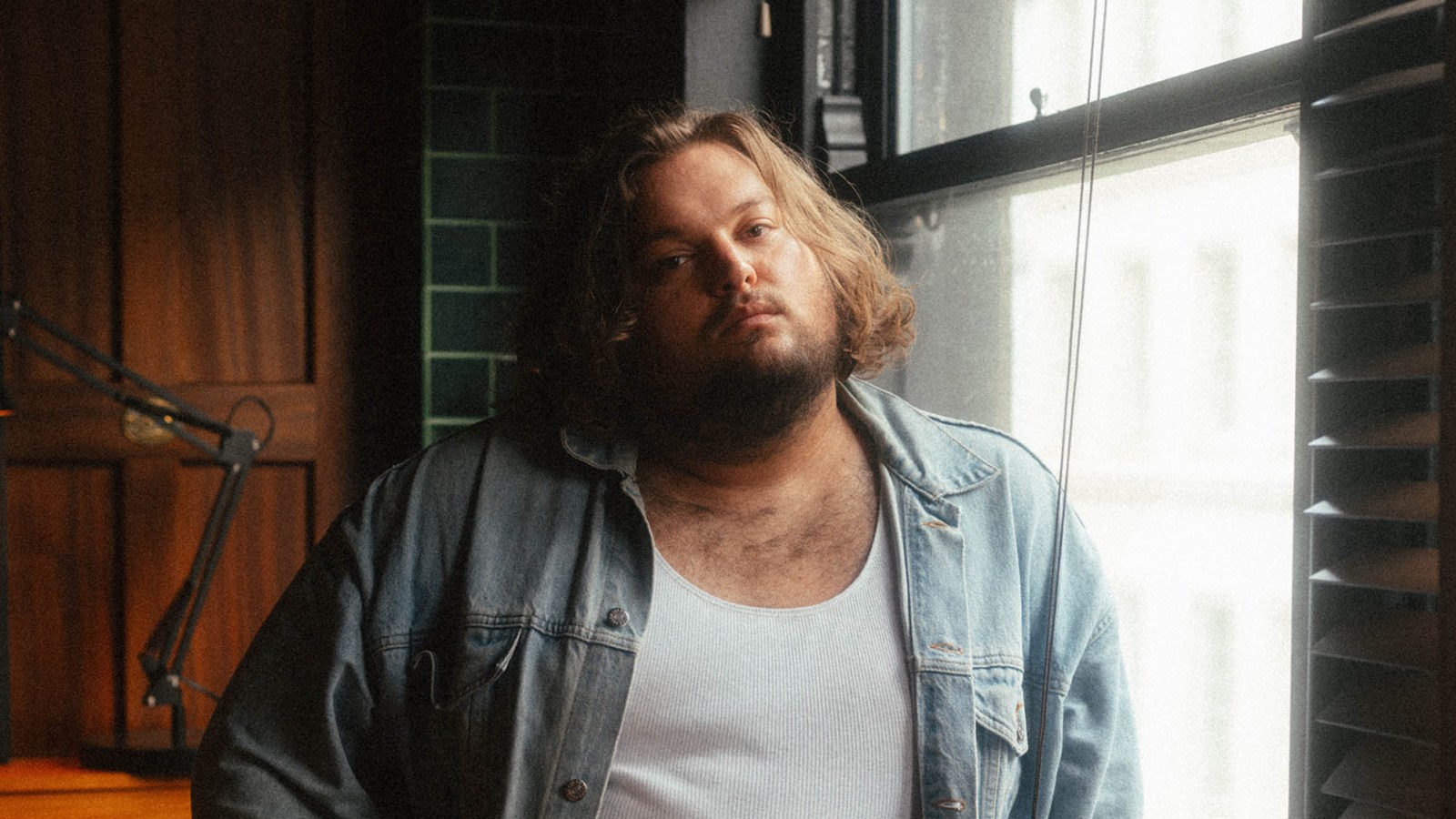

There’s a small part of Tyler Perry that can’t help but wish it were still 2022. That was back when he was becoming familiar with Academy of Light, the loosely formed ambient noise collective helmed by East L.A. musician, producer, and scene organizer Ryan Pollie. Much of the corresponding community of songwriters and bands centered around a tiny tavern-style bar in Eagle Rock called the Fable, which Perry began frequenting.
“I created Tyler Ballgame to play a show at the Fable,” Perry says, referring to the artist moniker under which he now performs. “There were 40 or 50 artists in L.A. who were part of this ambient collective, and all these bands started forming, and we’d all go to each other’s shows. That was a big part of building the myth around Ballgame.”
Mythology and community are two concepts that come up quite a bit in conversation with the 34-year-old singer whose album For the First Time, Again is one of 2026’s buzziest independent debuts. It’s yielded Perry a genuine indie radio hit (“I Believe in Love”), an opening slot for Alabama Shakes, and even a DM from his hero, Fleet Foxes’ Robin Pecknold. “Tyler has a very unique way of writing,” says Jonathan Rado, the album’s retro-fluent co-producer, who’s worked with Father John Misty, Miley Cyrus, and the Killers. “That obviously involves tapping into classic music and drawing on nostalgia, but it’s not completely wrapped up in that.”
A few days after the album’s release, Perry calls Rolling Stone from a London flat owned by his label, the latest temporary home he’s crashing in after the sudden and surreal experience of being “plucked,” as he puts it, from that Eagle Rock scene just a few years ago and signed as a next-big-thing to Rough Trade Records.
“I’m kind of waiting for the ‘Gee, shucks’ feeling to wear off and then just step into, ‘No, you’re an artist now, this is your life,” he says. “Maybe that kicks in by record two or three. It’s such a far cry from where I was not that long ago, and it feels like a bit of whiplash. But it’s also very validating, because I’ve always wanted this and expected this. When I was 13, in my little diary I wrote, ‘I’ll never give up until I make it.’ Ballgame is a character. It’s a mask. Anyone can be their idol if they wear the mask.”
When the album came out early this year, Perry was flooded with congratulatory notes from just about everyone in his life. Of all the messages he received, none meant more than the one he received from Greg Cooney, his music and drama teacher when he was growing up in Cumberland, Rhode Island. Perry took to theater and chorus as a kid, and it was Mr. Cooney who’d encouraged his adolescent passion, which included theater, chorus, and the classic rock legends that Perry would stay up late in bed listening to on his iPod, like David Bowie, Jim Morrison and the Who.
After high school, Perry and his friends formed a Fleet Foxes cover band called Knox and the Overstreets. Before long, he’d enrolled at Berklee College of Music, but that didn’t last long. He began soaking up all sorts of influences, from quiet songwriters like Joanna Newsom and Frankie Cosmos to Mexican crooner Juan Gabriel to the 2000s cult indie darlings Krill. (Perry recalls one memorable Krill show on Cape Cod as “red-faced, bald white guys sucking down their sixth oyster, and there’s Jonah [Furman] screaming and lamenting.”)
All those varied influences made their way into Ralph Waldo, the morose, folk-leaning musical project whose style Perry sums up as “thinking I was Nick Drake or something.” The Ralph Waldo period also coincided with what Ballgame has described as a prolonged period of depression. “I was consigned to my lot in life of being this talented person who was never going to make it,” he says.
Then Perry realized he could engage in a time-honored American tradition: He could become someone else in California. Borrowing part of the nickname for another New England legend, Red Sox Hall of Famer Ted Williams, Perry fled Rhode Island for Los Angeles and began rediscovering parts of himself he’d buried since childhood — namely, his operatic, full-bodied voice.
“The whole project of Tyler Ballgame is about me understanding ego and identity for the first time,” he says. “What are idols but stories? It’s the story that Ballgame is building: It’s not actually real. It’s this shared mythos that we all wound together and build, a cocoon around what’s actually real, which is right here, right now, my consciousness being right here and me breathing in and out of my body. It’s the freeing of myself from my suffering, which I had been so attached to. I was so depressed. And then, all of a sudden, I said, ‘If I want to change my life I can just leave everything and just try, for real.’ And I did, and it’s working.”
Perry first performed as Tyler Ballgame in 2022. “The first time the full band played at the Fable, it felt like the Cavern Club,” says Rado. The two connected for the sessions that lead to For the First Time, Again, which were co-produced by Pollie. The album is mostly getting talked about as a throwback blend of crooning and traditional vocals (he’s often compared to Roy Orbison). But there are plenty of surprising left-of-center moments that hint at Perry’s expansive influences — see the odd time signatures and multi-part odyssey of “Ooh.”
Perry plans on drawing on influences that range from Brazilian tropicália to hard punk on his next record. And he still talks wistfully about the ability to draw on — and take in — all those sounds from the free shows at the Fable a few years back.
The sudden rise of Tyler Ballgame from the Eagle Rock scene is something Perry seems to feel some ambivalence about. He’s profoundly grateful for his newfound success, a success he’s always craved, and he feels lucky to have had several years to find himself artistically under the radar alongside a community of like-minded artists he’s quick to shout out: Gelli Haha, Elissa Mielke, and Nymphlord, to name just a few. But another part of him is already nostalgic and wistful for that period, now that he’s living out of a suitcase as he globe-trots on a multi-year promotional cycle.
But if Perry has learned anything about himself in the past few years, it’s that Tyler Ballgame’s approach to such anxiety is to simply live in the moment.
“It’s been a challenge,” he says. “Because that now feels like a golden era that’s gone, or it’s at least going to take some real scheduling and muster to bring back remnants of that. But, also, a big part of me being where I’m at is letting go and surrendering to wherever the river is taking me.”