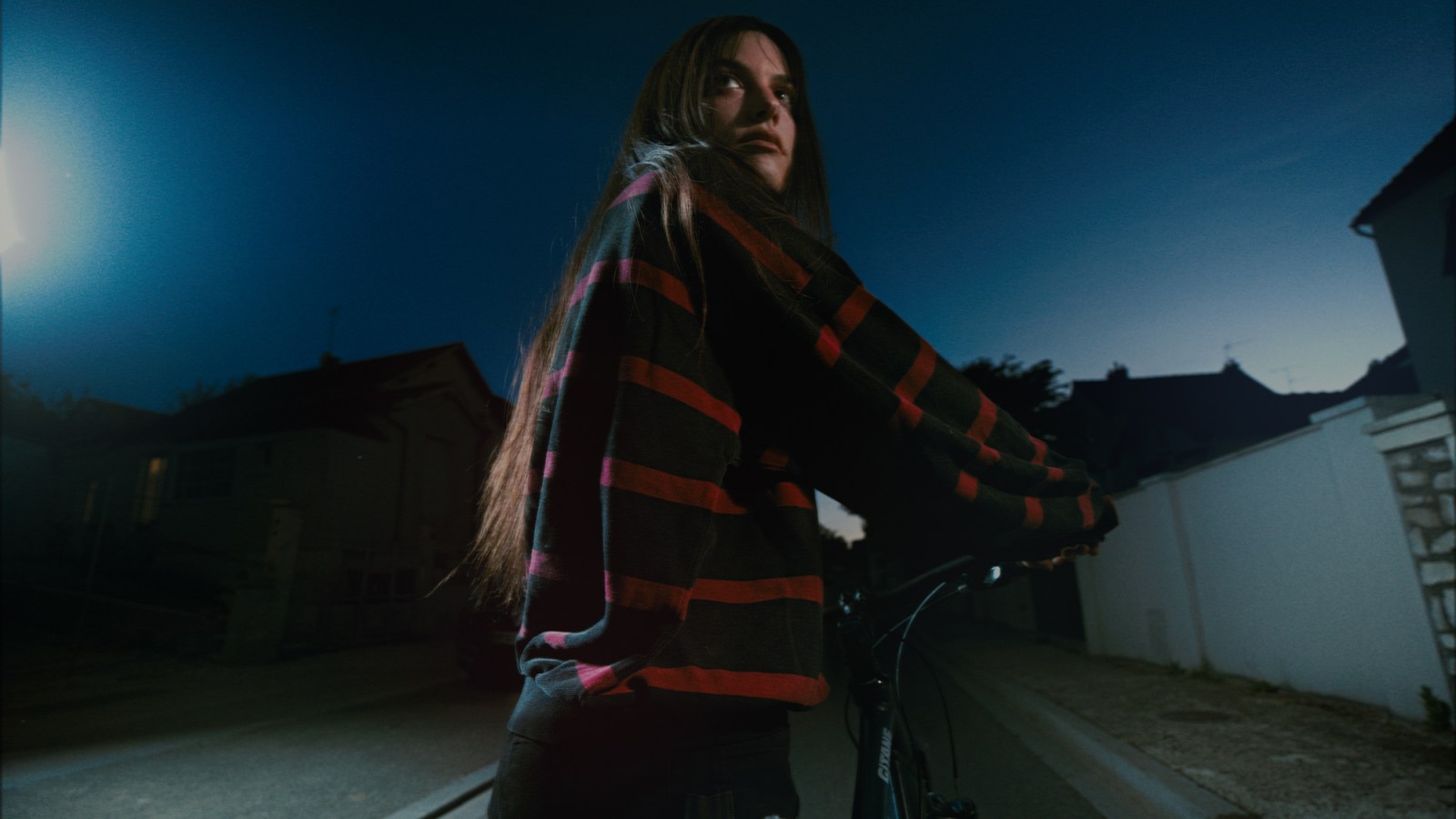

Last year, the French singer Oklou released Choke Enough, a debut album full of glitchy futurism and casual profundity, like the musical equivalent of an artwork by Jenny Holzer. Lauded by critics and fans alike, it quickly marked her as a new force in experimental pop music. She also became a mother, shared a deluxe edition of the album featuring FKA Twigs, and toured the world. When I reach her, she’s ducking into a cafe in the French countryside, where she now lives. It’s one of the rare periods of downtime she’s had in months, and she’s enjoying doing “not much” these days.
“I’ve been taking care of my son, taking care of my house, resting,” says the 32-year-old artist, born Marylou Mayniel. “I think I’ve been working too much, to be honest.”
Mayniel has been making music for as long as she can remember, attending conservatory as a child in western France and receiving classical training in piano and cello. She remembers her time in music school fondly: “I was very happy,” she says. “It was nice enough for me to not be disgusted, actually, by music theory.” That attention to technical knowledge has remained with her to this day, even if she considers her true music career to have begun “when I got my own computer.”
Choke Enough is the first official album she’s released as Oklou, but Mayniel’s music has been drifting around online since 2013 (a surprisingly comprehensive, lucky-for-us digital archive of her experimentation still exists on YouTube). In 2020, she released the mixtape Galore, which felt like the most cohesive, realized culmination of the signature sound she had been crafting for almost a decade. “It’s been years of research,” she says. “If I write a song and I feel like only I can embody it, only I can play it live…that feeling is what I’m seeking.”
Her album features a dreamlike, blue-tinted haziness, with flickering synths produced by A.G. Cook, Danny L Harle, and Casey MQ. That sound has been compared by some to easy listening or video-game music, but Mayniel sees it simply as a playful approach that’s rooted in her feminist perspective. “[People] sometimes claim your right as a woman is to speak louder than men, when I think that we don’t have to align with men at all,” she says. “We can do better. We can do different. I’m trying to convey really intense emotions without being physically intense. In that way, I think trying to be closer to children’s energy than men’s energy is something that I’m interested in.”
In a 2025 guest appearance on the streaming radio platform NTS titled “Choke Soundscape,” Mayniel curated an eccentric collection of inspirations behind Choke Enough, from cult favorites like English psych-folk artist Vashti Bunyan and New York vocal trio the Roches to bigger names like Tears for Fears and Yung Lean. In the mix, the songs have often been edited to sound more muted and distant, as if they’ve been dunked underwater, like one of those “[Song Name] But You’re In the Bathroom At a Party” videos on YouTube. The squawk of a bird comes up throughout the setlist, sounding also vaguely like a faraway siren. It’s a mechanical production element that also appears on other tracks, and if you think about it with enough whimsy, it’s the same creature she sings about on album closer “blade bird.”
“I can’t help it, my blade is on the bird,” she sings in an intonation close to that of a nursery rhyme. “I’ll be the one who ends up getting hurt.” Talking about that song in a 2024 interview with Office Magazine, she said: “You fall in love with people because they represent a sense of freedom, but for me, truly love and relationships are about being able to rely on somebody.” Her song is about the concept of loving without needing to possess, but it’s also a funeral for that idea.
Mayniel’s lyricism is often fragmented and piecemeal, and her words don’t always make straightforward sense. “When I sing on top of instrumentals, I use gibberish in English,” she says. That’s not to say all of it is entirely random. “Whatever sound I’m using, I’ve been using it for a reason,” she says. “I’m trying to stick to these sounds and find words that are actually matching the gibberish.”
In the midst of the album’s trance, Mayniel breaks the fourth wall when she asks deceptively simple questions that jolt the listener almost existentially. On “endless”: “Is the endless still unbound, or am I just different now?” In a contemplative moment on “family and friends”: “If I ever cradle my belly, stepping into the fantasy, will I wanna go back?” And on the title track, “Will this life grant me the space?”
Mayniel has said that the tension in the track “choke enough” is the same one that runs through the entire album. “What situations are we ready to put ourselves into in order to feel alive?” she asks. I turn the question back to her. Does the formula go: Danger = Life, Stability = Love? Is it possible to hold both at once? Will life grant us the space?
“I don’t know if I’m going to be good enough with my words to actually say what I feel deep inside, but for me, this question is almost political, because it talks about our Western societies and the relationship we have with modern life,” she responds. “You have to do so many things to feel alive, you have to travel, you have to do all this stuff. It’s a very consumerist and a very capitalist way of having to appreciate life, when 100 years ago, our own families were not living in that way at all and they were not unhappy.”
When asked about what specific form her happiness takes now, Mayniel takes a beat before speaking. “My career is taking a step,” she acknowledges. “I’m really not like, ‘I’m going to conquer the world.’ I just want to make sure that when I look back on my career at 70, I will be proud of the messages and the examples that I’ve been giving, [especially] for my son.”
Now that Choke Enough and its title track have had some time to breathe in the world as a finished product, the answers for Mayniel are getting clearer: “I feel like I’m just getting deeper and deeper into thinking that a humble life, respectful of the environment, and maybe away from the city is something I really believe in.”
As for what’s next, Mayniel doesn’t seem too pressed to figure it out. She’s “not so interested” in the idea of ushering in a new “era”: “I think you can do magnificent stuff without it being super intense or super surprising,” she says, breezily. “New things can be a channel for subtleties and quietness.” It’s a refreshing outlook on forward movement, rooted in the self-assuredness that Mayniel carries with her as an artist, as well as the peace she’s made with all that life offers, with all of its endlessness, limitations, and strangeness.
“I’m not scared of how things are going to turn out to be, because deep down, I know how I feel about them anyway,” she says. “For Choke Enough, for instance, I have a very special relationship with that album. I know what I think it misses. I know why I think it’s good in some other ways, and I feel like no criticism or no praise could change my relationship with my own record.”