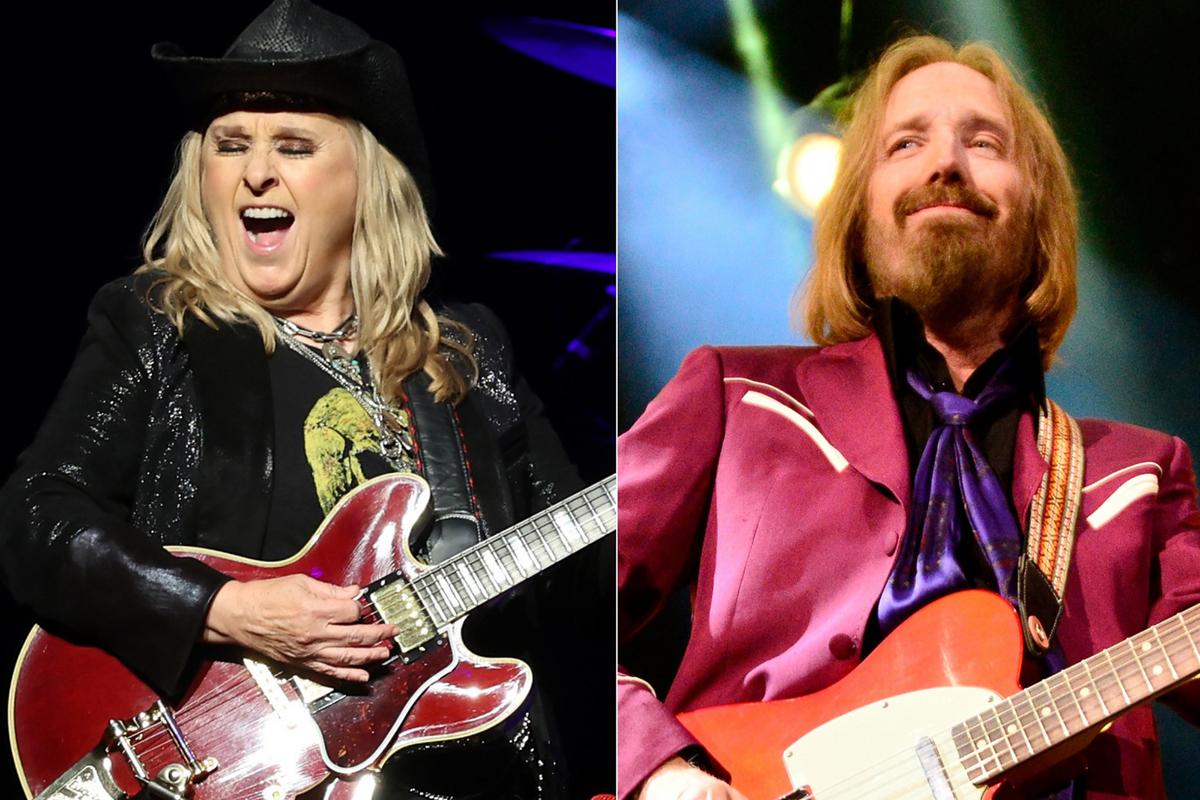

Melissa Etheridge wanted to play with the matches. But there’s no need to call the fire department.
Instead, it was Johnny Cash who lit the initial match, figuratively speaking, that provided the spark which led Etheridge, still a kid, to tell her mother that she wanted to play with the matches. It was her way of saying she wanted to do what she saw Johnny doing and play music.
It’s an experience that she’s now immortalized in song with “Matches,” one of the many potent tracks fans will hear on Rise, the singer-songwriter’s newest album (coproduced by Shooter Jennings), which landed in stores this week.
Her dreams certainly worked out. She played her first full set at Radio City Music Hall in 2025 during a gig where she shared the stage with the Indigo Girls, another bucket list venue and moment checked off in a career that has had many of them.
In today’s conversation, we discuss some of those highlights. She’s been nominated for the Rock & Roll Hall of Fame’s 2026 class, but she also was part of a star-studded bill at the Rock Hall’s grand opening concert more than 30 years ago.
Bruce Springsteen joined her on stage for her MTV Unplugged that same year, sharing the microphone for a powerful version of his “Thunder Road.” The more you talk with Etheridge, the more these anecdotes come to the surface.
They’ve all helped to form the fabric of Rise, a great driving record that as she told us, was informed by the feeling of albums she loved in a similarly road-ready way as she was coming up. It’s a lengthy list which includes artists like Tom Petty, Eagles, Fleetwood Mac and many others.
Hearing “Don’t You Want a Woman” during the Radio City performance and other standouts on Rise like “The Other Side of Blue,” a collaboration with Chris Stapleton, it’s clear that Etheridge has a lot of miles left on her own journey.
You’re nominated for the Rock Hall and I want to start there, because you were part of one of my favorite shows, when you played the grand opening concert for the Hall in 1995. What are your favorite memories of that day?
I was overwhelmed by how many of my heroes were there. It was…overwhelming, is a very, very good word. There were moments that are just seared into my head. I remember [one moment with] myself, Sheryl Crow, Natalie Merchant, Chrissie Hynde…it was just all us girls and we were just dancing.
We got ourselves caught up in this backstage dance and man, that was fun. [But] my favorite memory is when James Brown was on stage, and they had a bleacher side stage that you could come out and watch [the show]. It was packed with John Fogerty, Bruce Springsteen, John Mellencamp, myself and on and on and on. We’re all watching James Brown and I still get goosebumps when I think about it now.
The hardest part was…I have a Chuck Berry story now, like many others. Bruce Springsteen comes to me and says, “Hey, I’m going to do ‘Rock and Roll Music’ with Chuck Berry. Do you want to do it with me?”
I was like, ‘Duh, yeah!’
So, right before we go on, Chuck Berry tells us it’s in G and we walk on stage, and the band that’s playing [included] Duck Dunn and it was this great band [Booker T. and the M.G.’s], and they’ve been playing all day, and they’re wasted, okay? They’re out of their minds. We started the song and it sounds so bad. I’m looking at Bruce and I’m looking around and I’m like, ‘We’re not playing in the same key and it’s a simple rock and roll song. It’s ‘Rock and Roll Music.'”
But Chuck Berry has done what he does, and he told the band one key and he told us one key. I tried to get over to the band, I’m like, “Oh my god, what key are you in?” And I’m trying to look at [Chuck’s] fretboard and he just keeps looking at me, going, “You’re really pretty.” I’m like, This is a nightmare!” So my great Chuck Berry, Bruce Springsteen moment, it’s not even on the internet. It was so bad.
READ MORE: 8 Things You Didn’t Know About ‘The Concert for the Rock & Roll Hall of Fame’
Watch Melissa Etheridge and Bruce Springsteen Perform ‘Thunder Road’
Since you mentioned Bruce, it was such an iconic moment when he came out to do “Thunder Road” with you on MTV Unplugged. As you’re getting ready to play the song with him, you told the audience the story of what it meant to you. But can you take us a little bit behind the scenes that day as far as getting ready for that with Bruce?
I just recently was working with a couple of young women who were like babies when I did that and I said, “Oh, you got to see this.” And I pulled up the YouTube of me introducing Bruce and then singing with him. As I listened to myself talk to the audience. I got nervous all over again. I was like, “Oh my God, I’m feeling it again.” [It’s that] feeling [that] you’re in a dream come true moment. Remember this for the rest of your life. Take it in. Breathe. This is worlds coming together — and it was so special.
The whole experience with him, from rehearsing the song up in the dressing room at the Brooklyn Academy of Music, I’m just sitting there with him and we’re practicing “Thunder Road.” We’re saying, “Okay, you do this, you do that,” and we’re singing it. He looks at me and he goes, “You know, this song doesn’t have any chorus,” like it’s the first time he ever thought that “Thunder Road” didn’t have any chorus. I was like, “Yeah, ‘Thunder Road’ doesn’t have a chorus, but it’s one of the greatest songs ever written, so I think you did okay.”
We walked on stage for the soundcheck and he looked around and goes, “Where’s your band?” I said, “Dude, this is Unplugged. It’s just me and my guitar.” And he goes, “You don’t have a band?” And this is actually right before he did [his album] The Ghost of Tom Joad. He actually watched and he did it with me, just him and I and he had never broken it down so much. And after that, he went out with Tom Joad. And I was like, “Yeah, you go be a solo guy!”
READ MORE: When Bruce Springsteen Unplugged Again With ‘The Ghost of Tom Joad’
I like that you used the term “I want to play with the matches” when telling your mother that you wanted to play music, to do what Johnny Cash was doing.
When that came to me, I was sort of swimming in the memory of when Johnny Cash came to my hometown of Leavenworth, Kansas. Which we didn’t even have a venue for people to play, so anybody coming to Leavenworth, Kansas was huge news. But he was playing at the prison. I was eight years old and it made such an impression because it was in the local paper. I knew I could see the prison from my backyard. It was like three blocks away.
The last project I did was with the Topeka Correctional Facility for Women, which is the women’s prison in Kansas. People had been asking me and I was telling them this Johnny Cash story. I remember just thinking, “Oh, that he could come to my town means that somehow there’s a possibility that I could go out in the world.”
Somehow it made sense in my eight-year old brain. Music and singing music for people, was the thing that was lighting me up. And it was just what I wanted to do. I was thinking of [how], you know, no one in 1969 is going to look at a little girl and go, “Oh, you want to be a rock star. Okay?” You know that that wasn’t something. And so it was that sort of forbidden thing that I wanted to do. So “Matches” is that story of, “Oh, mama, let me play with the matches. Let me do it.”
By the time I was 13, I was playing in in bars, in cover bands with these older guys. And my mother was…I would hate it. I don’t want my 13-year old going to a bar. So I understand it now, but then I’m like, “No, no, please. Let me do this. Let me play with the matches!” Actually, matches is one of my favorite songs on the album.
Listen to Melissa Etheridge’s ‘Matches’
I love the way you gently bring the listener into the song with the sound and the tone of the way that song unfolds.
“Matches,” I call it my “scratch pad song.” When I go in to write, there’s like a big notebook, and on the first page and second page, I’ve just got lyrics. Probably “Mama, let me play with the matches” was written on it because that’s the feeling that I wanted and it’s the scratch pad.
I have no expectation for the song, I’m just throwing things out and throwing lines together and the intro to the song is so different. And then how I turn the song from minor to major was not even [what I would have been thinking] if I had been constructing [things] like, “Okay, this is song number three, and I’m going to do this,” I would have constructed it differently. But because I was more free-form, it really flew.
And then when I realized, “Oh, I need to get into the verse this way, it was just like, “Oh, well, I’ll just do this.” [The transition happens] not carelessly, but easily and that’s why the song has this sort of easy feel to it. I wasn’t even going to put it on the album until I played it for my wife. And she was like, “Oh no, you have to put that on the album!” [Etheridge laughs]
“Matches” and “The Other Side of Blue” are two songs on this album that sound like musical versions of fever dreams. They take you to a certain place. It feels good when you have a song like that taking shape.
Oh, “The Other Side of Blue” is a whole ‘nother creation and I’ll get back to that. But the intention for this album was I wanted it to sonically attract people. I wanted it to be the album that you can take that 45-minute drive you’ve got to take. You’re starting with the first song, and you turn it up a little and you turn it up a little more because it just sounds so good in your car. That’s what those songs are.
The song intros and everything, I just wanted it to be [like when] I drove out to California from Kansas. I had tapes of the Eagles, Fleetwood Mac and even Tom Petty, just this, California sort of rock and roll. I was working with Shooter Jennings [on the] production and I said, “This is the sound I want.” I wanted it to sound like those good, rich, yummy, songs you can sit in the middle of and hear the guitar being played and hear everything.
Watch Melissa Etheridge’s ‘The Other Side of Blue’ Video Featuring Chris Stapleton
“The Other Side of Blue,” I had recorded the album and I hadn’t worked with Chris. I had put out a request [asking] if he would like to work with me — and he said yes. Which, he was the only one I was interested in collaborating with, so I went down to Nashville.
I’d never met him. I never talked to him at all, but we showed up in Nashville at RCA , Studio, B, I believe, Chet Atkins used to record [his] Countrypolitan albums [there] and it was the biggest studio I’ve ever been in my life. [Chris] and I are in there, just in the corner, writing. I had come in and we just started the small talk. I asked him, “Do you have any kids? He’s got five kids and it’s always really busy.
And then he asked me if I had any kids. I said, “Oh, well, I had four of them, but I lost one about five years ago.” And he said, “Oh, I’m so sorry.” And I said, “No, no, no, he was my greatest teacher.” Chris stopped and looked at me and he said, “Wow, Melissa, you you talk in song.” And that’s the first lyric We started writing it right there. And for the next hour, that song just rolled out.
You’re starting a big tour. You’ve got to be itching to play this stuff on stage. “Don’t You Want a Woman” sounded great at the Radio City show last year.
I realized that years ago, I was like, ‘Okay, I I can be as clever as I want to be in the studio, but I’m going to live with these songs for years, and I’m going to sing ’em. So when I was approaching this album, I said, “I want every song to be able to just go right on the stage and it be the song that you hear on the record.” It was very, very intentional. That’s why I went in with my band. We did do [some] overdubs. We made it sound good. It’s not going to sound exactly like it, but the meat of the song, you’re going to know it. You’re going to be able to hear it live and then go find it and it will be the song. I want people to go, “Oh, I like that. Maybe I’ll get that album. That’s the way I work now.
Watch Melissa Etheridge’s ‘Don’t You Want a Woman’ Video
64 Women Who Deserve to Be in the Rock and Roll Hall of Fame
Girl groups, singer-songwriters, guitarists and everything in between.
Gallery Credit: Allison Rapp