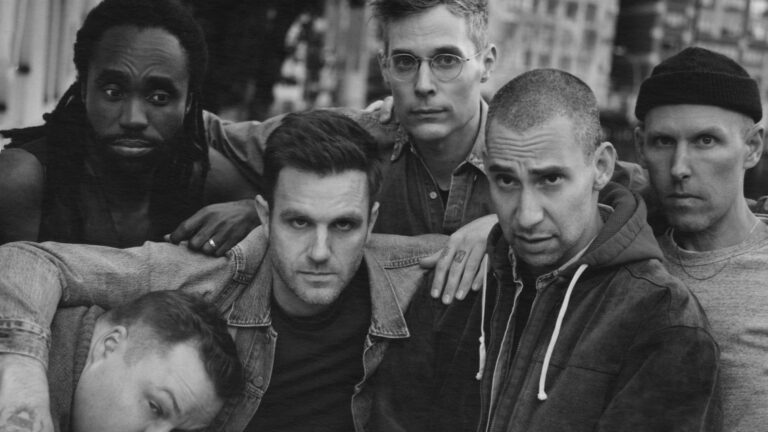
In his new book, Almost Grown: A New York Memoir, singer, songwriter, and hardcore punk pioneer Jesse Malin chronicles his rise from the streets of Queens to the stage at Madison Square Garden. But it’s not just a New York City tale: It’s a story of perseverance and overcoming the odds, both in Malin’s musical career and in his personal life. In May 2023, the author suffered a rare spinal stroke that left him paralyzed from the waist down.
Malin bookends his memoir with the recollections of his medical injury and his ongoing recovery, but in the chapter “Young Anarchists (In Love),” exclusively excerpted here, he recounts how he and his friends were perhaps too earnest in their anarchist beliefs, even as the music they was making and listening to was a reaction to the politics of the Seventies and Eighties. Read today, it’s hard not to also interpret Malin’s words as a commentary on life in the U.S. in 2026. “We hung out in bookstores and on stoops dissecting these ideas,” he writes. “We hated the right-wing politicians who were thirsty for war.” Malin’s memoir is out today, via Akashic Books.
To this day, I still can’t hear the line “Most of all you’ve got to hide it from the kids” from the Simon & Garfunkel song “Mrs. Robinson” without choking up.
When my mother got sick, she didn’t tell me or my sister for a long time. I gleaned the truth from eavesdropping on her kitchen phone calls. I heard the fear in her voice.
After Grandma Renee died young, my mother was afraid that she would get cancer, too. When she was diagnosed with breast cancer at thirty-seven, she hid it from us kids, especially Juliet, who was scared of her own shadow. Scared of monsters under the bed, scared to go to school, scared of everything—that was sweet, gentle Juliet.
Eventually, my mother couldn’t hide her illness from us anymore. She had a single mastectomy, followed by chemotherapy. She had a hard time with losing her hair and the surgical devastation of her body. Mastectomies were crude back then. She looked like she’d been attacked with a chainsaw. She had a long, jagged scar across her torso, and no reconstruction—just a prosthetic breast to wear inside her bra.
I remember looking at Lisa and thinking, If something this awful happened to her, would I still love her just as much? I knew the answer: nothing could change how I felt about her. We were madly in love, constantly looking for places to fool around. That must have been hard on my mother while she was going through this. She wasn’t always so nice to Lisa.
I think my mother felt robbed of her beauty, and perhaps any chance to find a real partner. Frank Shira still came around, when he could. He never abandoned her—but he never left his wife, either.
When my mother went into remission, we were overjoyed. But my sister was still scared, and would beg, “Mommy, please, promise me that you’re not gonna die.”
“I promise you I’m not gonna die,” my mother said every time.
On an icy January day, Paul, Danny, Javier, and I lugged our gear from Javier’s beat-up blue station wagon into Radio City Music Hall’s side entrance on 50th Street. I had just turned sixteen, and Heart Attack was about to make a new record.
Ed Bahlman produced arty bands like the Bush Tetras and Liquid Liquid. After seeing Heart Attack play the Ritz, Ed booked us into Plaza Sound on Radio City’s eighth floor. I couldn’t believe we’d made it all the way from crooked Northern Boulevard to shiny Rockefeller Center.
As I dragged my little amp into the studio, I was floored by its massive size. The walls were covered with mirrors and ballet barres for Rockettes rehearsals. I was more excited that the Ramones had made their first album here. Ace Frehley from KISS recorded “Back in the New York Groove” here, too.
Danny and I took off like a couple of chimps, running down the stairs and dashing all over the Radio City stage. I climbed a narrow iron ladder until I reached a catwalk high above the stage. I charged across it with total disregard for life and limb. We finally calmed down enough to return to the studio. Javier eyed us with disdain, shaking his head as he tuned his drums.
With Ed at the helm, wearing some funky outfit that looked like his pajamas, we tracked six songs. Javier’s ferocious drumming on “From What I See” is one of the first blast beats ever recorded. Danny added tight, tough-fisted guitar. Keep Your Distance was Heart Attack’s most political record yet.
Anarchy was in the air. The circle-A was spray-painted on walls all over downtown. It decorated T-shirts and jackets at trendy stores. But Lisa and I were interested in real anarchists, not the poseurs shopping for anarchy at the mall I mocked in my song “Trendies.”
We loved the film Anarchism in America, which taught us that the US was founded on anarchist principles of freedom and independence. Giorgio hipped us to the French Situationists and The Society of the Spectacle by Guy Debord. These influences were antiauthoritarian—but also intellectual. They opened my mind to an entire world of subversive ideas and actions beyond punk rock.
Lisa and I ran with a group of earnest kids who passionately believed that we could change the world. We believed in a free, self-governing society based on trust, not rules. We hung out in bookstores and on stoops dissecting these ideas. We hated the right-wing politicians who were thirsty for war.
In just two years, I would be required to register with the military. As a child, I had seen soldiers’ bodies come home in boxes from the Vietnam War on TV. Now, I was scared that I could be drafted into Reagan’s dirty wars in Central America.
Lisa and I attended every antiwar and human rights demonstration in town, and all the Rock Against Racism and Rock Against Reagan shows. Heart Attack played at some of them, too.
My mother got fed up with my nonstop preaching. “I don’t wanna hear that garbage in my house! What, are you being brainwashed by communists? Go down to Washington Square and stand on a soapbox if you wanna talk that crap.”
Some anarchists railed against eating meat, but I conveniently ignored that. I lived on McDonald’s and White Castle burgers. My heroes, the Bad Brains, were vegetarian, but I associated that with their Rastafari beliefs.
One day, though, I noticed a bumper sticker on Nick Marden’s stove: LOVE ANIMALS, DON’T EAT THEM. It stopped me in my tracks—and made me think. I had never connected a hamburger to a living being before. I bought a copy of What’s Wrong with Eating Meat? at St. Mark’s Bookshop. After reading it, I couldn’t kill a cow to get a burger anymore. I switched my diet to bagels, falafel, and deep-fried tofu burgers. I had yet to learn Vegetarianism 101: eat some vegetables.
Lisa went vegetarian six months before I did. She was into feminism, too, and fighting the patriarchy. Our pal Philo Virgin pressured me to sell my “sexist” rock albums. Philo wore the same utilitarian outfit every day: black wool cap over shaved head, plain black T-shirt, black pants, black boots. No badges or chains. “You gotta get rid of all this Zeppelin and Aerosmith,” he declared, rifling through the albums in my bedroom. “These records are degrading to women! . . . The Dead Boys gotta go, too.”
“Why?” I cried. “They’re punk rock!”
“‘Caught with the Meat in Your Mouth?’ That’s punk?” Philo sneered. “And fuck Iggy Pop—screwing teenage groupies. These pigs treat women like objects.”
“Not Iggy!” I groaned, as Philo tossed Raw Power onto the reject pile.
This was just the beginning of us young anarchists becoming judgmental jerks.
Lisa and I started an anarchist collective with Philo, Stephan from False Prophets, my bass player Paul Pittman, and Sharon Gannon—an artist and animal-rights activist who waitressed at Life Cafe. We held meetings at Stephan’s grimy ground-floor apartment on Avenue B.
Stephan’s bedroom was a horny hoarder’s paradise, filled with stacks of dirty magazines. Lisa and I decided this was unacceptable for an anarchist. We hatched a direct-action plan—for the cause. We would meet at Columbus Circle at precisely three o’clock on Friday and head downtown.
We exited the subway at Astor Place, marched over to Stephan’s apartment, and banged on the door. He opened it in his pajamas, rubbing his eyes.
“Hey,” Stephan yawned, “what’s up?”
“We need to talk, man,” I said.
Stephan sighed. “All right. Come on in.”
Lisa and I sat down while Stephan poured himself a mug of coffee and went to get dressed. When he came out, Lisa announced, “You need to throw out all your porn.”
“I . . . what?” Stephan muttered, taken aback. He shot me a pleading look.
“Yeah, man,” I said. “You gotta get rid of it. If you wanna be a real anarchist.”
Being anarchists, we had to debate this for a good hour. Eventually, Stephan caved. Lisa and I supervised as he reluctantly stuffed his magazines into half a dozen Hefty trash bags. He trudged unhappily out the door with each bag, and tossed it into the dumpster down the street.
Mission accomplished, Lisa and I headed to St. Marks to sell my “sexist” records on the sidewalk. People sold used clothes, books, and records dirt cheap on sheets and blankets from Broadway to Second Avenue. Some of the stuff was definitely hot.
Once, someone broke into Javier’s van and grabbed my motorcycle jacket—the first one I ever had made of real leather. That jacket meant the world to me. I had painted MASSACRE—one of my song titles—on the back in big white letters. The next day, Javier and I spotted a guy strutting along St. Marks wearing my jacket. We chased him down and he grudgingly handed it over. He had bought it for twenty bucks off some sidewalk-selling junkie.
Lisa and I hung out on the sidewalk all day sometimes—selling our stuff, drinking beer, and joking around with characters like Jerry the Peddler, Geneva Unconventional, and Matt Zombie. I liked selling things I didn’t want anymore, as a stepping stone into my life’s next chapter. It felt freeing to let things go. Another fun way to make a little money just hanging out.
The sidewalk wasn’t some cozy suburban garage sale, though. There were lots of crazies wandering around. And if you set up in front of a shop, look out. The owner might charge out and kick your things into the street screaming, “You’re blocking my store, assholes! Get the fuck outta here!”
Paul Pittman was a smart kid from Great Neck whose family had a little money. Paul got into New York University and moved into Weinstein Hall on University Place. I informed him that since we were all anarchists, Lisa and I were moving in, too. Share the wealth and all that.
We dragged Paul’s mattress onto the floor for me and Lisa. Paul slept on the box spring. Philo crashed in Paul’s dorm room, too, sometimes. Paul’s roommate, Adam Dubin, wasn’t thrilled about this anarchist incursion, but he tolerated us.
Adam’s friend Rick Rubin lived down the hall. Rick blasted heavy rock 24-7 through giant PA speakers in his closet-sized room while he skipped classes and built a studio in there. I knew Rick from his band the Pricks. He used to call my house asking to play with Heart Attack.
“Ma,” I’d yell when I got home from school, “did anybody call?”
“Yeah, Rick the prick.”
“Really, Ma? Come on.”
“Yeah, really. Rick the prick.”
“Stop, Ma!”
I thought she was pulling my leg, because she was always teasing me that Jello Biafra had called. She loved saying his ridiculous name. The joke was on her the day Jello actually called our apartment.
Rick started recording his new band Hose—slow and sludgy, with lots of screechy feedback—in his room at earsplitting volume. He hardly ever left the dorm, except to get food or check out rappers at the Roxy on 18th Street. Paul and I bombed his room with toilet paper a couple times when he did.
Our little anarchist collective began meeting in the dorm lobby late at night, instead of at Stephan’s place. Sometimes, when Rubin was walking through the lobby with his Cozy Burger bag, he’d stop to listen to us rant about veganism or some other “ism.” Then he’d shake his head and take his cheeseburgers upstairs.
Rubin was friends with the front desk clerk, Mr. Ric, who kept track of the demos arriving for Rubin’s new record label, Def Jam—like the cassette tape from a Queens teenager named LL Cool J.
Occasionally I’d grab a tray at the cafeteria and pretend I was a student. I also snuck into a film class at Tisch Hall called “Scorsese/Coppola.” The professor would talk about Apocalypse Now or The Godfather for a half hour, show the film, and discuss it afterward. I thought this was the greatest thing ever. Somehow, I never got caught.
A stocky woman in her twenties with a stubbly mohawk and a nose ring joined our anarchist collective. Her name was Laura A—for Anarchy, naturally. Like all of us, Laura had some damage and rage fueling her passion for protest. I had the feeling she’d been badly abused growing up.
I crashed at Laura’s place once after a show. She climbed on top of me during the night wearing a sheer tutu with no panties, and started grinding away. I was freaked out, and played dead while Laura did her humping turtle dance. She finally gave up and went away.
Our collective preached against “physicalism.” That’s what we called judging people by their appearance. We argued that you should be attracted to someone’s great politics, even if you find them physically unappealing. All I can say is, it didn’t work for me.
We meant well. But we became obsessed with political correctness, and outdoing each other. Don’t shop at that store. Don’t eat at that restaurant. Can’t wear leather. Can’t listen to any band on a major label. So many rules.
Eventually, I realized that if the Clash hadn’t been on a major label, the world would have never heard Sandinista! Artists like John Lennon and Bob Dylan weren’t sellouts. They used the system to fuck the system—and got their message out to millions.
Being anarchists also meant Lisa and I shouldn’t “own” each other—or feel jealous. We started sleeping with other people, including each other’s best friends. We pretended everything was fine, but inside we were two kids aching, heartbreaking, and wrecking ourselves. We tried to be perfect, and forgot that we were human. Friends like Lyle and Danny started laughing at us and edging away, calling Lisa my Yoko.
You preach what you need to learn. In the end, our judgmental bullshit controlled us as much as any government ever could.
In spite of all this drama, we organized the first-ever Anarchy Festival to ring in 1984. We rented the New York Theatre Ensemble on East 4th Street. We booked bands, planned workshops, brought in vegan food, and arranged to show the film Animal Farm.
The A-Fest was a surprising success. People flew in from around the world, and it was packed day and night. Laura A was in charge of collecting the money. We covered all our expenses, and then some.
But the next day, Laura A disappeared forever—and so did our cash. Like Stephan had written on the A-Fest flier: ORWELL THAT ENDS WELL
Under license from Akashic Books, New York (www.akashicbooks.com), from the book Almost Grown by Jesse Malin