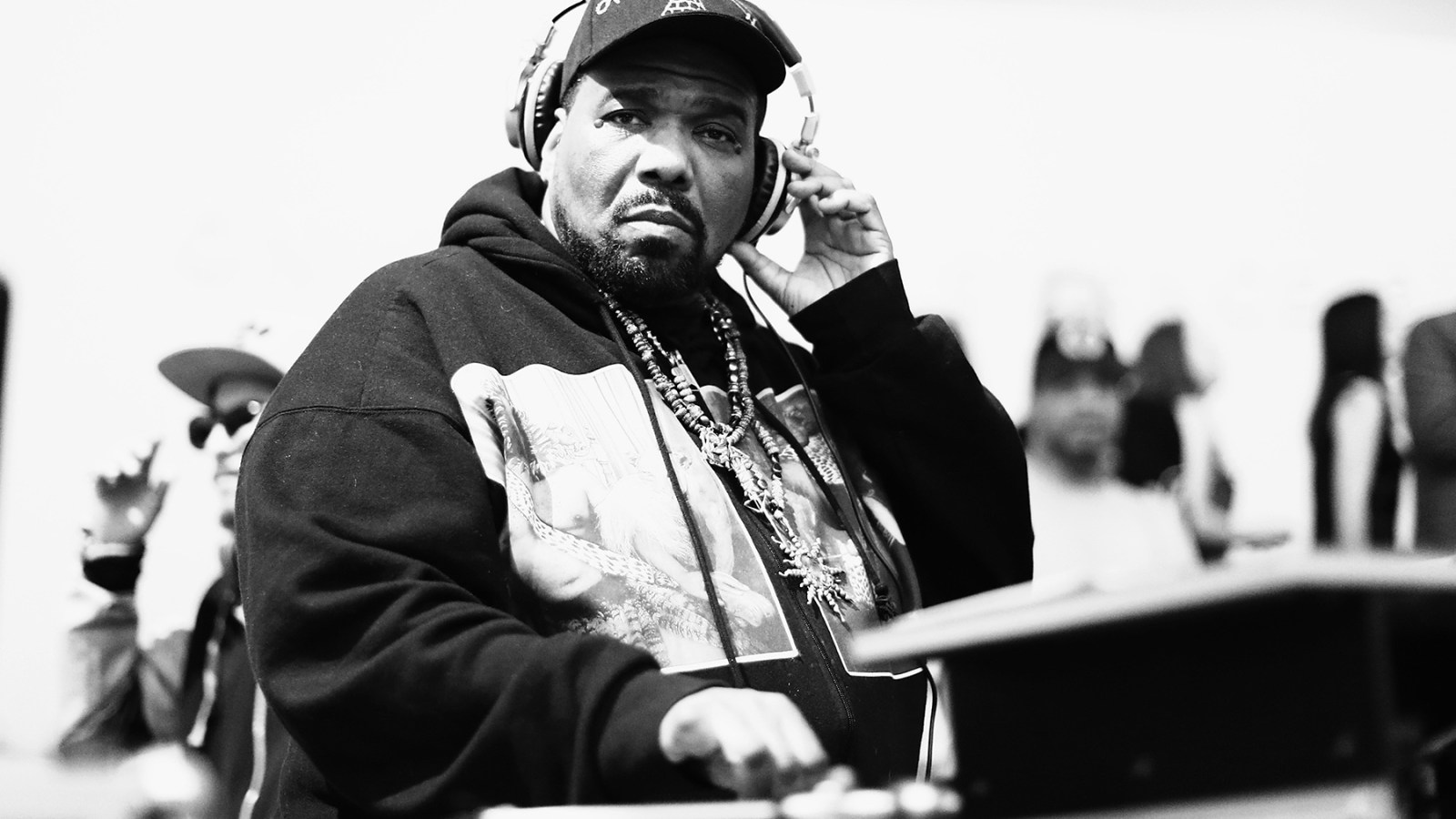

Afrika Bambaataa, the visionary DJ, rapper, producer, and activist who became one of the first global hip-hop stars and later faced multiple, widespread accusations of sexual abuse, has died at age 67. A cause of death was not immediately available.
“Today, we acknowledge the transition of a foundational architect of Hip Hop culture, Afrika Bambaataa,” Kurtis Blow wrote in a statement as executive director of the Hip Hop Alliance, a labor force founded by himself alongside Chuck D, KRS-One, and others. “[He] helped shape the early identity of Hip Hop as a global movement rooted in peace, unity, love, and having fun. His vision transformed the Bronx into the birthplace of a culture that now reaches every corner of the world … At the same time, we recognize that his legacy is complex and has been the subject of serious conversations within our community.”
As a recording artist, Bambaataa’s legacy rests on “Planet Rock,” the seminal 1982 12-inch he recorded with the Soulsonic Force and backing vocalists Planet Patrol. Produced by Arthur Baker, the gold-certified single launched Bambaataa into public consciousness around the globe. Its electronic sound — largely influenced by the German outfit Kraftwerk — inspired a years-long trend of electro-rap and dance-pop records in the mid-Eighties. Generations of musicians, from Missy Elliott to City Girls, drew inspiration from the song. Rap artists shouted out Bambaataa in their verses. Others, like the Chemical Brothers (“It Began in Afrika”), dedicated entire songs to him.
Once called a “philosopher king” by Rock & Roll Confidential, Bambaataa made recordings steeped in an Afrofuturist sensibility, with references to Egyptology and Black cosmology. As a DJ, he boasted a reputation as “Master of Records,” one whose tastes and selections encompassed a wide gamut of soulful funk, boogie rock, electro breaks, and all sorts of novelty kitsch. The Universal Zulu Nation, an organization he co-founded in the late Seventies, sprouted chapters across the world and organized annual “anniversary” parties that featured top acts from the music industry.
When the term “hip-hop,” a term credited to the late Keith “Cowboy” Wiggins from Grandmaster Flash & the Furious Five, was popularized in the early Eighties — the genre’s Bronx pioneers also utilized names like “b-beat” and “hip-hip” — it was Bambaataa who helped define it as four elements: DJ’ing, graffiti, breakdancing, and rapping.
Prolific to a fault, Bambaataa issued dozens of albums throughout his career. While he never equaled the success of “Planet Rock” in the U.S., he continued to enjoy chart success overseas, notably with “Reckless,” a 1988 UK top 20 hit with British reggae-pop band UB40 as Afrika Bambaataa & Family; and “Afrika Shox,” a 1999 UK top 10 hit by electronic duo Leftfield that featured him as a guest. Meanwhile, journalists often referred to him, Kool Herc, and Grandmaster Flash as an unofficial holy trinity key to hip-hop’s growth into the most important American cultural movement of the end of the 20th century.
In March 2016, Ronald Savage, a former “crate boy” who carried the DJ’s records to gigs, told New York radio jock Troi Tarain that Bambaataa sexually abused him in 1981. Savage’s allegations prompted widespread press coverage. In a statement given to Rolling Stone, Bambaataa said, “These allegations are baseless and are a cowardly attempt to tarnish my reputation and legacy.” Several men subsequently accused Bambaataa and other Zulu Nation leaders of sexually abusing them as teenagers, and at least one John Doe lawsuit was filed in 2021. Meanwhile, The Zulu Nation leadership publicly distanced itself from him. (Savage would later retract his allegations.)
Reaction in the hip-hop community to Bambaataa’s stunning fall was divided. Melle Mel claimed that people within the scene had known about it for years. A Zulu Nation spokesperson, TC Izlam, resigned from the organization in protest; a year later, he was murdered in Atlanta under mysterious circumstances. Dozens of onetime Zulu Nation chapters, some which have existed since the Eighties, defected to form a new organization, Zulu Union.
However, KRS-One, whose Boogie Down Productions’ classic “South Bronx” recounts hip-hop’s early development, defended Bambaataa’s legacy. “For me, if you keep it hip-hop, nothing can be taken away from Afrika Bambaataa,” he told the podcast Drink Champs. “History is history.”
Lance Taylor was born in 1957 in Bronx River Projects, a public housing community in the South Bronx, New York. His mother was Jamaican, and his father was from Barbados. In 2014, he told Vice that his mother’s record collection inspired his famously eclectic DJ sets. “One minute you could hear soul, like James Brown and Motown and the STAX-Volt sound, and the next minute it could be African sounds like ‘Mama Africa’ by Miriam Makeba, and calypso and salsa or Salsoul [Records]… and then more pop sounds like Edith Piaf and Barbara Streisand, to, like, Three Dog Night and Creedence Clearwater Revival.”
Much of Taylor’s life is shrouded in mystery and myth. For decades, he told journalists he was “Kevin Donovan,” an anonymous member of the Harlem Underground Band who arranged Bambaataa’s debut 12-inch with Cosmic Force, 1980’s “Zulu Nation Throwdown.” Scholars didn’t confirm Bambaataa’s actual birth name until 2016, when oral testimonies circulated about his abuse allegations. He also gave inconsistent dates about life events prior to becoming a public figure with “Planet Rock.”
As a youth, Taylor joined the Black Spades, one of several street gangs active in the South Bronx in the late Sixties. While attending Adlai Stevenson High School, he founded The Organization with a few former Spades members that evolved into the Zulu Nation. Taylor took inspiration from a 1975 trip he made to Africa, the result of winning a UNICEF essay contest; and Zulu, a 1964 war movie film where a band of British soldiers battled African warriors during the Anglo-Zulu war.
Taylor has said that he first began playing records for his family at house parties and gave his first professional DJ performance in 1976. “It was limited to mixing records, no effects,” he told the East Village Eye in 1982.
Bambaataa established a reputation for dazzling partiers with “wild and unconventional records,” as he said to East Village Eye. Meanwhile, the fledging Zulu Nation served as his crew and security team. The latter were necessary in an environment where locals policed themselves and tried to keep unruly teenage energy from boiling over into violence. “Being an ex-Black Spade, Bam always had a gang of hardheads around him to make sure his parties didn’t go AWOL,” wrote Grandmaster Flash in his autobiography with David Ritz, The Adventures of Grandmaster Flash. “They made it hard to get to the DJ table, but when I did, Bam was always nice. Bam was the kind of cat who would loan me any record he had.”
Like most of the top rap acts, Bambaataa was initially dismissive when the Fatback Band’s “King Tim III” and the Sugarhill Gang’s “Rapper’s Delight” dropped in 1979, heralding the arrival of rap music in the mainstream. He released two 12-inches in 1980 to little impact. But after he scored with “Planet Rock,” Death Mix — Live!!!, taken from a mixtape recording of a Bambaataa gig at a high school, offered precious official evidence of the DJ’s early performances.
In 1981, Bambaataa connected with Tommy Boy Records founder Tom Silverman and helped mixed its first release, Cotton Candy’s “Havin’ Fun.” He also assembled “Jazzy Sensation,” a modest club hit with the Kryptic Krew and Zulu Nation associates like DJ Jazzy Jay and Bronx rap crew the Jazzy 5.
The following year came “Planet Rock,” a recording partly inspired by Bambaataa’s experiences playing to mixed audiences at the Mudd Club in East Village and encountering New York’s famed early Eighties “downtown” scene that brought together punks, hip-hoppers, New Wavers, and fashionistas. “After the Mudd Club, he knew just what to do. The rest is history,” said Fab 5 Freddy in the 1982 Village Voice article. The 12-inch peaked at Number Four on Billboard’s Black Singles chart, barely missed the pop top 40 at Number 48, and sold over 650,000 copies. Meanwhile, Bambaataa helped launch “Zulu Beats,” a radio mixshow featuring Zulu Nation protégés like Afrika Islam and DJ Red Alert on New York station WHBI-FM.
In 1983, Bambaataa, the Soulsonic Force, Baker, and Robie reunited for two more 12-inches, “Looking for the Perfect Beat” and “Renegades of Funk!” While not as groundbreaking as “Planet Rock,” both certified Bambaataa as a top electro artist.
As captured in the video for “Planet Rock,” Bambaataa & Soulsonic Force’s performances found them wearing elaborate Asiatic costumes that evoked Sun Ra and Earth, Wind & Fire. Much like George Clinton’s P-Funk, Bambaataa oversaw a loose collective of Zulu Nation rappers, DJs, and musicians for his recordings. He called them his “funk family.”
Bambaataa’s funk ethos inspired a dizzying number of projects. He formed Shango with Bill Laswell’s Material and released the 1984 album Shango Funk Theology, a collection of chants and vocal hooks over synthesized beats. Bambaataa and Material also collaborated in 1984’s “World Destruction,” an anti-nukes 12-inch with former Sex Pistol turned Public Image Limited frontman John Lydon.
For American hip-hop audiences, Bambaataa’s last major hit was “Unity,” an acclaimed 1984 collaboration with James Brown that Rolling Stone called “the classic funk record of the year.” During his life, Bambaataa scored 16 entries on the British charts, a sign of how his music found greater acceptance in Europe than the States.
As b-boys turned their attention to new-school acts like Run-D.M.C., Whodini, and LL Cool J, Bambaataa remained an important father figure. He dispensed wisdom on BET’s Rap City and appeared on the cover of The Source. Public Enemy memorably shouted him out on their 1988 single “Night of the Living Bassheads”: “Here it is, Bam!” On the 1991 song “Vibes & Stuff” by A Tribe Called Quest, Q-Tip paid tribute, “Give enough respect to Afrika Bambaataa.”
The Universal Zulu Nation continued to sprout chapters around the world. Much of the rap world was “down” with the organization, whether due to membership, its many events, or out of admiration with its peaceful ethos and pro-Black philosophy. The organization drew inspiration from “different ideologies, whether it was the Nation of Islam, the Black Panther Party, the Young Lords,” Bambaataa told Vice. “We dealt with Five Percenters, Christians, Hindus, Buddhists. In Zulu Nation, our lessons can come from anyone who did their research.” However, the Zulus’ original Bronx River chapter was targeted by New York Mayor Rudy Giuliani. Claiming that the Zulus were a “gang” despite no evidence of criminal activity, the city banned the group from the housing project in 1995. “I know that’s a bunch of jive,” Bambaataa responded in the New York Times.
Musically, Bambaataa continued to be active, particularly with charity projects. In 1985, he joined Artists United Against Apartheid, a collective formed by Steven Van Zandt to protest South Africa’s apartheid regime. Their 1985 anthem, “Sun City,” charted at number 38 on the Billboard Hot 100; Rolling Stone named it Single of the Year.
But Bambaataa’s work was increasingly defined by his forays into electro breaks and house music, scenes greatly inspired by his Soulsonic Force hits. He DJ’ed at raves and festivals and collaborated with techno producers like Germany’s WestBam and Britain’s Paul Oakenfold, the latter resulting in a remake of “Planet Rock” for the 2001 movie Swordfish. He released a 1999 mix compilation, United DJs of America — Volume 13: Electro Funk Breakdown. That same year, he presented Planet Rock: The Dance Album.
Bambaataa earned numerous honors during his lifetime. In 2007, he was nominated for the Rock & Roll Hall of Fame. In 2012, he held a three-year position as visiting professor at Cornell University, which also acquired his papers. In 2014, DJ Shadow and Cut Chemist paid homage to the Bronx pioneer by mounting an international tour utilizing his famed collection, “Renegades of Rhythm.” In 2011, Bambaataa and a group led by former DJ and record executive Rocky Bucano initiated efforts to create a hip-hop museum in the Bronx. Their efforts led to the Universal Hip-Hop Museum, a multi-million-dollar mixed-use property scheduled to open in 2024.
When the sexual-abuse allegations broke, the fledgling group issued a statement that claimed, “Afrika Bambaataa has not had a role at the Universal Hip-Hop Museum since 2016.” But he continued to appear in its marketing materials. Rumors abounded that he also continued to play a role in Zulu Nation up to his death.
Until the end of his life, Bambaataa recorded and toured overseas, mining his interests in cosmic electronic funk as “the Amen Ra of Hip-Hop Culture.” His collaborators remained unaware — or kept willfully oblivious — about the allegations. For much of the public, he remained the man who made “Planet Rock” and helped popularize a worldwide movement. “It’s the Universal Zulu Nation Hip Hop Culture Anniversaries that every year each artists came to perform or to be at,” he wrote in a typically enigmatic Instagram message. “Or did all of you forget too quickly to be manipulated?”