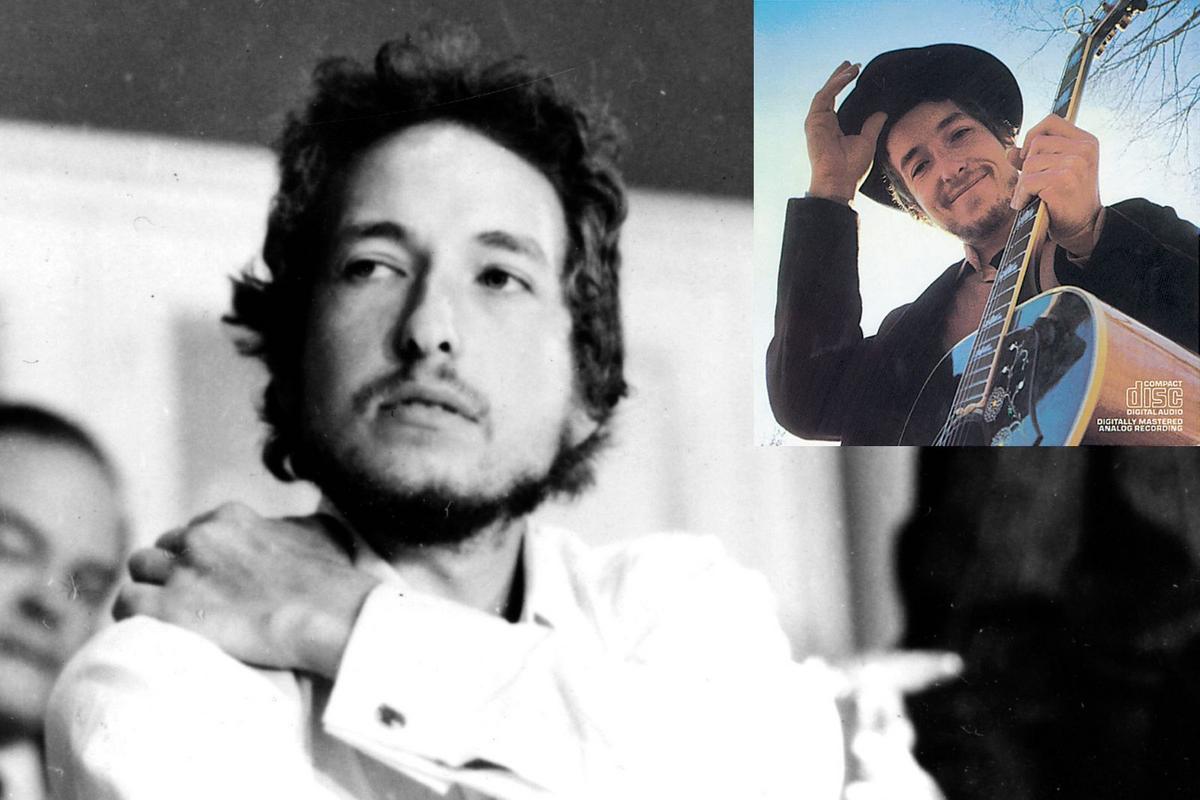

If you listen to Bob Dylan’s albums in order, you’re bound to notice the change that occurs in his singing voice when you hit his ninth release, 1969’s Nashville Skyline.
Compared to all of his previous recordings, where Dylan’s voice might be described as nasally and almost sneering, his singing on Nashville Skyline took a turn for something much softer and croon-ish. To many listeners at the time, it sounded like another person entirely.
Was this Dylan’s “real” voice so to speak? Why the sudden change?
The Drastic Change, According to Dylan
Naturally, Dylan was asked about this.
“I’m sure you read the reviews of Nashville Skyline,” Jann Wenner, cofounder of Rolling Stone, said to Dylan in November of 1969, approximately seven months after the album’s release. “Everybody remarks on the change of your singing style…”
Dylan’s explanation was simple: “Well Jann, I’ll tell you something. There’s not too much of a change in my singing style, but I’ll tell you something which is true…I stopped smoking. When I stopped smoking, my voice changed…so drastically, I couldn’t believe it myself. That’s true. I tell you, you stop smoking those cigarettes [Laughter]…and you’ll be able to sing like [Italian opera singer Enrico] Caruso.”
Not that Dylan was approaching the making of Nashville Skyline in some kind of precious way.
“We just take a song; I play it and everyone else just sort of fills in behind it,” he explained. “No sooner you got that done, and at the same time you’re doing that, there’s someone in the control booth who’s turning all those dials to where the proper sound is coming in…and then it’s done. Just like that.”
Dylan’s Recent Accident
Additionally, Dylan’s candor in speaking about his health was a bit surprising given what had happened to him a few years earlier. Reportedly, Dylan was in a motorcycle accident in July of 1966, though exactly what transpired remains, to this day, unclear. Despite being severely injured, an ambulance wasn’t called and Dylan was never hospitalized. In the decades since, he’s never spoken much about the incident or what caused it — the only thing that was certain was that the crash took Dylan out of the public eye for years.
When Wenner asked about “what change” the accident had made, Dylan’s answer was rather avoidant.
“What change?” he said. “Well, it…it limited me. It’s hard to speak about the change, you know? It’s not the type of change that one can put into words…besides the physical change. I had a busted vertebrae; neck vertebrae. And there’s really not much to talk about. I don’t want to talk about it.”
READ MORE: Bob Dylan Album Opening Songs Ranked
But not only had Dylan’s voice physically changed since quitting smoking, he made some adjustments to it in the studio — a significant amount of echo and limiting (a technique that caps the volume of a vocal take at a certain level). Wenner asked Dylan why he chose to do that, “rather than doing it more or less flat.”
Again, Dylan threw the question back: “Well, how would you have liked it better? Would you have liked it flat?”
“I dig the echo myself,” he continued. “That’s why…we did it that way. The old records do sound flat. I mean there’s just a flatness to them, they’re like two-dimensional. Isn’t that right? Well in this day and age, there’s no reason to make records like that.”
It’s worth noting that Dylan’s next two albums, Self Portrait and New Morning, featured a return to his “normal” voice. As Rolling Stone wrote in their 1970 review of the latter: “Well, friends, Bob Dylan is back with us again.
Listen to Bob Dylan’s ‘Tonight I’ll Be Staying Here With You’ From ‘Nashville Skyline’
The Stories Behind 20 Bob Dylan Album Covers
Looking back at the artwork chosen by the famously enigmatic songwriter.
Gallery Credit: Allison Rapp