
Steve Perry‘s beloved mother Mary Quaresma had always been his biggest supporter, memorably buying him a special eighth-note necklace that he wore for good luck.
Her marriage to Raymond Pereira also led Perry to a lasting passion for radio: Perry’s dad was co-owner of the former KNGS, which broadcast out of a distinctive art deco building located between Hanford and Visalia, California. Unfortunately, Mary’s health faltered during the writing and recording of Raised on Radio, the Journey comeback album released on April 21, 1986, after several years apart.
“They went over to Sausalito to cut that record at the Record Plant, and Perry’s mom is dying — and he’s a complete mama’s boy,” veteran San Francisco journalist Joel Selvin said in Journey: Worlds Apart. “He had a helicopter parked in the parking lot, and he was helicoptering to his mother’s bedside from the sessions.”
How Steve Perry Reconnected With Journey
In the meantime, two bandmates, an agreed-upon LP title, wives and even the tapes themselves would also be lost. Just getting into the studio had required something that sounded an awful lot like couples therapy. Days turned into months as bandmate Jonathan Cain tried to coax Perry back to his muse.
Even as she lingered, Mary encouraged Perry to return to Journey — and he finally got back on track creatively with Cain, his main songwriting partner. “She just didn’t want to leave me here,” Perry told Selvin back then. “It was her fleeting last strength of maternal love.”
As Cain and Perry began to reconnect on demos using a click track, Cain admitted that he repositioned his writing to accommodate the soul-leaning sounds of Perry’s debut solo album, 1984’s double-platinum Street Talk. It was the first, but far from the last, concession required to coax Perry back for Raised on Radio.
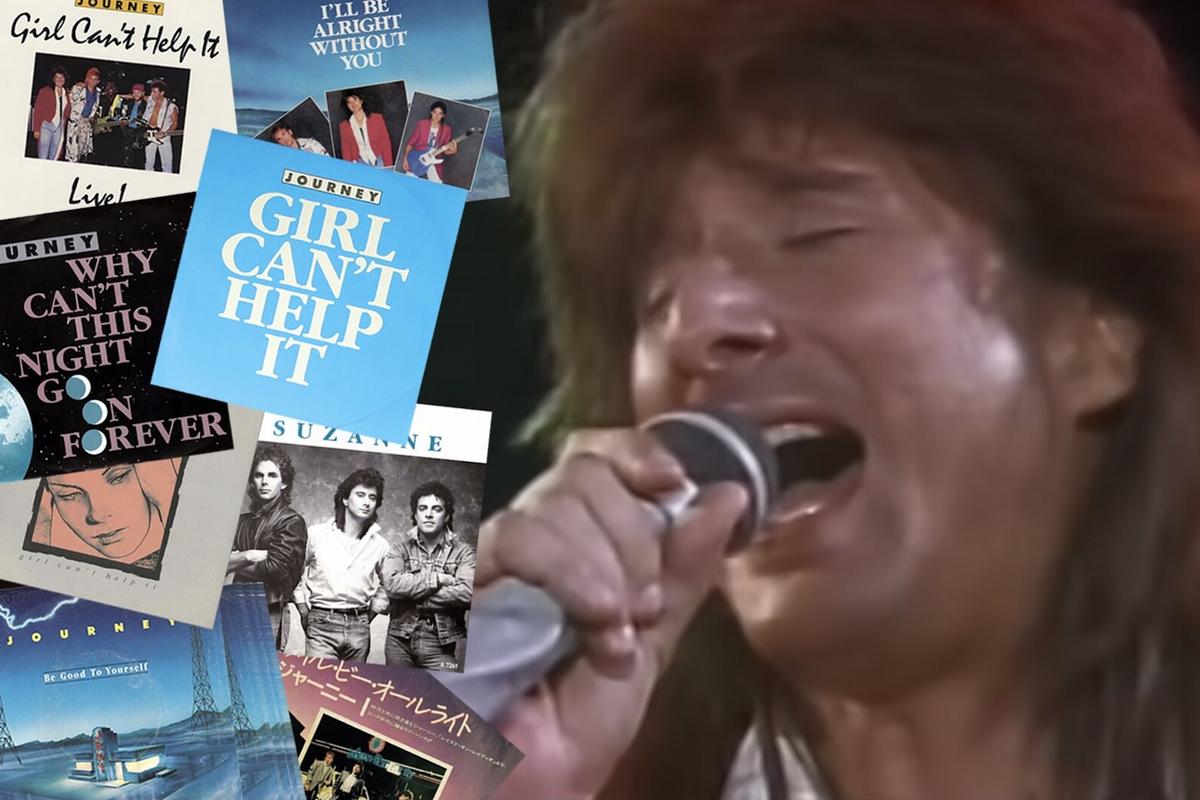
Watch Journey’s ‘Girl Can’t Help It’ Video
Next, Perry engineered the ouster of bassist Ross Valory and drummer Steve Smith. Founding manager Herbie Herbert hadn’t even been told. (Selvin said the distraught Valory was never far away during the Raised on Radio era: “Ross Valory went to every session, every day, and sat out in the game room playing pinball,” he remembered, “even though he never put a note on that record.”)
Their absence would have huge implications on the feel of the resulting album. Now down to a nucleus of Perry, Cain, and Neal Schon, Journey essentially started over. Perry brought in ringers from his solo LP, including sessions bassists Bob Glaub and Randy Jackson and the late drummer Larrie Londin. They recut most of the songs in less than two weeks, achieving a very similar sound.
READ MORE: Top 35 Journey Videos – Together and Apart
The moves were meant to “try to keep Steve in the brotherhood,” Cain said in his autobiography. Everyone had been unsure if he would ever return, so “we felt we had to pursue the music he wanted to make. I helped our band make the particular type of sound Steve wanted.”
Neal Schon and Steve Perry tour in support of 1986’s ‘Raised on Radio.’ (Icons and Images, Getty Images)
Why Journey Changed the LP Name to ‘Raised on Radio’
Then in the wake of his mother’s death, Perry changed the name of the album from Freedom (which had been Herbert’s preference) to reflect something more personal. His takeover was complete.
“She had a very intense relationship with him,” long-time Journey road manager Pat Morrow said in Journey: Worlds Apart. “When she died, we’re sitting in folding chairs at the gravesite, and he jumps up and runs over to the coffin as it’s about to be lowered down. And he hugs the coffin, going: ‘I love you, mama. I love you, mama. I love you, mama.’ She was everything to him.”
Early Journey member Prairie Prince, also a talented artist, refashioned the cover image. Perry’s family radio station was depicted, with nary a scarab in sight. Perry attempted to tie it all together with a nostalgic title track that mentioned a string of early-rock favorites like Chuck Berry and Buddy Holly.
Watch Journey’s ‘I’ll Be Alright Without You’ Video
“Protracted negotiations take place,” Selvin recalled in Journey: Worlds Apart. “[Perry] demands all kinds of things — like the firing of the drummer and the bass player — which nobody really had any problem with but him. He wanted to be named producer of the album. He wanted to be in control of naming the album. He wanted Journey to be his backup band — and he got his way, because he had the keys to the kingdom.”
READ MORE: Jonathan Cain’s Best Songs With Journey, the Babys and Bad English
Schon also altered his sound to better match what Cain and Perry had begun, moving away from his typical army-of-guitars approach in order to focus on more tasteful single lines. He even used a different guitar altogether on “I’ll Be Alright With You,” though Schon has since discarded the instrument.
“It was one of those really ugly Roland 707 guitars that kind of looked like a weird synthesizer guitar,” Schon said in Journey: Worlds Apart. Unlike the Fender Stratocaster, a Schon guitar of choice, the Roland 707 featured a then-hip graphite body and neck. “It didn’t vibrate — and that gave it a very even tone,” Schon added. “So, I felt like it translated no matter where I was playing, up and down the neck on that one song.”
How Did Journey Fans Receive ‘Raised on Radio’?
The next stumbling block arrived in the form of the U.S. Organized Crime and Drug Enforcement Task Force, as the authorities tried to determine if Journey’s studio had been purchased with illegal proceeds. The tapes for Raised on Radio were briefly confiscated, along with their equipment.
Londin ultimately replaced Smith on all but three tracks. The reformulated group created some isolated moments when Raised on Radio sounded like typical ’80s-era Journey fare, including “Be Good to Yourself,” “Girl Can’t Help It” and “Why Can’t This Night Go On Forever.” Much of the rest of the LP, however, did not.
READ MORE: Ranking Every Journey Solo LP
Even amid new R&B influences, there was a notable softness in the songwriting, which had not initially included Schon’s muscular touches: “If your cup of tea is Mantovani meets Foreigner — go for it,” sniffed one Creem reviewer. Despite that, Raised on Radio was a multi-platinum No. 4 smash. Journey scored four more Top 20 singles, and “Why Can’t This Night Go On Forever” became a mid-sized adult-contemporary hit, too.
Watch Journey’s ‘Why Can’t This Night Go On Forever’ Video
In some ways, Raised on Radio was an album about moving on — or at least trying. Certainly, that’s true with “I’ll Be Alright Without You.” Cain confirmed in interviews with Selvin for 1992’s Time3 box set that the song directly connected with everyone’s recent trauma. He called it the other half of “Once You Love Somebody,” a love-struck ballad found earlier on the Raised on Radio.
This complicated history plays out in the music, as seen in the following countdown of every song from Journey’s penultimate album with Perry. He quit the first time during Journey’s subsequent tour, leaving the others to release a pair of leftovers from these sessions on the multi-disc Time3. We’ve included those tracks, as well.
No. 13. “Positive Touch”
From: Raised on Radio (1986)
Demos for this LP were completed with a click track rather than in a room together as Journey had typically done in the past. That left drummer Steve Smith to either copy these metronomic sounds – heard to teeth-grating effect on “Positive Touch” – or to stay home. Part way through the sessions, it became the latter.
No. 12. “Into Your Arms”
From: Time3 (1992)
One of a pair of unfinished jams from the Raised on Radio sessions that were later completed during a hiatus for release as part of the Journey’s Time3 box set, and the less interesting of the two.
No. 11. “Happy to Give”
From: Raised on Radio (1986)
Perry had trouble nailing the vocal on this too-atmospheric ballad, which should have told them something. (In fact, it got to the point where Cain started referring to “Happy to Give” as Perry’s “pet song.”) It’s understandable: “Happy to Give” grew out of a soundtrack idea Cain had, and sounds just like that. Journey never played the song live.
No. 10. “With a Tear”
From: Time3 (1992)
Another leftover instrumental track from the Raised on Radio era that Schon and Cain returned to finish during a break from Perry in the early-’90s. Had it come to fruition earlier, this would have been the edgiest thing on the album after “Be Good to Yourself.”
No. 9. “Once You Love Somebody”
From: Raised on Radio (1986)
They tried for a bluesy feel on a song echoing the relationship troubles that both Perry and Cain were then experiencing, but there’s simply not enough grit to this.
No. 8. “It Could Have Been You”
From: Raised on Radio (1986)
Schon’s riffy contributions work in brilliant counterpoint to Perry’s poignancy, underscoring why this partnership meshed so easily – and so well.
No. 7. “Raised on Radio”
From: Raised on Radio (1986)
If things had gone another way, Perry said he could’ve see himself as a DJ, rather than a huge pop star. Radio holds a talismanic place in his imagination for two reasons: His dad owned a station. But it was also a constant presence in the youthful places where he returns, time and time again, for creative sustenance.
No. 6. “Why Can’t This Night Go on Forever”
From: Raised on Radio (1986)
Written in tribute to their fans, “Why Can’t This Night Go on Forever” moved past its quite overt “Open Arms” / “Faithfully”-style ambitions on the strength of performances by Perry and Schon.
No. 5. “The Eyes of a Woman”
From: Raised on Radio (1986)
Steve Smith only appeared on three Raised on Radio tracks, but still had an undeniable impact. His anticipatory rhythm builds a palpable tension on the underrated “The Eyes of a Woman,” as Schon’s echoing chords surround the vocal. Perry has called this one of his favorite Journey songs.
No. 4. “Suzanne”
From: Raised on Radio (1986)
If Steve Perry sounds a little overwhelmed on the second single from this album, there’s a reason for that. This No. 17 hit was written in tribute to an actual crush.
No. 3. “Be Good to Yourself”
From: Raised on Radio (1986)
A throwback Top 10 rocker, “Be Good to Yourself” had little in common with the sleeker, more adult-contemporary feel found elsewhere on Raised on Radio. It didn’t make for the most representative lead single, but – in a rare moment with Perry in ascension – manager Herbie Herbert prevailed.
No. 2. “I’ll Be Alright Without You”
From: Raised on Radio (1986)
Schon, who earned a co-writing credit with Cain and Perry, was best known for using a 1963 Fender Stratocaster. But he experimented with a graphite Roland 707 here to get a different tone. It worked: “I’ll Be Alright Without You” remains Journey’s penultimate Top 20 hit, followed by “When You Love a Woman.”
No. 1. “Girl Can’t Help It”
From: Raised on Radio (1986)
Perry had taken control of Journey, switching out band members for sidemen with whom he’d worked before then serving as the project’s de facto producer. That led to song treatments that moved well away from anything Journey had done before, or since. “Girl Can’t Help It,” the best of this LP’s four Top 20 singles, was the exception. It’s classic Journey, spit-shined up for a new era.
Journey Albums Ranked
Some Journey lineups were respected but low-selling, while others were bestsellers who got critically ignored. But which one was best?
Gallery Credit: UCR Staff
You Think You Know Journey?