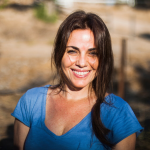
Crystal Rose’s band were still setting up their gear at the East Room, a grungy venue next door to an occult shop in East Nashville, when a small group of women gathered near the front of the stage. After blending into the crowd, they quietly began to sing a chant-like refrain, silencing the chatty audience into rapt attention. Rose, who put together the flash choir just a few weeks earlier, stepped off the stage to join them.
The song was titled “Call See Call” and Rose — a Kansas City, Missouri, native who fuses pop and soul, hip-hop and folk into a mesmerizing roots-music blend — used it to announce herself as one of Nashville’s most promising new artists. Over the course of her set, she and her band captivated the East Room crowd, part of Nashville’s 615 Indie Live day, a celebration of the city’s indie venues, with originals like “Call See Call,” the devastating “Never the Bride,” and her forthcoming single, “Mad Black Woman.” Some fans danced and sang along; at least one wept.
“‘Call See Call,’ that song came, like, as a download. I sat down and wrote it with a roommate of mine at the time. I just wanted to try something new, something that was a little scary to me,” Rose says of the song’s debut performance at the East Room in February. “I put a post out on Instagram, like, ‘I’m putting a little choir together. Are there any girls who want to join?’ I decided to start out the whole set with that song.”
Rose, 34, grew up singing in church and committed herself to music in elementary school after singing the national anthem at a local university in Missouri. At the time, her parents only allowed her to listen to Christian music and gospel. She was especially drawn to Kirk Franklin and his 2006 compilation album, Songs for the Storm. But then she heard Whitney Houston, whose big vocals helped shape the way Rose now sings. After a guy she had a crush on uploaded the live version of blues guitarist Jonny Lang’s song “Only a Man” to her iPod, she found her herself becoming obsessed with concert recordings.
“That song really shifted the trajectory of my love for music, and different styles. I just really loved the sound of live music,” she says. “I never would listen to the record version again after that.”
Rose competed on The Voice in 2019 but lost in the first round (“It’s show business,” she says, “and there are scripts and plot lines. But I’m grateful for the experience”). In 2021, she moved from Hot Springs, Arkansas, where she was living at the time, to Nashville, based only on a gut feeling and what she gleaned about Music City from devouring ABC’s soapy drama Nashville. “All I knew about Nashville was country music, but I still had this knowing that I was supposed to be here,” she says. “And everything that I wanted, if I didn’t see it, I knew that I would build it.”
She was adamant, however, about not being dubbed an R&B singer. To her, that label was a lazy descriptor. “In Kansas City I was making indie folky music. I was running from being pigeon-holed as an R&B soul singer, because everyone just assumes, you’re Black, you make neo-soul. I was trying to do anything but that,” Rose says. “I was also trying to run a little bit from my upbringing in church too.”

Once in Nashville, she leaned into elements of rock and hip-hop, especially when it came to percussion. “My music now is a little more fluid, and I love darker tones — really warm, purple, blue sounds,” she says. “Things that are a little cloudy.”
Rose recorded an album — a live album, naturally — in 2025 and is gearing up to release it later this year. She’ll drop the first single, “Mad Black Woman,” in August, and hopes to continue building a community of genre-defiant Black female artists in Nashville. Earlier this spring, she staged the third edition of her own mini-festival, Touched by Sun, which showcases the range of Black women creatives in Music City.
As her showcase at the East Room and an appearance on Rolling Stone’s Nashville Now podcast made clear, Rose refuses to be defined by any one sound. As she already said, she prefers things on the cloudier side.
“As an artist, I could be labeled as a ‘soul singer,” she says. “The soul is there, but soul is just the starting point.”