
This story was originally published in the August 11, 1994 issue of “Rolling Stone.”
We’re talking big food at Gladstone’s, on the Santa Monica, California, beachfront. Godzilla food. A feed-an-entire-emerging-nation platter of lobster, clams, mussels and shrimp delivered by a tanning-booth-obsessed waitress in microshorts.
“Ever since we signed to a major label, whenever we have any kind of meeting, we make them take us out for lobster,” L7 vocalist Donita Sparks explains cheerfully.
It’s the punk thing to do.
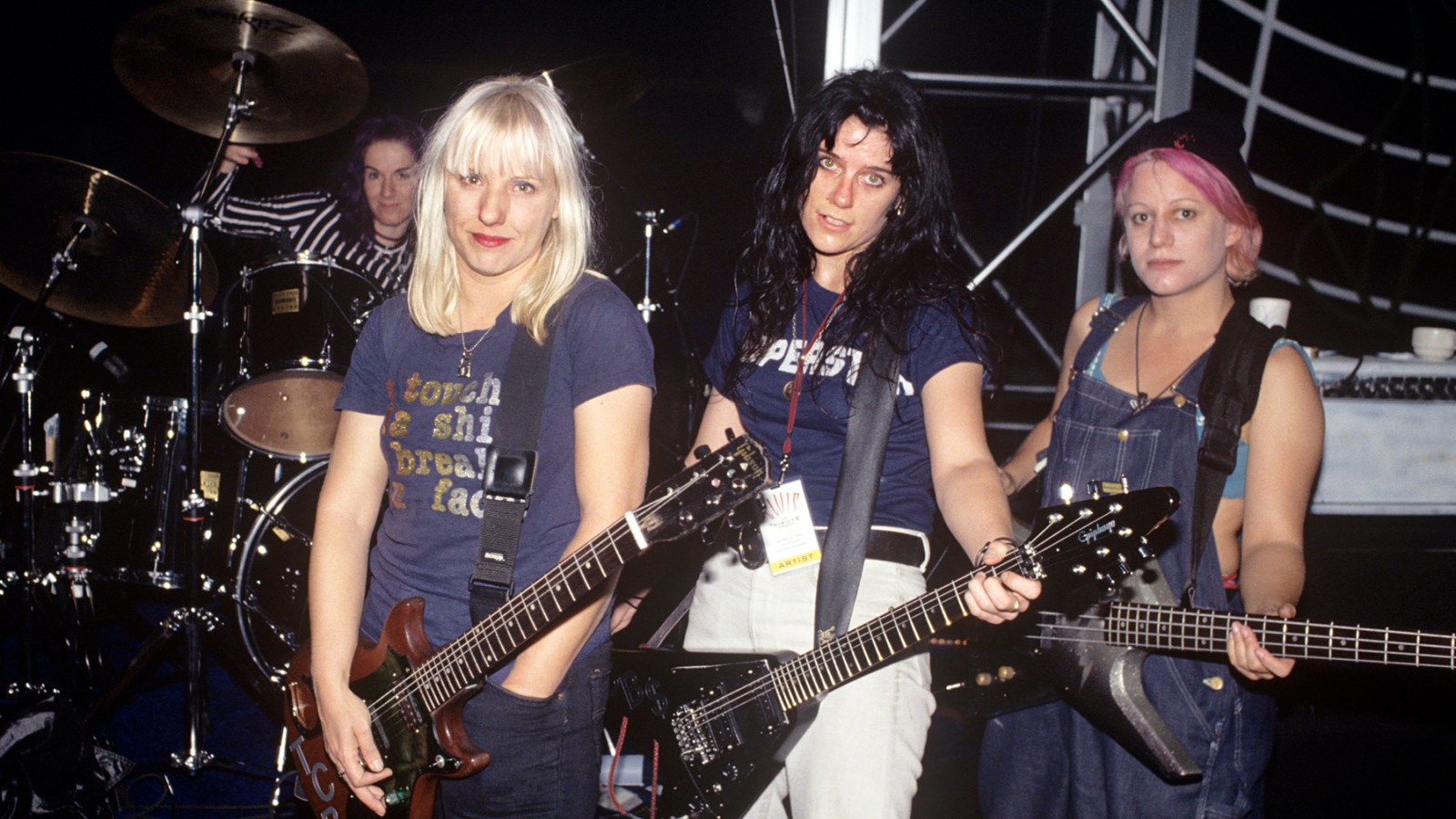
“Our waitress doesn’t have enough clothes on,” says bassist Jennifer Finch, whose own cropped top isn’t all that demure. But combined with a pierced navel, multiple tattoos, and a stocky build, the effect isn’t sexy but confrontational. The members of L7 are, proudly, the weirdest-looking people at Gladstone’s. Drummer Dee Plakas has extremely green hair. Guitarist Suzi Gardner sports one of those gleefully hideous multicolored leather patch jackets that the ’70s revival has made trendy again.
L7 may be coming into their own in the age of grunge and riot grrrls, but it’s old-time punk rock that’s central to their D.I.Y. fuck-you spirit. Ramones. Sex Pistols. X. Inspired, insanely energetic sloppiness. Mean, squealing, subversive guitars that Sparks and Gardner wield like the weapons they are. Tough, uncompromising lyrics whose allegiances sport a ferocious Thelma-and-Louise-blow-up-the-truck feminism.
“How many times must you be told/ There’s nowhere we don’t go” is the anthemic refrain of “Shirley,” off L7’s new disc, Hungry for Stink, a paean to champion drag racer Shirley Muldowney. “What’s a beautiful girl like you doing racing in a place like this?” a reporter asks Muldowney in the sample off the film Heart Like a Wheel. Muldowney replies, “Winning.” L7 loop it over and over again. “Winning.” “Winning.” “Winning.”
“It was so ironic, because in the beginning, we used to get a lot of questions like that,” says Finch. “Woman in a man’s world, all that kind of crap.” L7 are not, they emphasize, “foxcore,” riot grrrls, insert-label-of-your-choice-here girls.
“To create genre out of gender is just horrible to me,” Finch says. “I think journalism perpetuates that. I hope the story angles for L7 will eventually be the same as for Nirvana or Cracker. There’s a uniqueness in being a woman, but not that much.”
Still, L7 delight in throwing their gender into people’s faces — quite literally at England’s Reading Festival in 1992, where Sparks removed her tampon onstage and tossed it into the genuinely shocked audience. (Tampax has yet to take advantage of this unique endorsement opportunity, though Midol — whose cramp-relief products appear on L7’s concert rider — did send them a big box of free merchandise once.)
L7 also rely on a fierce camaraderie any pro sports team would envy. Cigarettes. Politics. Unity. There are no stars in L7. They don’t do individual interviews or photo shoots. They communicate as a team, finishing one another’s sentences, a wisp of conversation lending itself to yet another in-joke.
Being misquoted “happens to us a lot,” says Finch.
“Did you pitch this story, or were you assigned to it?” Finch asks suspiciously. “Did you come out from New York just for this?” L7 protect their turf.
When they first started out, in the mid-’80s, L7 practiced at the home of Maxine Nazworthy, the benevolent and free-spirited Max Factor heiress who acted as Medici patroness to a whole generation of L.A. punks, including the Chemical People, Redd Kross, and Down by Law.
“It was funny driving to Beverly Hills to rehearse,” says Finch. “Very ironic.”
The bassist is the only native Angeleno in the bunch. Sparks and Plakas are refugees from Chicago, while Gardner grew up in Sacramento, California.
“All these losers that were in my hometown playing rock & roll, they didn’t have a clue,” Gardner says. “I knew I had to get out.”
“Suzi was involved in the River’s Edge scandal,” offers Sparks.
“River’s Edge [the film based on a real case wherein a teenager murders his girlfriend, then takes his buddies to see the body] epitomizes that whole area and the kids I hung out with,” Gardner continues.
“Suzi found the body,” says Finch.
“I nearly was that body,” says Gardner. “I swear to God, I came, like, this close.”
Luckily, she hooked up with Sparks instead, enduring a few years of lame, sociopathic bassists and drummers before discovering Finch and Plakas. L7 was released by Epitaph in 1988, followed by a 1990 Sub Pop EP, Smell the Magic. But it was 1992’s Bricks Are Heavy and its surprisingly commercial single, “Pretend We’re Dead,” that started moving their CDs (250,000 and counting).
They’ve since crossed over to the movies, recently playing the band the Camel Lips in John Waters’ movie Serial Mom. “Babes in Toyland couldn’t do it,” quips Finch. “We were honored to do it, ’cause we’ve been John Waters fans for a long time.”
Now, L7 are about to have a Lollapalooza summer, complete with anticipated hefty sales of Hungry for Stink, a record that’s such a triumph of stripped-down energy over any snotty trend du jour that it practically demands big-time success.
L7 may throw in the occasional quirky love-and-angst tune, like “Andres.” (“Down in North Hollywood/There’s a guy with long hair/He’s really, really nice/But we had a problem,” wails Sparks, who has the most bizarrely expressive voice this side of Björk — squealing, growling, soaring, often during the same note.) But it’s their deep defiance that raises the album to the level of a classic. “People like you just fuel my fire!” screams Sparks on “Fuel My Fire,” backed by a Tilt-a-Whirl rhythm section that comes off both assaultive and joyous.
“People Like You” seems to apply to a lot of oppressive Republican types and miscellaneous assholes, but L7’s primary political focus remains Rock for Choice, the pro-choice organization they founded in 1991. This summer, they hope it will be included among the Lollapalooza booths.
“When we started Rock for Choice,” says Sparks, “one of the things that concerned us the most was that Bush was in office representing a huge contingent to take away women’s rights. Since then, we’ve moved on to other issues, more grassroots: Right now, Rock for Choice money is buying surveillance equipment and bulletproof vests for clinic workers, which run around $2,500 apiece.”
Rock for Choice benefits around the country raised a lot of money for the Fund for the Feminist Majority. “More than our goal,” says Sparks. “But in Pensacola, Florida, we did this huge show with Pearl Jam, and there was very little money raised because it was so expensive to put on, and Pensacola law enforcement insisted on a very large security staff. It’s good-old-boy territory. They were going to cancel the show otherwise.”
Good old boys sometimes show up at their gigs, to no avail. “There will be an occasional something like, ‘Show us your tits,’” says Finch in perfect Beavis-and-Butt-head-ese. “But we’re the ones with a microphone. To battle us is ridiculous.”
In the Gladstone’s meeting of L7 versus the lobsters, however, the lobsters win. The leftovers return lovingly encased in tinfoil critters of dubious identity.
“I just insulted the aluminum-foil artist by calling his whale a turkey,” says Plakas.
“I wonder if he’s actually a foil artist and answered an ad for foil artists,” says Finch, “and if his foil art is suffering at home because he has to do it at work.”
L7 are probably going to eat their leftovers. Rock stars or not, their finances haven’t changed much. Gardner speaks wistfully of her ’73 Cadillac, which requires $2,500 worth of work. Plakas drives a bumper-sticker-bedecked clunker.
“My dad still drives us to the airport,” says Finch. “He’s the band dad in a way, because he’s from here. But when we go to these guys’ towns, Suzi’s mom takes us to a buffet, and Dee’s mom cooks for us. Donita’s mom cooks for us.”
L7 got a glimpse of their future, however, when they toured Brazil and Japan in support of Bricks Are Heavy: They were lovingly mobbed, per local custom. “At first, it’s novel, and then it’s a pain in the ass,” says Gardner. “Brazilian fans are way more aggressive. In Japan, they’ll sit in front of your hotel for hours, and when you walk out, they’ll smile to see if you want to be approached.”
“In Brazil, they’ll rip your hair out,” says Plakas.
“You just tell them to calm down, and they usually listen,” says Finch.
“Not in Brazil,” says Sparks.
“They didn’t speak English,” says Finch.
“They were chasing our bus down the street,” says Gardner.
“They wanted our cigarette butts,” says Finch.
Their new star status almost intact, L7 feel more confident about talking to celebrities. Seems Finch recently ran into Angelyne, the Jayne Mansfield wannabe whose ballistic cleavage and platinum bouffant has graced L.A. billboards for years. Finch asked Angelyne to write “Good luck on Lollapalooza,” along with her autograph.
“She said [Finch goes into an Angelyne impression], ‘I just did an interview for a Lollapalooza.’ I said, ‘Really, ’cause you know, it’s a concert series.’ And she said, ‘Are you in a band?’ Then she goes, ‘If you need video work, here’s my card.’ It was really weird.”
Finch considers this and laughs. “I liked her. I saw a lot of us in her, in 20 years, with her pink Corvette.…”