
G
racie Abrams would like very much to ensure that, no matter what she reveals, I will not get angry. “Just don’t be mad at me,” she pleads, bending over in her chair, imploring. “Shit. I’m scared, girl. I hope you’re not so horrified.”
It’s a sunny spring morning in Brooklyn, though in this cavernous art studio, the lights are dim and candles are lit, creating a mood that’s as contemplative as an Abrams ballad amid the sawhorses and drop cloths. It had been Abrams’ idea to conduct our first interview while painting portraits of each other, an attempt, she explains, to approximate the art-infused gatherings she’s been hosting recently in London, in the house she shares with her partner, Irish actor Paul Mescal. “Whenever we have people over, there’s always pens and paper and pastels out, and the party-favor segment is everyone goes home with portraits of the night,” she says, settling her Bambi limbs behind an easel and getting to work. “I try not to take my hand off the canvas while I do a sketch of your face, so it’s going to be super abstract. I have the plan of attack that I use with my friends at home, which is that the more abstract I go, the less offended everyone is. As a nonvisual artist, I’m going to just try not to hurt anybody’s feelings.”
A few minutes in, she swirls her paintbrush in a can of water and surveys the canvas with some dismay. “This is a whole mess,” she sighs. “I feel so embarrassed about my amateur level of artistry.”
To be fair, I’m not concerned. Since a teenage Abrams began posting rough cuts of songs she’d recorded in her Pacific Palisades bedroom, she’s made a career out of plying her insecurity to great artistic effect. Her first LP, 2023’s Good Riddance — written on the heels of her breakup with producer Blake Slatkin and earning her a Grammy nomination for Best New Artist, as well as an opening-act spot on 49 dates of Taylor Swift’s Eras Tour — could fairly neatly be summed up as: It’s bad that you love me (what with me being so emotionally messy and avoidant and insecure and self-sabotaging and all).
Her 2024 follow-up, The Secret of Us, which she has said was written in the throes of “a big crush” she felt at the time “was unrequited” (it likely wasn’t; see above re: Mescal) pretty solidly sends the message: It’s bad that I love you (proof of me, again, being so emotionally messy and avoidant and insecure and self-sabotaging and all). Halfway through our painting session, Abrams (who already has not one, but two songs with “I’m sorry” in the title) will drop the announcement of her third LP, Daughter from Hell, a sonically bigger, more varied offering in which, she tells me, she “mines deeper” all that emotional messiness, avoidance, etc., this time going all the way back to her childhood. Many of the arena tour dates behind the album will go on to sell out in minutes.
Watch the video interview below
And soon, she’ll be out in the world promoting Daughter from Hell exactly like a daughter from hell wouldn’t, charmingly braising leeks on YouTube, playing the courteous guest on the Table Manners podcast (“Can I help at all?”) and graciously telling The New York Times that of course she understands why she, the daughter of acclaimed filmmaker J.J. Abrams and Hollywood producer Katie McGrath, deserves the nepo-baby label: “I had a safety net, and that allowed me the ability to experiment and to concentrate, and I had the gift of time to dedicate to doing this thing I love.… When I see people pointing that out, it’s like, I get it, hardcore.” Likewise, in the video for the “Look at My Life” single, she’ll belie her daughter-from-hell bona fides by starting a dumpster fire, but then putting it out. “If there’s anybody I want to go get a martini with, it’s my mom,” she tells me now, sweetly, explaining that they spent the previous day, which just so happened to be Mother’s Day, together in New York. “I want to be as much like her as I can be. I FaceTime her six times a day.”
All of which is to say that the emotional “metabolizing” Abrams says her songwriting allows her to do seems to be working pretty damn well. And as her music has grown in scope from whispery bedroom ballads to ballsy anthems that fill arenas, it has also grown in perspective, in its ability to take what emotionally ails her and do a clear-eyed processing of it in measured, melodic time. A daughter from hell maybe wouldn’t even realize that she was one, much less have the perspective to write an album that functions in some ways as a sonic apology tour. “I was really careful to try to have a better understanding of being both the protagonist and the antagonist in each song,” Abrams says.

So it’s tempting, isn’t it, to say that this is the moment of true self-actualization? That Abrams has put all of her youthful insecurities behind her and finally embraced the sum of her parts? That this is both a departure and an arrival?
But now, over her easel, Abrams pushes back on such a redemptive narrative, on the easy notion that she’s reached any sort of denouement. “In previous interviews or conversations I’ve had around my other albums, I know I have said exactly that, like, ‘Now I’m here, and I’ve arrived!’ ” But it wasn’t true then, she says, not really. And it isn’t true now. If anything, the album is an exploration of an “in-between quality,” she tells me. “The theme to me is trying to paint an accurate picture of all of these different versions of who you are in this decade when you are sort of one foot in a past life and one foot in the future.”
She studies the canvas in front of her. “It’s weird to become an adult, you know what I mean?”
OH, BUT I DO. I do know what she means. It is weird becoming an adult. And few songwriters have made both the universal and the particular emotional messiness of becoming a Gen Z adult so poetic. So dramatic. So very much like they’d simply opened up their dog-eared journal and let us all peruse. Yes, Abrams started out writing from her bedroom in a mansion with views of the Pacific Ocean and neighbors like Steven Spielberg and Adam Levine. But she was still writing from her bedroom, in her childhood home, and about curfews and traffic and parents waiting by the door. Yes, she had a supremely Instagrammable face, but she also had doubts and hang-ups and a knack for witty self-deprecation.

And think about it: Swift basically had deity status by then. Olivia Rodrigo skews a bit punk. Phoebe Bridgers — who Abrams refers to as “a real poet” — trends a little darker and more unsettling. But Abrams’ lyrics could cut to the quick and somehow still get home in time for dinner. She gave teenage angst a soft and dulcet landing, made her anxieties amiable and accessible.
Take the way she was as a kid, complex and conflicted but so relatably so: “Kind of shy, but kind of proud also,” as she puts it; frequently embarrassed; vaguely emo and “bedroom-dwelling” but also “ambitious socially”; impulsive and thrill-seeking but “more afraid than not — and that was a complicated thing to contend with.” She attended a crunchy L.A. school where weirdness had a currency, knowing she was weird but maybe not weird enough. “Their whole motto was ‘Celebrate differences,’ ” she says. “Just on a formative level, what a fucking gift that is, but in my mind, I felt like one of the less-brave kids within that bubble. I think I was quite judgmental — of myself. I don’t think I had the ears on for words of affirmation at all.”
“It’s Weird to Become an Adult, You Know What I Mean?”
In her high school years, sure, she did some things that would alarm a careful parent, which she says hers were (“not helicopter parents; also never hands off the wheel”). She’d sneak out, sneak around. She had the earliest curfew of anyone she knew, but with all L.A. had on offer, she didn’t need much time to make questionable choices: “It’d be like, ‘OK, I have to be home at 10 p.m. Crunch time. What does raspberry vodka taste like after being on a mechanical bull?’ I’d come home soooo sick.”
Other times, she’d just stay in, headphones on, scribbling away in her journal and maybe, surreptitiously, getting a little high. “I think I liked weed because it helped numb a handful of different feelings that I didn’t want to pay attention to, acutely,” she says. Looking back, she can see how hellish her vibe might have been for her parents: “I do know [they] probably had concern around my energy, because why would I be that way if not stoned or depressed or super anxious?”
Songwriting, famously, became the place she put all of her complicated emotions, a sort of exorcism. She started banging on a “shitty little kid’s drum kit” her dad had left in the garage, picking melodies out on the family piano, journaling phrases that sometimes morphed into lyrics. “I do think words are like spells. They’re witchy,” she says approvingly. The first time she did a solo musical performance was for a school assembly in the fifth grade. She’d planned to do a soccer trick when it was her turn to show a skill, but McGrath intervened. “My mom, who is the least stage-parent type — truly — that I’ve ever met, was like, ‘That’s not honest. The thing you love to do is play music, and you’re taking the easy road if you don’t tell the truth about yourself.’ ” Abrams cried, terrified, through her entire rendition of Christina Aguilera’s “Beautiful,” trying to hide behind the upright piano. “Friends of mine that I went to school with then have been like, ‘Remember when that happened? Now, you don’t cry when you play!’ ” She did not perform solo in public again until she was being paid to do so.
And once she was being paid to do so (an experience she has referred to as “exposure therapy”), she basically didn’t stop for four years straight. At 22, she was opening for Olivia Rodrigo on her Sour tour. By 25, she was headlining Red Rocks and Madison Square Garden, having navigated her early twenties from the back of a tour bus and in front of millions of eyes — and having amassed a fanbase who’d somehow seen something of themselves in the shy girl posting sullen, silky siren songs. “I think it was inspiring for me when I was young to watch videos with people who were just writing songs in their bedroom,” says Rodrigo, who came across Abrams on Instagram when they were both in their teens and Sour was still mostly unwritten. “It kind of made me feel like, ‘Oh, I can do that too.’ You know what I mean? You don’t need some big fancy setup or some fancy studio to do something that inspires you. She had a really distinctive sound and a distinctive style of writing.”


And since those bedroom days, of course Abrams has grown profoundly. Of course she’s learned so much. When her The Secret of Us tour ended last August; when her nervous system had a chance to reregulate; when she was no longer making her meals on the bus’ George Foreman grill, no longer waking up at 4 p.m., playing a show, and then staying up all night hopped up on adrenaline; when she could begin to hear her own internal voice again … when all of that happened, well, she figured she’d have Something Big to Say. She thought she’d switch things up, write a concept album, reinvent herself to some degree.
Then she got in the room with her closest collaborator, the National’s Aaron Dessner, and something else happened instead. “Gracie hadn’t played a show yet when we first started working together,” says Dessner, who produced both Good Riddance and The Secret of Us. “She’s been through a lot personally in that time, through breakups and through all kinds of challenges, so she’s been grappling with where her life is.… Some of these songs go to places that I think she didn’t even realize were inside of her. I don’t think she’s thinking to herself, ‘I want to write a song that’s an apology to my mom.’ It just comes out.” Abrams credits Dessner with this emotional conjuring. “As soon as I got back into the studio with Aaron, his effect on me has always been one of tapping into shit that I, for whatever reason, in a room without him, am not easily able to access,” she explains. “It’s like a therapy session every time.”
They worked as they had for the past six years: Dessner finding a melody, a beat, a hook on the guitar or keys, and Abrams waiting for inspiration to strike, waiting for “that kind of drug-like feeling of ‘It’s happening.’ ” Between writing sessions in Manhattan and London, and at Dessner’s Long Pond Studio in upstate New York, she quickly abandoned the idea of a concept album. “I’m like, ‘That’s just a dishonest approach,’ ” she says. “I’d look silly as fuck trying to switch it up really hard in order to get people to care.”
At Long Pond, Abrams could sense the passage of time in a way that felt pure and embodied. She’d known Dessner’s children when they were so little, when she’d go with them to splash in the creek or kick a soccer ball around the yard. “I’ve gotten to watch them grow up,” she says. “Now, Ingrid will come into the studio with her teenage friends, and I’ll be like, ‘Do you think this is cool? Do you like this?’ ” It all made her think about the stages of her own life, about where she’d been and where she was now rather than where she was theoretically going. Dessner encouraged her to linger there, to be OK with the in-between, to see it as a safe place. “It’s like the pendulum for me will swing hard, and sometimes that’s what freaks me out,” Abrams says of her emotional highs and lows. Dessner told her she could just stay put.
“She seems to be so high-functioning, but she also lives in a pattern of breakdowns,” he says, pulling a lyric from “Hit the Wall.” “But she’s able to express it. While she struggles and has self-doubt, there’s also just this tremendous depth to her as a human being and as an artist.”
“I want to be as much like [my mom] as I can be. I FaceTime her six times a day.”
There was also, they realized, new depth and range to the type of music they were creating. Abrams’ last tour had started in theaters and ended in arenas; she went into the process of making the album knowing she wanted it to have a bigger and more-produced sound, one that would fit the scale of the venues where she was performing: “I think, selfishly, touring the last album, there were types of songs that I wanted to play that I hadn’t written yet, so the sound design was in part due to imagining what I would have a really good time performing.”
Dessner refers to the early music they made together as “much more sort of hermetically sealed, where it’s almost like she’s still in her bedroom at home, singing, and we’re crafting a world that she would live in.” Over time, he says, “this world has expanded and become much bolder and much sharper and kind of Technicolor.” Still, he continues, the emotional core has remained the same. “She doesn’t really write bad songs. A lot of people, it’s not the case; you write, like, 200 songs to find 12 or something. But with Gracie, she’s just an incredibly strong songwriter.… Her best work, it’s very subtle in some ways. It’s kind of awkward. Dark. She’s not a narcissist. She doesn’t get so excited by herself. She can be really hard on herself. A lot of the record is an interrogation of the self, I think.”

A MONTH AFTER OUR painting session, I meet Abrams at Fomo Studio in London’s Camden neighborhood, in an empty rehearsal space upstairs from where her band is preparing for a performance on BBC Radio 1’s Live Lounge. The night before, jet-lagged from returning from New York, she’d found herself at her Bechstein piano well past midnight, playing alongside her younger brother, Auggie, who is living with her and Mescal while studying abroad. “He’s just been teaching himself, and we’ve been playing together a lot,” she says. “His intuition and his instincts are so off-the-charts impressive to me.” This morning, she’d awoken early — “I don’t sleep well,” she tells me — and ventured out for a coffee and a walk around Highbury Fields before the London rain grew torrential, coming down in blustery sheets that made the June morning feel like a fall afternoon. “It’s very classic,” she says of the weather, settling into a corner of a leather Chesterfield sofa by the window and curling her legs up under her, cozy in a navy hoodie, a Boston Red Sox hat, and baggy track pants with “P.M.” embroidered on the thigh (Mescal’s, she confirms). “We’re on an emotional journey together right now,” she says by way of greeting.
She’s only half-kidding. Two days before, a long profile of Abrams had come out, detailing her prior thoughts about how her songwriting might be affected by being in a stable relationship, free of the relational angst that had long been her muse. Now, she stands by what she told that reporter but is flummoxed by the response to it, the many follow-up articles touting some version of the headline “Gracie Abrams’ Career Threatened by Paul Mescal.”
“I’m like, ‘Are we on crack? Like, what the fuck?’ ” she says. “That was my cue to be like, ‘Oh, remember why you don’t look [at social media]?’ ” She sucks in her breath. “Run with it, circus.”
I point out that Abrams, daughter from Hollywood, might have had some idea of how circus-y the circus could be. “If you’re asking about the public-eye piece, it was very contained,” she says of her early exposure to her parents’ level of fame. “Like, it was fun the handful of times that we visited my dad on set. But regardless of what your parents do, growing up, nothing is less cool than your parents — so it’s pure rejection of the thing.” She says that she had no idea that her dad worked in TV or film until kids at her elementary school started asking her what happened at the end of a season of Lost — and that, initially, she didn’t even know what they were talking about. Later, she realized how sheltered she’d been when it came to her own cultural currency: “I [grew] up with families whose parents also worked in the entertainment business, who were heat-seeking missiles with their children in a way that could not have been further from the truth for us.”
As naive as she knows it now sounds, Abrams says that posting her early music on social media also felt contained, a way to participate in a supportive but disembodied community. It wasn’t until she got to Barnard College in 2018 for her first and only year (she’s technically still on a leave of absence) that she was recognized by a flesh-and-blood stranger for the first time. Once the pandemic eased and she began performing live, she was shocked — and touched — to see so many people singing her lyrics back at her. “All of this,” she says, “has extended beyond every limitation in my head that day when I signed [with Interscope] — by miles.”

In navigating how much of themselves to share with the public, both Abrams and Mescal have been particularly careful about sharing the parts of their lives that involve each other. “I want to protect those things fundamentally,” Mescal had told me when I met him for a Rolling Stone profile last summer. “Everything to do with that [relationship] is deeply precious to me.” At the time, he was in rehearsals to play Paul McCartney in Sam Mendes’ four Beatles biopics, a job that kept him mostly in London. Now, the films are deep into shooting, and Abrams’ own break from touring has allowed them swaths of time together to establish a kind of routine. “Living such a peripatetic lifestyle has been confusing and hard on my body and on my brain,” Abrams says. “It’s been such a great feeling to be in one place again.”
She describes their home as one where artists of various stripes often converge, where music is a constant. In his preparation for the McCartney role, Mescal had to teach himself to play bass with the opposite hand (McCartney is famously left-handed), and Abrams says that his dedication has been “so amazing to witness. He’s like an alien. I mean, he’s better at guitar backwards than I have been at guitar my whole life.”
The two collaborate frequently enough that she can’t even remember the origin story of “Imaginary Friend,” a song on Daughter from Hell on which Mescal is credited. “It wasn’t some extraordinary event,” she says. “We’re a very musical household, and so there’s always something brewing. I started playing this guitar part — but we do that all the time. I feel lucky to be generally inspired by him as a person and by his brain. It’s the easiest thing to make stuff together.”
Which is why the circus can kind of just go to hell. Before Mescal came along, Abrams says, she did have “far less experience sitting down to write when I was filled with security and joy and love and safety. And I was like, ‘Oh, shit, how am I going to approach this?’ Or, you know, ‘How’s it going to impact the quantity of songs I write?’ And it’s had the most amazing effect on my writing. It has given me the most amount of space to reflect on everything in my life. It has held a mirror to me in ways that I didn’t know a relationship with another person of any kind could. It has given me all the perspective that I could have ever hoped for, on previous relationships, on my relationship with my family, on my friendships. It is the greatest gift, period.”
Still, while Abrams believes that a supportive and stable partnership can improve someone’s quality of life, she resists framing it as happily ever after. At one point, I bring up the internet’s penchant for psychoanalyzing her songs, how there’s a bit of a refrain: Tell me your favorite Gracie Abrams song, and I’ll tell you what—

“Mental illness you have?” Abrams interjects, bluntly and correctly. “Incredible. I haven’t seen that, but I love it.” I tell her about a recent video in which a therapist goes through “Hit the Wall” line by line, tearfully plumbing the lyrics’ supposed psychological depths. “I need to see that,” Abrams responds. “How’d she diagnose me?”
“Avoidant,” I tell her.
“Great. Perfect,” Abrams replies, laughing. “Actually, I cried that day in the studio, writing it. And I sobbed writing ‘Daughter From Hell.’ Like, ‘How am I going to cut this fucking vocal?’ ”
The last time she remembers crying, she tells me, was two days before our painting session in New York. Alone in a hotel room, she’d had the worst panic attack of her life, had spent the night in a state of dismay that the semi-hibernation of writing an album was coming to a close and the white-knuckle frenzy of promotion and touring on it was about to begin. “I was just not taking it one day at a time, and just overwhelmed looking at scheduling stuff,” she says.
In the throes of the attack, her physical sensations were so off-kilter that she almost went to urgent care. Then she just disassociated. “Going into our conversation, that was still so in my body,” she tells me, pulling her hood up and drawing the string so that only her eyes, nose, and mouth are visible — an elegant turtle going into its shell. In preparation for our New York interview, she’d taken a beta blocker to calm the adrenaline (I confess to her that I had, too). “You know how excitement and anxiety live in the same part of your brain?” she asks. “I think the anticipatory excitement and anxiety can sometimes get confused for me. That’s always been true for me across the board.”
“I’m like, ‘are we on crack?’ That was my cue: ‘This is why you don’t look at social media.’”
She knows how this sounds, of course. She knows that she’s “very, very, very, very, very lucky in all of the ways that exist,” that a lyric like “Got what I wanted, it doesn’t sit right” might not sit right with every listener, especially when it’s coming from her. “I’m comfortable with the reality that people will interpret my music from their own personal point of view, and I understand the position from which I’m writing,” she concedes. “But sometimes the way that things present are not how they feel inside. In some core ways, there are aspects to this whole thing that feel at odds with my nervous system, personally — and there’s total confusion and guilt and shame associated with that feeling, for sure. You can become untethered from yourself quite quickly if you’re not careful.”
According to Abrams’ friend and collaborator Noah Kahan, a frequent topic of conversation between them is how to navigate the gulf between the raw, attuned sensitivity required of songwriters and the thick skin it takes to be public-facing and to perform. “Gracie and I’ve had several lengthy conversations about different iterations of that tension,” Kahan tells me. “It’s a hard balance to find. I think she navigates this very well, and she’s been very helpful in my own journey of finding that line and walking that line.”

In the same way, Abrams says she’s had mentors — women, particularly — who have shown her that it’s best just to be honest about the moment, the contradictions, the in-betweenness of it all, to let it all fully come out in the music. “Something I’ve admired so much about Taylor [Swift]’s career, as a forever fan, is her output, not just from a place of a quantity, but seemingly from a place of freedom within herself, to just be like, ‘Yep, here’s the nutshell from this time,’ ” says Abrams of her friend. “I think her years of experience tuning out feedback — quote, unquote — that’s [the result of] an earned relationship one has with themselves. And that’s helped me feel less precious, with my ego, about being like, ‘Ooh, six months from now, am I not going to relate to this so much?’ Who cares? I love it.”
THE EVENING BEFORE Daughter from Hell’s midnight release, Abrams and I speak again over the phone. She’s just finished taping Jimmy Fallon, and is heading back to her hotel, through a Manhattan filled with acrid smoke from wildfires in Canada, a cityscape reminiscent of the many recurring dreams she says she has: fires, crashes, tsunamis, natural disasters. “It’s a strange time to be growing into yourself and becoming an individual in the world,” she tells me when I ask about her generation, and whether there’s a sort of sadness or fearfulness baked in. “As you leave home and search for your place and look for people to really believe in — and when our administration looks the way it does — I think it can be incredibly painful and disheartening.”
It was a refrain she’d mentioned a few nights before, when she’d played an intimate show at the Bowery Ballroom in advance of Daughter from Hell’s release. “It’s very weird to be growing up when shit has hit the fan and when people are made to feel so unsafe and when it’s all super, super sideways,” she’d said before a fairly political song called “Humming.” Then she’d had the audience sing a note while she recorded it, and mixed it into the song live. “I just want us to be on a song together,” she’d said. “Finally our duet.”
It was a touch that could have skewed twee, but Abrams made it heartfelt. As public facing as shows may be, they are also affirming, a time when Abrams’s social battery is recharged — another contradiction she stands by. “I think it’s sort of like the antidote to the times we’re living in in terms of it being a space where people are connected,” she says.

Now, just hours before the album’s drop, she says she feels “pretty mellow about it, to be honest.” The process of making it had been so beautiful, and she’d already been able to quietly celebrate that process with the people who’d taken part in it. Back at her hotel, she plans to unplug and spend the night alone. She thinks she’ll be asleep before midnight. “It won’t be a very sexy night for me,” she says. “I have 20 minutes left of Who’s Afraid of Virginia Woolf?, so I’ll probably fall asleep to that.”
No matter the album’s reception (it will go on to debut at Number One on the Billboard 200), once Abrams wakes up, there won’t be much time to dwell on it. Tomorrow, she flies back to Europe, where she’ll soon be on set for her first day of filming Please with Halina Reijn, the writer and director of 2024’s erotic thriller Babygirl. The two met for breakfast three years ago, ostensibly to discuss having Abrams contribute songs to one of Reijn’s films, but they hit it off enough that when Reijn started working on a new screenplay, Abrams immediately came to mind for one of the roles. The night Reijn called to say she’d gotten the part (after she’d auditioned “many, many, many, many, many, many, many, many times”), Abrams was home on the sofa with Mescal. “I was in such shock, I was practically nonverbal. It was just kind of like, I am going to squeeze his hand so hard, I’m going to snap his bones.”
“Right now, what I’m appreciating the most about this time in my life is that in-between quality.”
Since then, she’s read the script “100 times over and been working really closely with Halina and the cast” (which include Tom Burke and David Jonsson). She’s written music inspired by her character and curated the playlist she started the day she was sent the script, before she even knew she would be auditioning. “I just was so moved by the inner life of this character,” she says. “There’s this song called ‘The Snow Is Dancing’ that has been very central, I suppose. It feels like a pillar in the playlist to me.” Other than that, she’s not sure what she can reveal about the weeks ahead. “It’s such a humbling experience, and it scares the fuck out of me, which is how I know I’m in the right place, I think.”
Between the movie and the tour, the next two years of Abrams’ life are largely planned out, a reality that had led to the panic attack in New York. Sometimes it’s hard to look beyond that time, to see past the in-between and the plans that are already made. But Dessner’s life at Long Pond, and the career and family he’s established, often function as a sort of blueprint of what’s possible. (“When Gracie comes to Long Pond, she barely leaves,” Dessner had told me. “She just likes being there.”)
In the past, Abrams didn’t think she wanted kids, but now, she knows she does. Now, she knows what families can work through, how they can “reap the benefits of fighting to love each other and see each other,” as she explains it, how the relationships that result can feel “very earned” and “very lucky.” Now, she knows how those relationships can find their way into songs.
Mostly, she wants to keep writing music. “I would do it every day,” she tells me. “I would choose it every day. I crave those days in the studio so much. I think after this album cycle wraps up, the way that me, today, imagines planning my life will look way more like that.

“I see long stretches in one place,” she continues. “I see long, creative projects — I feel desperate to collaborate with people and be around people that are not shy in their expression.” She thinks of her home in London, of the “gorgeous gift of all of our friends doing the arts, but mixed mediums, all under the same roof often and sharing that with one another.”
Last time we’d talked in New York, I’d mentioned how hard that in-between stage of life could be, the challenge of being launched yet not having landed, of still not entirely knowing what shape your life will take. But Abrams doesn’t see it that way. “Honestly, the truth for me right now is that what I’m appreciating the most about this time in my life is that in-between quality,” she says. “I don’t think any of us have any real idea at this point how it’s all going to pan out, but I feel grateful for what this decade thus far has allowed me to reflect on with more softness and grace.”
By then, she’s given up on capturing my likeness and is resorting to painting my aura. “It’s baby blue,” she tells me, swishing her brush around before the big reveal, the moment when we show each other the portraits we’d painted.
“Girl, don’t lie, because it’s so ugly what I did,” she says, laughing.
But, really, it isn’t. It captures something of me. Something of my aura, for sure. Something of that fleeting moment of time we spent together in between all the other in-between parts of our lives. “I love it,” I tell her, honestly. She doesn’t have to apologize for a thing.

Production and Clothing Credits
Styling by SPENCER SINGER for DOBEDO REPRESENTS. Hair by FABIO PETRI for THE WALL GROUP using HAIR BY SAM MCKNIGHT. Makeup by EMILY CHENG for THE WALL GROUP. Nails by GEORGIA RAE for THE SET AGENCY. Set design by AMY STICKLAND for SECOND NAME. Production by FARAGO PROJECTS. Photography Assistance: BAILEY BECKSTEAD, LLOYD RAMOS, GEORGE HUTTON. Styling Assistance: BRIGITTE KOVATS, MÓNICA ARMARIO. Set Design Assistance: JESS COLEMAN and ELLIE KOSLOWSKY.
Clothing Credits
Cover: Romper: vintage ALAIA via RELLIK. Bracelet By CHANEL. Socks By PANTHERELLA. Shoes By VERSACE
Owl: Coat by MIU MIU. Vintage shirt via GOOSE FINDS.
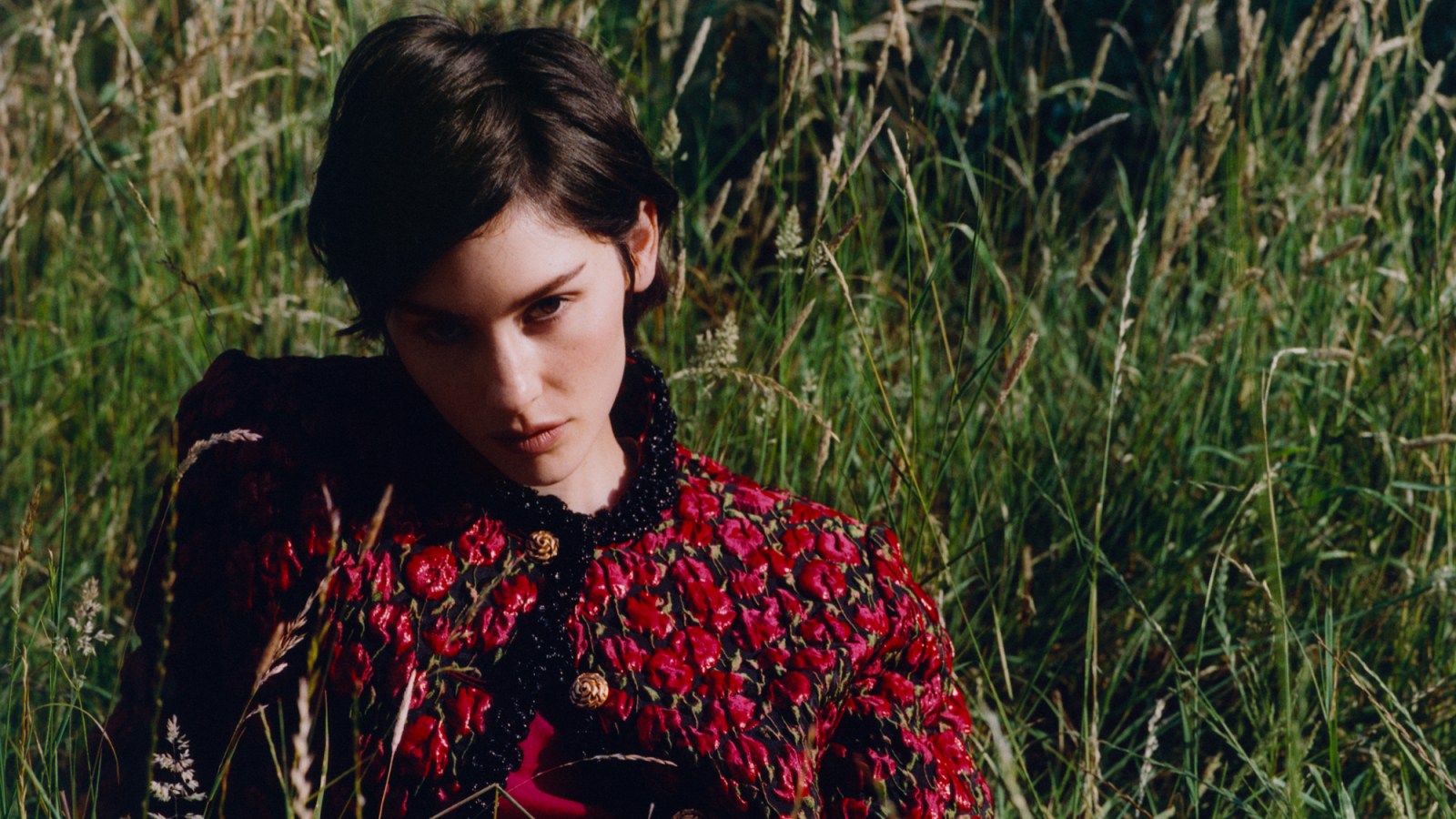
Rose jacket in grass: Jacket by CHANEL. Vintage top via THE GOOSE FINDS.
Swimsuit & Pants: Swimsuit by VERSACE. Vintage OLRIK pants. Shoes by REPETTO.
Blazer: Jacket by CHANEL. Dress by STEFAN COOKE.
Polo & skirt: Vintage shirt via THE GOOSE FINDS. Skirt by CHANEL. Brooch by OSCAR OUYANG.