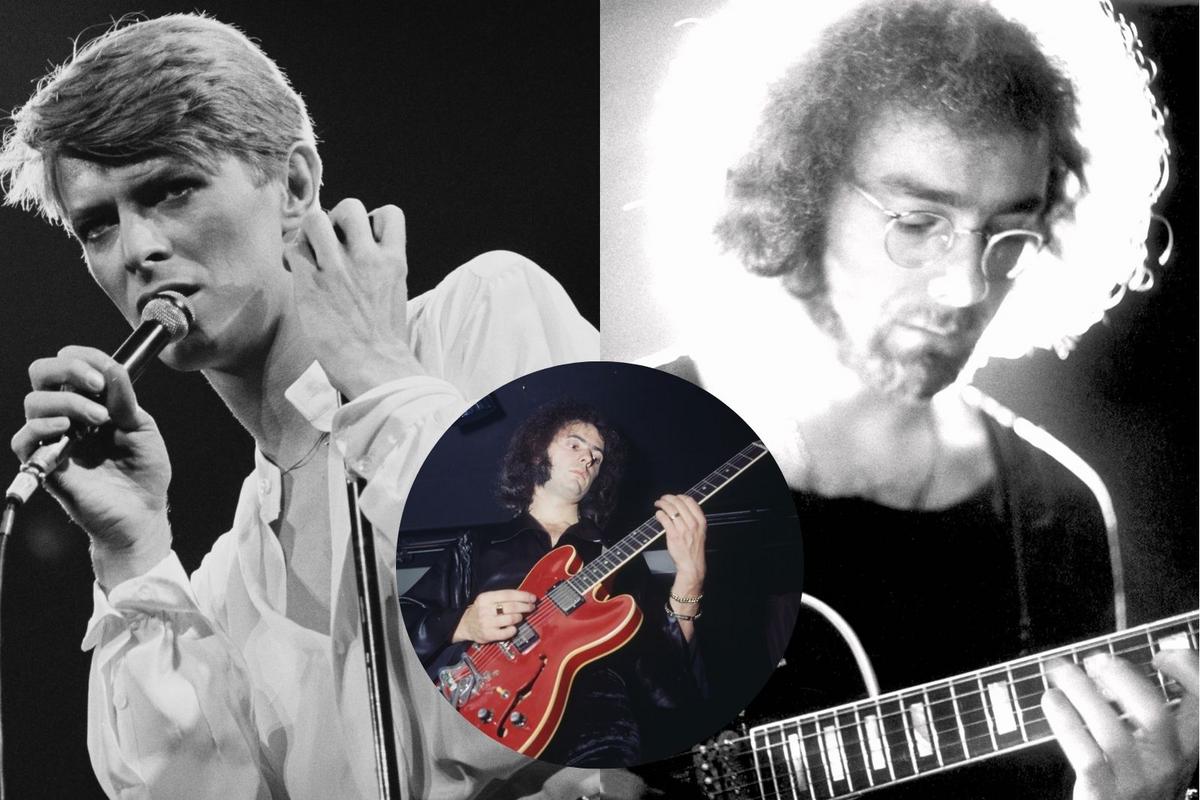

Robert Fripp recalled several of his interactions with David Bowie, including recording sessions in 1977 and 1980, and refusing Bowie’s invitation to join his touring band.
Fripp’s contribution to 1977’s “Heroes” is a milestone in rock history – but the King Crimson mastermind recently told Guitar World that he hadn’t been sure it would work.
“When I got the phone call…I was in New York,” he said. “I didn’t view myself as a working player at that time, having just been in retreat for 10 months with no intention of going back to anything like that, so when David asked me to provide guitar, I said, ‘Well, I don’t know, but if you’re prepared to take a chance, so am I.’”
READ MORE: Wildly Different Covers of David Bowie’s ‘Heroes’
He described the three-day session as “very in the moment,” adding: “I don’t remember any direction from anyone…although I’m not saying it didn’t take place. … It was about immediacy, play and laughter, which are ideal working conditions for an improvising, creative person.”
Later that year, Bowie invited Fripp to his New York hotel: “He asked me to go on tour as his live guitarist, and I said, ‘No. I’ve just come off the road after six years of touring.’”
Hinting at how much persuasion Bowie tried to apply, he noted: “He was very charismatic. That’s the first word I’d use to describe him.” He continued: “[B]ut it wasn’t right for me at the time.
“Would I have been a good live guitarist for David? I don’t know. I think his live guitarist probably did a far better job of covering his catalog than I would have ever done.”
Robert Fripp: How People Should Remember David Bowie
Fripp went on to recall the part he played in Bowie’s 1980 album Scary Monsters (and Super Creeps), saying: “I asked David, ‘Any suggestions?’ because there’s any number of ways you can go. He said, ‘Think Ritchie Blackmore.’ I didn’t expect that, but I understood what he meant.
“Did I sound like Ritchie Blackmore? No. But I’d seen Ritchie in the Outlaws…when I was 17, and his playing was phenomenal. He had all the moves. So I’d seen Ritchie, I’d heard Ritchie, and I wasn’t going to play like Ritchie would, but I knew what David meant.”
Fripp reflected: “How should we remember David Bowie? Simply as we knew him. Some people knew him personally, other people knew him through his work, and still other people will remember David as the person who said to them very directly, ‘You have permission to be who you are.’”
David Bowie Year by Year: 1965-2012 Photographs
David Bowie’s fashion sense fueled his chameleon-like career, from the early days as a mod and a folksinger through Ziggy Stardust, the Thin White Duke and beyond.
Gallery Credit: Dave Lifton