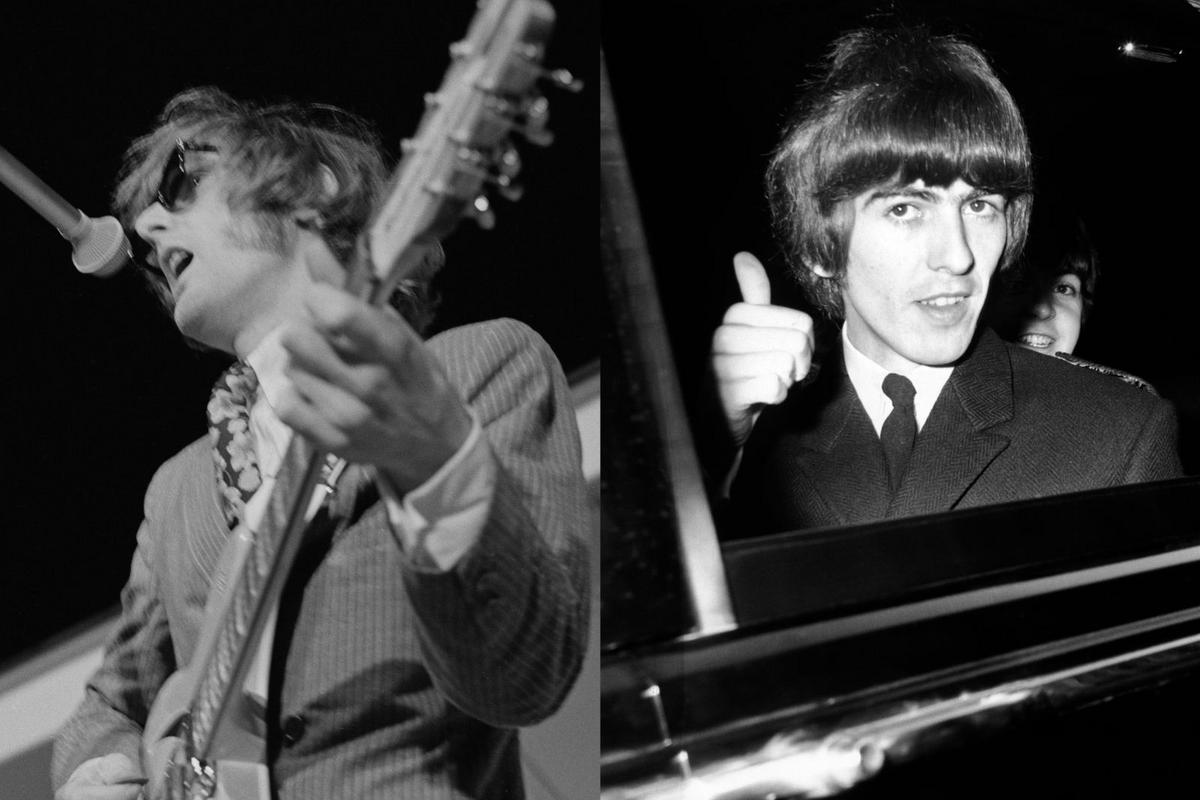

So often in music, what goes around comes around. It’s how George Harrison‘s “If I Needed Someone” from 1965’s Rubber Soul came to be.
As Harrison explained to Guitar World in 1992, the Beatles had always been familiar — friends, too — with the Byrds, the folk rock band out of Los Angeles with such similarities to the Fab Four that they were sometimes described as the “American Beatles.” When Harrison was writing “If I Needed Someone,” he had a particular one of their songs in his head.
“Now that I’m thinking about it, that song actually was inspired by a Byrds song, ‘The Bells of Rhymney,'” he said. “Any guitar player knows that, with that open-position D chord, you just move your fingers around and you get all these little maladies…I mean melodies! Well, sometimes maladies [Laughs] And that became a thrill, to see how many more tunes you could write around that open D, like ‘Here Comes the Sun.'”
“The Bells of Rhymney” was originally written by folk singer Pete Seeger, but it was the Byrds’ 1965 recording, that became popular.
Listen to the Byrds’ ‘The Bells of Rhymney’
One listen to “The Bells of Rhymney” and it’s clear how inspired Harrison was, which is why he made sure to alert Byrds frontman Roger McGuinn about his song’s guitar part in particular before the album was released.
Roger McGuinn’s Recollection
McGuinn has recalled this happening in a couple different ways.
“George was very open about it,” he said in one version (via Rolling Stone). At that time, McGuinn was still mainly using his given name, Jim. “He sent [the record] to us in advance and said, ‘This is for Jim’ — because of that lick.”
READ MORE: The Byrds Albums Ranked Worst to Best
In 2026, McGuinn told Guitar Player that he’d been paid a visit by Derek Taylor, the Beatles’ press officer. Taylor was living in Los Angeles at the time, in the same Laurel Canyon neighborhood that many musicians did then, including McGuinn and Byrds bassist Chris Hillman.
“Derek came over to my house with this three-inch reel-to-reel tape, and said, ‘George wants you to play this,'” he recalled. “So I played it, and it was ‘If I Needed Someone.’ He said he wants you to know that he got that riff from ‘The Bells of Rhymney.'”
Listen to the Beatles’ ‘If I Needed Someone’
The Byrds’ Original Inspiration
The great irony, however, was that the Byrds themselves had been inspired by Harrison, who had started using a 12-string electric Rickenbacker guitar in 1964, both live and in the studio. It was that specific guitar that McGuinn locked eyes on.
“We all went to the movies and saw A Hard Day’s Night,” McGuinn remembered, “and I’d heard that sound on the records, but I didn’t know what instrument it was. But George came out with a Rickenbacker, and it looked like a six [string] from the front.
“But he turned it sideways, and you could see six other tuning pegs, like a classical guitar, sticking out of the back. I went, ‘Oh, they kind of condensed the 12-string head into something good-looking.’ And it sounded great. I had to get one.”
READ MORE: Why George Harrison Almost Didn’t Join the Quarrymen
And it was that guitar that McGuinn used heavily on Mr. Tambourine Man, the album on which “The Bells of Rhymney” appeared. The whole thing had gone full circle.
Harrison’s message to McGuinn was a professional move, an acknowledgement between two highly adept songwriters to ensure no misunderstanding.
“That guitar line,” Harrison wrote in I, Me, Mine, “or variations on it, is found in many a song and it amazes me that people still find new permutations of the same notes.”
How the Beatles’ ‘Rubber Soul’ Influenced These 15 Artists
The band’s sixth studio album was unlike anything else on the market when it was released on Dec. 3, 1965.
Gallery Credit: Allison Rapp