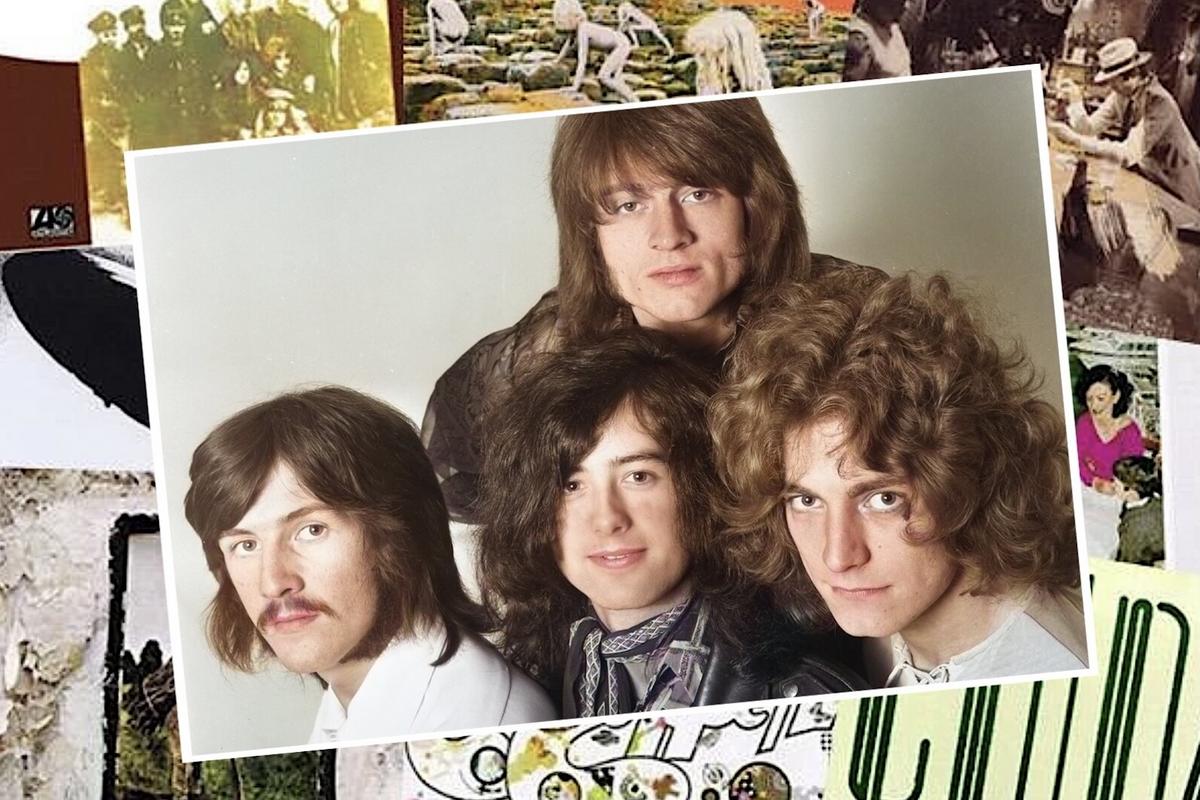

Unlike so many of their late-’60s-era contemporaries, Led Zeppelin was never considered a singles band. They rose to fame in the album era and, in many ways, helped define it.
But they did, release singles – 12 of them, in fact, in the roughly 10 years between 1969’s Led Zeppelin I and 1979’s In Through the Out Door. At the same time, other songs like “Stairway to Heaven” from 1971’s Led Zeppelin IV became radio staples then charted much later.
Four songs were released from their debut, followed by four more from 1969’s Led Zeppelin II and 1970’s Led Zeppelin III. “Whole Lotta Love (b/w “Living Loving Maid”) became a gold-selling Top 5 smash on the Billboard singles chart. “Immigrant Song” and “Black Dog” also cracked the Top 20.
What’s the Best Led Zeppelin Deep Cut?
By the time Led Zeppelin reached 1973’s Houses of the Holy, six of its songs were actually issued as A- and B-sides, with “D’yer Mak’er” (b/w “The Crunge”) reaching the U.S. Top 20. “Fool in the Rain,” Led Zeppelin’s last major single, just missed at No. 21.
So, those songs can’t be part of any discussion of Led Zeppelin deep cuts. Their fourth album, a twice diamond-certified international Top 5 smash, likewise became so ubiquitous that none of that material can rightly be called overlooked.
READ MORE: Top 10 Most Head-Scratching Led Zeppelin Lyrics
Where does that leave us? With plenty of tracks from 1975’s jam-packed Physical Graffiti double album, for one. (But that wouldn’t include “Kashmir,” which was never officially released during Led Zeppelin’s original era but is hardly an undiscovered gem.) Only two songs were subsequently issued from 1976’s Presence – “Candy Store Rock” b/w “Royal Orleans” – though neither charted.
They also emptied the vaults with 1982’s Coda, which arrived after the group split. That’s more than enough material to compile this ranked look back at Led Zeppelin’s Top 20 Deep Cuts:
No. 20. “Your Time is Gonna Come”
From: Led Zeppelin I (1969)
A song marked by remarkable juxtapositions, “Your Time is Gonna Come” is so weird that it’s great. John Paul Jones‘ searching, Procol Harum-esque organ introduces a dark lyric about the fate of a cheating partner before Robert Plant uncoils one of his most utterly ascendant choruses. The heavy drum pattern works in similar antithesis to the dreamy acoustic. Then there’s Jimmy Page‘s badly out-of-tune Fender 800. He once claimed to have learned to play this 10-string steel guitar during these very sessions. That tracks.
No. 19. “Ozone Baby”
From: Coda (1982)
This propulsive track was simply too propulsive for 1979’s often more pop-leaning In Through the Outdoor. So, “Ozone Baby” became one of three outtakes that later appeared on a collection of post-breakup odds and ends. There’s a sad irony to that as Led Zeppelin deftly plays off the post-punk sounds of the day. “Ozone Baby” pointed the way to a never-realized new era. “We knew how to make that s— up,” Plant later told CBC, “but we were so busy trying to write eight-minute epics about crossing the Atlas Mountains.”
No. 18. “Wanton Song”
From: Physical Graffiti (1975)
There’s a shambolic nature to “Wanton Song” that seems to betray its origins in soundcheck jams during a 1973 U.S. tour. But as so often with Led Zeppelin, real craft girds everything. Page plays through some intriguing effects, using echo to create great tension, even as John Bonham adds new wrinkles to a funky gait that resembles 1971’s “Immigrant Song.” Plant’s rather unkempt vocal matches the lyric’s salaciousness, though he’d eventually smooth that out when making many post-Led Zeppelin returns to this song.
No. 17. “For Your Life”
From: Presence (1976)
This was a furious attack on the now-empty excesses of the Los Angeles-era setting where Plant and Page composed the bulk of Presence, even though “For Your Life” was completed far away in Munich. As the lyrics take aim at plasticine relationships and rampant drug use, Bonham unleashes more monstrous yet surprisingly limber polyrhythms. Plant later described the results as “a bitter treaty with rock ‘n’ roll.” Page matches his venomous attitude strum for angry strum.
No. 16. “Bring It On Home”
From: Led Zeppelin II (1969)
Led Zeppelin paid tribute – and expanded upon – “Bring It On Home” just a few years after Sonny Boy Williamson II released his seminal version. They echo Williamson’s single to begin and end, though with far more carnal danger, then insert a rattling, utterly original midsection. Led Zeppelin didn’t credit the original composer, however, leading to a bombshell lawsuit. They hadn’t gotten a firm grasp yet on this new combination of bone-deep blues and heavier sounds (or copyright law), but Led Zeppelin was getting closer.
No. 14. “Ten Years Gone”
From: Physical Graffiti (1975)
Page worked out the general contours of this trippy epic prior to Led Zeppelin’s early-1974 sessions at Headley Grange. “There’s a number of sections on ‘Ten Years Gone’ and movements,” Page later remembered, “and I’d already sort of constructed all of this before going in.” Then an aching turn by Plant almost transformed “Ten Years Gone” into their best power ballad not named “Stairway to Heaven.” Still, that intricate arrangement meant that John Paul Jones had to play an unwieldy triple-neck guitar in concert.
No. 15. “Hots On for Nowhere”
From: Presence (1976)
Despite its happy-go-lucky vibe, “Hots On for Nowhere” actually grew out of discontent during Plant’s long convalescence after a car accident. (He mentions friends who “give me their shoulder” or (worse) “who will give me f— all.”) Page’s accompanying solo is tough, if customary – that is, until he unleashes an eye-popping twang in the middle, courtesy of the tremolo arm on a Lake Placid Stratocaster that was reportedly borrowed from Gene Parsons of Byrds fame.
No. 13. “Custard Pie”
From: Physical Graffiti (1975)
“Custard Pie” also emerged from Headley Grange sessions that produced enough material for about three sides of music. Led Zeppelin decided to round things out for a double-disc release with some earlier (occasionally not as interesting) leftovers, rather than make judicious cuts to release a single LP. In the end, they lost considerable momentum after “Custard Pie” provided such a hard-charging start. Page ran that eruptive guitar solo through an ARP synthesizer, and it’s almost worth the price of admission.
No. 12. “The Song Remains the Same”
From: Houses of the Holy (1973)
By now, they’d played plenty of shows – and they had plenty of stories. That made it easy for Plant to add road-themed lyrics to this song, which began life as a Page instrumental simply called “The Overture” that was meant to precede “The Rain Song.” His inventive arrangement found Led Zeppelin slowing down for a nifty half-tempo section on “The Song Remains the Same” before ramping up to a furious end. It’s a preview of the rangy inventiveness that would mark this often-underrated LP.
No. 11. “How Many More Times”
From: Led Zeppelin I (1969)
Page employed his iconic violin bow on “How Many More Times” a second time after “Dazed and Confused,” which doesn’t qualify for this list of deep cuts since it was a B-side to “Babe I’m Gonna Leave You.” Page had been working on both songs since his embryonic Yardbirds era, attaching bits and pieces into a larger whole. Then “How Many More Times” was played live in the studio, Page later told Guitar World. “I think I did some good things with the bow on that track, but I really got much better with it later on.”
No. 10. “In My Time of Dying”
From: Physical Graffiti (1975)
Led Zeppelin found Blind Willie Johnson’s ageless gospel song through Bob Dylan‘s far more recent ’60s-era cover, then made it their own with armies of Page guitars and another inventive time signature from Bonham. For all of its complexity, however, “In My Time of Dying” was largely recorded just as it sounds. “This is Led Zeppelin just going for it for an 11-minute song,” Page told Rolling Stone, “with all the changes in it and everything and the musical map that you have to remember when it goes 1-2-3-4, tapes rolling.”
No. 9. “Thank You”
From: Led Zeppelin II (1969)
In the first complete set of lyrics he ever wrote, legendary swordsman Robert Plant offers a paean to … the contentment of married life? (Hat tip to Jimi Hendrix‘s contemporary song “If 6 Was 9,” which included two very-similar lines: “If the sun refused to shine” and “if the mountains fell in the sea.”) “Thank You” also finds Jimmy Page playing … an acoustic solo? Led Zeppelin had small ways to surprise even in their earliest days.
No. 8. “No Quarter”
From: Houses of the Holy (1973)
“No Quarter” was a triumph of quiet innovation, a showcase for Jones’ overlooked genius, and another example of the striking diversity found on Houses of the Holy. Did that make for a great album? Not if the hope was for more of their sludgy, often derivative early songs. Instead, “No Quarter” confirmed that a band who began by ripping off old blues guys had brilliantly synthesized those early influences into something new. They’d become one of rock’s most deeply involving – and completely fearless – voices.
No. 7. “Nobody’s Fault but Mine”
From: Presence (1976)
Another ’20s-era Blind Willie Johnson song transformed by Led Zeppelin into the stammering recollection of their own fall from grace. Yet Plant’s positively vitriolic harmonica solo is anything but introspective. A triple-tracked Page then took things up a notch – actually several notches – by applying a phaser while playing one guitar an octave higher. “Nobody’s Fault but Mine” might come off like a loose jam at first, but it was actually (once again) all carefully constructed choreography.
No. 6. “That’s the Way”
From: Led Zeppelin III (1970)
Led Zeppelin had begun hinting that they contained multitudes. “It was not all blood and thunder,” Plant later mused with Dan Rather. “There was a delicacy about it, too.” That was certainly true of the elegantly conveyed “That’s the Way,” written during a retreat at bucolic Bron-y-Aur in Wales. As the song built to its emotional conclusion, Page became something of a Swiss Army knife. He added a dulcimer atop a track that already included his acoustic guitars and pedal steel, then dubbed in Jones’ bass parts, too.
No. 5. “What Is and What Should Never Be”
From: Led Zeppelin II (1969)
This has a fun kitchen-sink attitude. Plant dabbled with phased-out vocals, while Page’s guitar swept from side to side across the entire stereo spectrum. As it spun, “What Is and What Should Never Be” also shined a deft light on this group’s two strengths: It was folky and ruminative one moment, brawny and tough the next. John Bonham leads the way. Despite his justifiable reputation as a stick-breaking pounder, “What Is and What Should Never Be” underscored the sweep of Bonham’s considerable talents.
No. 4. “In the Evening”
From: In Through the Out Door (1979)
A throwback to their first albums in the very best sense of the word: “In the Evening” kicked off In Through the Out Door with a spiky riff that might have easily emerged a decade earlier or more, but retained the dizzying sense of musical gumption that eventually took their collective career to the next level. The only problem? As the LP unfolds, nothing else really matches this leering, thrillingly metallic plea for love. It remains Page’s best turn on In Through the Out Door, a studio project that could’ve used a lot more.
No. 3. “Ramble On”
From: Led Zeppelin II (1969)
Plant’s storytelling begins to combine the stereotypical blues-dude pursuits (looking for a woman, never sticking around for long) with some seriously mystic Lord of the Rings vibes. (Mordor, Gollum and the Evil One – presumably Sauron? – are name checked late in “Ramble On.”) Fun fact: It remains unclear how Bonham created his pattering rhythmic accompaniment. Either way, Plant would return to the worlds of J.R.R. Tolkien on both “Misty Mountain Hop” and “The Battle of Evermore.”
No. 2. “Achilles Last Stand”
From: Presence (1976)
Plant offers the first hint at this LP’s autobiographical turn by alluding to their tax-exile status. He also chose a title that winked at the severe ankle injury he’d suffered in car accident: (In Greek mythology, Achilles was brought down by an arrow to the heel.) Page piled up six guitars while Jones added a distinctive bass line. But they were no match for Bonham, whose monstrous drum work serves as lead instrument for the song’s first half. This set a standard for shifting time signatures that would dominate the next wave of heavy metal.
No. 1. “House of the Holy”
From: Physical Graffiti (1975)
It was actually a good thing that Led Zeppelin left “House of the Holy” off their most recent studio album. This catchy pop-metal song grounded what could otherwise be a overloaded, weirdly experimental project. At the same time, no Led Zeppelin track so smartly married Plant’s idiosyncratic obsessions with both fantasy and sex: “In my hand a sword of gold. Let me wander in your garden and the seeds of love I’ll sow.” Hard to believe they ever shelved it, even with Bonham’s stubbornly squeaky kick pedal.
Ranking Every Led Zeppelin Live Album
It took a while, but they finally got things right.
Gallery Credit: Nick DeRiso
Listen to Kevin Shirley on the ‘UCR Podcast’