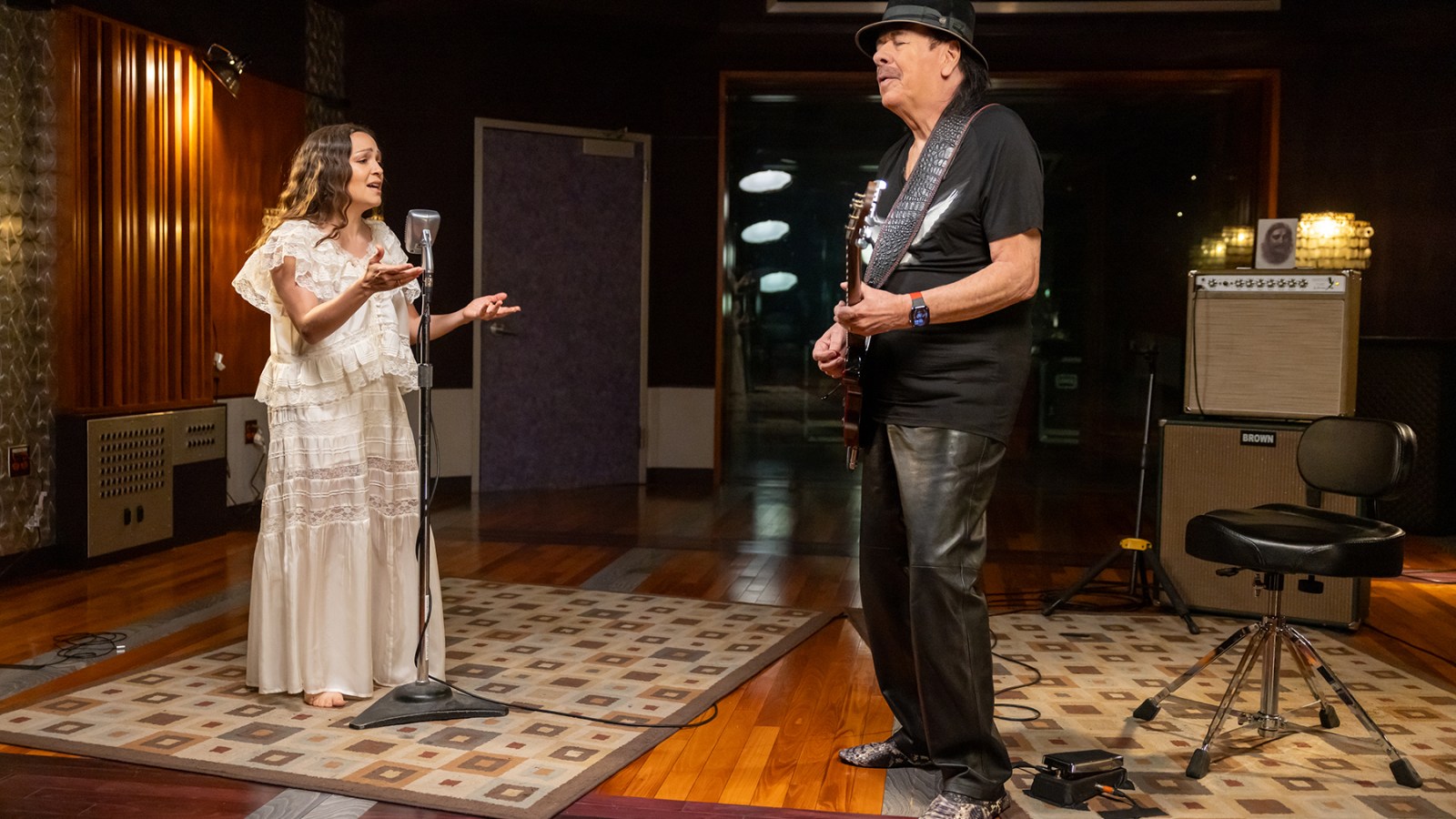

“Hermano,” a heartfelt ode to the immigrant community, came to Natalia Lafourcade in a dream. “I turned around and told my husband, ‘Please hold the baby, because there’s a tune in my mind and I have to get out of bed,’ and started singing it,” she tells Rolling Stone. “It is not common for an idea to arrive so fully formed like that.”
Titled “Hermano,” the track finds the singer/songwriter teaming up with iconic Latin rock pioneer Carlos Santana and hit-making producer Edgar Barrera. It follows the release of Santana’s “Mi Gran Amor” — a high-profile duet with Becky G — last May, and his 2025 collabs with Carín León and Grupo Frontera.
An earthy ballad with touches of traditional son jarocho, “Hermano” is a call for unity at a particularly bleak time for the Latino community in the U.S. Far from sounding preachy, the song employs Lafourcade’s serene vocal style and Santana’s soulful guitar as an invitation to reconcile.
“Carlos wanted to make a song that spoke to our Latin American brothers and the migrant community,” Lafourcade says. “It is such a pity that the world is still experiencing issues of discrimination, violence, and racism. At the end of the day, these conflicts stem from a lack of empathy and justice.”
Lafourcade and Santana connected with Rolling Stone over Zoom to discuss their creative process and the song’s timely message.
How did “Hermano” come to be?
Santana: Everything that happened since I was born has a lot to do with grace. Grace is the female side of God, and it is very important to me. When I go see a band, I need a balance between the testosterone and the softness of a flower in a female — I need all the colors in the rainbow. I feel this song has been ordained, just like all these incredible artists who come forward and want to share their heart and vision with me. By the time I show up, all I need to do is close my eyes and play the guitar.
Lafourcade: When I was invited to work with Carlos, I sent the demo to Edgar wondering if it would be a good fit. He loved it and asked that we meet in Miami to work on the structure and lyrics. His contribution was marvelous. We both felt the track needed to exude a hopeful air of love and light. There are a few moments when the song becomes an offering. Hold my hand; let’s reflect and remember our brotherhood.
On first listen, it sounds like such a simple song. Is it the folk component that adds a layer of sophistication?
Lafourcade: It started as a ballad. It felt really country-like, with a strong Veracruz accent. It’s not 100 percent folk, but you can hear the huapango influence, and the 6/8 rhythm. We also used a cuatro, an instrument that I love deeply and often keeps me company when I’m writing songs. You can hear the cuatro in Venezuela, Colombia, and a lot of Latin folklore. When we started recording with Edgar, I wanted it to have a Mexican feeling, but also to sound universal. We combined the roots with a contemporary touch and Santana’s footprint. Having the chance to work with Edgar was incredible. He can tackle so many different genres, and I also got to see his versatility as a producer.
Carlos, is “Hermano” also a nod to your own Latin American roots?
Santana: When I was starting out, I identified with Ritchie Valens and José Feliciano. I looked up to Dolores Huerta. But the person who was like a mentor to me was Harry Belafonte. I think he said, “It’s not how much money you have, or how famous you are; it’s how you carry yourself.” I liked that.
I was asked once, “Carlos, how do you see yourself?” And I said, “Oh well, I try not to define myself. But if I must, I call myself a multidimensional Mexican motherfucker.” Those words are not necessarily bad, you know. Being from Tijuana, you need to have tenacity.
Carlos’ guitar work on this track is especially delicate and understated. Was this a classic case of less is more?
Lafourcade: Absolutely. This gentleman has a lot of experience. I see him as a seasoned sea wolf. He reminds me of the people who work the land here at home — they know exactly how to chop the bamboo with a machete. No matter where Carlos plays, you will know it’s him. He has the Santana sound, and it’s really nice to work with musicians who have nothing left to prove. When you place your humility and generosity at the service of a musical arrangement, you allow the other components to shine, and end up shining brighter as well. That’s where his experience really comes through.
The lyrics are very poignant. I remembered the power of a great song to really make a difference.
Santana: I never identified with the victim mentality. I don’t walk around with my tail between my legs and apologize for being a Mexican in the United States. I think there needs to be a time and a place when we reclaim that we are worthy of being on this planet. It doesn’t matter where you live, San Rafael, Kauai, or Las Vegas. It’s just another room in the same house.
Lafourcade: More than ever before, I feel a strong desire to create the kind of songs that can transform us all. That’s my biggest request to the muse right now — finding the inspiration that will lead to more of this kind of music.
When you release a song into the world, you have no control over how many hearts it will touch, or what kind of influence it will have. The only thing you control is your own intention. My wish is that this track may awaken some consciousness. Perhaps it will touch the hearts of people who are mistreating their own brothers. It may also question how we cultivate our individual light in order to have an impact on a collective level. The notion that life is an individual pursuit is outmoded. It’s about time we begin to experience reality as an integrated whole.