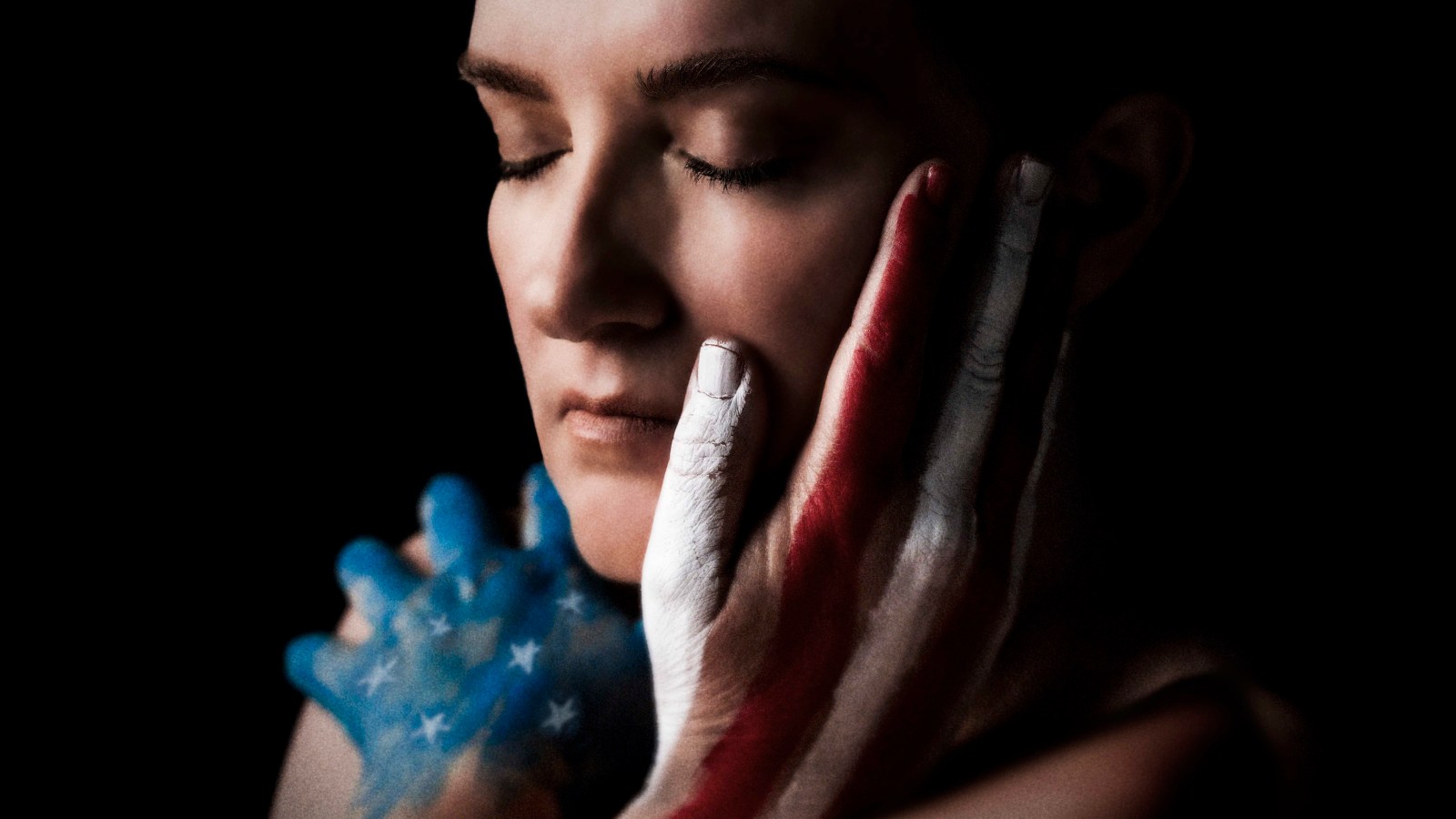

When Brandy Clark arrived on set to film the lyric video for her new single “American Roots,” her makeup artist had an idea. He wanted to paint her face and hands red, white, and blue, to riff on the song’s ideas of envisioning a loving, inclusive America where everyone, including immigrants, belong.
Clark was a little nervous at first, but it didn’t stop her from moving forward. “I’m so associated with the rainbow flag,” Clark, whose excellent new album The Bird is out in January, tells Rolling Stone. “But we deserve this. My fans deserve to see this. And a lot of people in my family, my dad being one of them, served in the military for that flag. That’s all of our flag. MAGA does not own the flag.”
It’s a sentiment that a lot of Americans have been wrestling with as the Trump administration has worked to turn the flag into a symbol not of pride, but exclusion — and for country fans, one that was co-opted in a post 9/11 landscape where jingoistic songs passing as patriotism became radio gold. In the wake of the November midterms, however, when a blue wave saw Democratic gains in states once dismissed as lost causes, can artists change their relationship to patriotic songs?
Long before Tuesday’s elections, it’s something that Clark was thinking about with “American Roots,” along with others like Mickey Guyton, the War and Treaty, and many more country and roots artists interested in reframing exactly who gets to own the idea of patriotism. In a clip from Newport Folk Festival making the viral rounds this week, Joan Baez, alongside Mavis Staples, Nathaniel Rateliff, Brandi Carlile, and others, close the festival with their take on “America the Beautiful,” introduced with some potent words. “This song is something that we are taking back,” Baez said.
Part of this process, according to the War and Treaty’s Michael Trotter Jr., is divorcing patriotism from partisan (and often hateful, exclusionary) politics. Zac Brown tried to claim his performance of the National Anthem at President Trump’s UFC match on the White House lawn last summer was just “patriotism, not politics.” That was hard to square, however, when the country singer stood on the same stage where heavyweight fighter Josh Hokit later celebrated his win by shouting, “Michelle Obama is a man.”
“I take great pride in being able to say that I served this country and served it well,” Trotter, a combat veteran of the Iraq war, told Rolling Stone. “So, I am ashamed that people would hide behind the term ‘patriotism.’” Sheryl Crow, in a visit to Nashville Now, agrees.
“There are words we use against each other to create sides: ‘fake,’ and ‘woke,’ and ‘patriot,’” Crow said. “The word ‘patriotic’ and ‘patriot’ really is offensive to me. Because I feel very patriotic about my country, but I’m not a conservative. I’m a middle-of-the-road pragmatist. But [patriotic] is used for one category of people and it’s used against others and I take offense with that.”
That approach has been a part of the country music playbook for decades now, and was on Clark’s mind when she started writing “American Roots,” a song that is gentle in its messaging: we’re all Americans, with equal rights to walk on our hallowed land, wherever you may come from originally. It hinges on a lyric in the bridge. “When you set foot onto that shore,” she sings, “it’s no more mine than it is yours.”
“To me that song is a conversation between two people, and two people who might not agree,” Clark says. “Like, tell me about your family tree, when we start digging where’s it going to lead? It’s about finding commonality throughout the whole song. And then when you get to the bridge, it’s like, okay, here it is. My hope is that someone who doesn’t agree with that statement has found enough of themselves in the song that they can at least hear it.”
The 2026 midterm elections have, for many, made that dream feel all the more realistic. Voters vehemently rebuked, with some important exceptions, Trump’s hateful policymaking, with Democrats taking both the house and the senate. Scores of historic elections will put the first Native American female governor, Black female governor, Muslim senator, openly gay male senator and more in power, crafting a government that actually reflects the people living within in. Whether it leads to more artists feeling emboldened to reclaim their version of a patriotic anthem is still yet to be seen, but with songs like “American Roots,” the tide seems to be turning. Everyone should get to partake in this musical tradition, regardless of political beliefs.
Guyton, back in 2021, was already pushing the concept on “All American” from her debut LP Remember Her Name, an album all about claiming and reclaiming space in both country music and the country itself. “We got the same stars, the same stripes, just wanna live that good life,” she sang. “Ain’t we all? Ain’t we all all-American?” A version of that sung by a white conservative man would have been a radio hit, but Guyton’s song has more impact than a fleeting Number One: it changes the definition of who gets to own a patriotic song.
Clark is working on that, too. “I’m a proud American,” she says. “Why can’t I be patriotic by saying we all belong?”