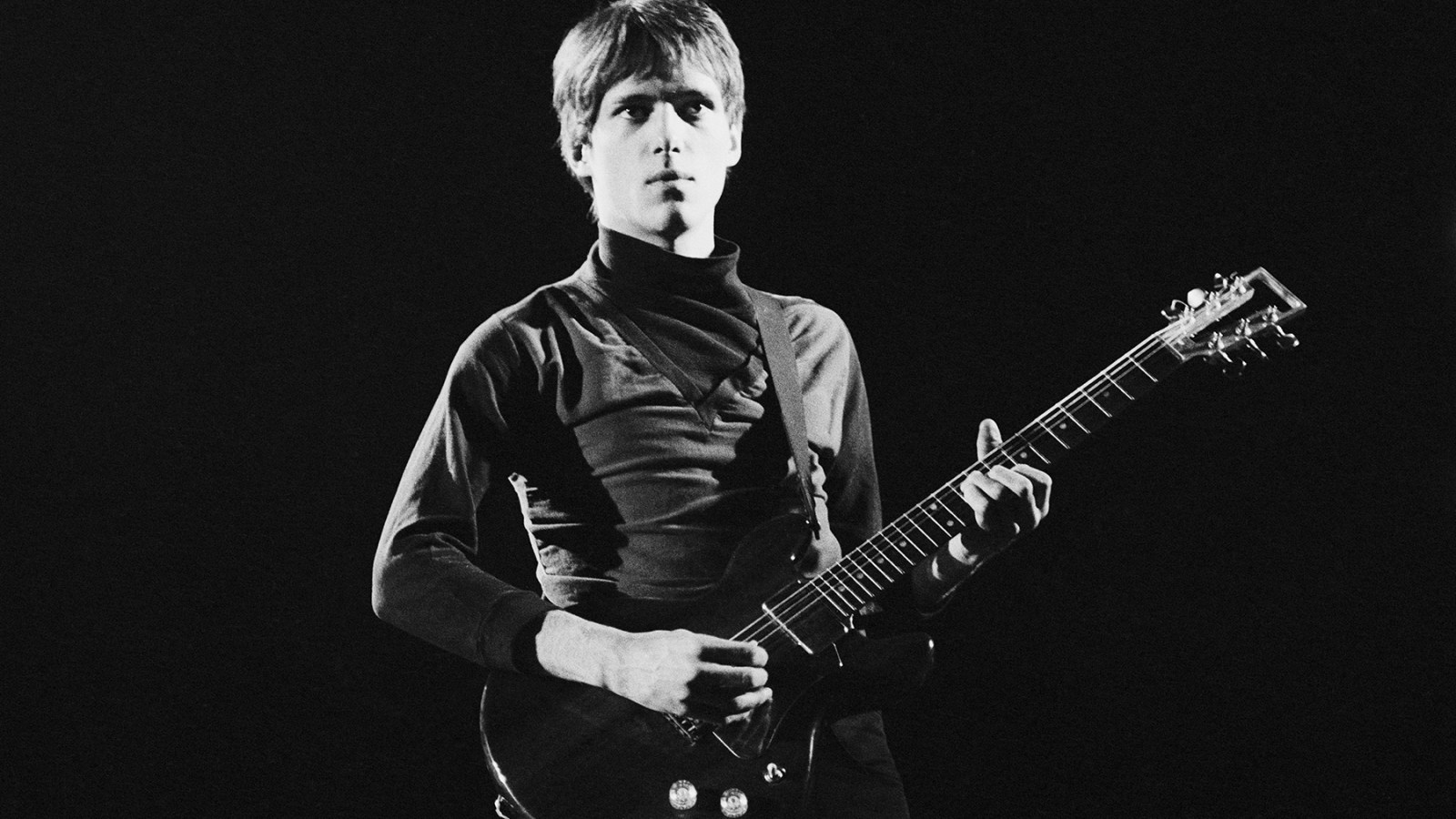

The music world is in mourning Richard Lloyd, the guitar virtuoso from Television, the New York band that put CBGB on the map and kicked off the punk rock explosion. Lloyd made Television one of the all-time great guitar bands, in his tumultuous partnership with Tom Verlaine. He died on Saturday, at 75, after a fight with cancer. But he created a lifetime’s worth of rock magic with Television, in classics like “Marquee Moon,” “Little Johnny Jewel,” and “Days.”
Television barely stuck together for five years and two albums — yet that was enough to change how guitar music has sounded ever since. They never got a shot at American radio airplay, but they inspired upstarts all over the world, like R.E.M., U2, Sonic Youth, and Radiohead. Lloyd played so many of their most dazzling solos, as in “Elevation,” “Guiding Light,” or “See No Evil,” where his guitar sums up all the “destructive urges” Verlaine sings about. You could devote your whole life to exploring Television live bootlegs, and some of us do.
Lloyd was always underrated — the George Harrison figure in Television, a couple of years younger than Verlaine, but constantly rebelling against his kid-brother status. He was the band’s wild child, the chaotic rock & roll hellion with the face of a choirboy. Verlaine didn’t touch drugs; Lloyd gobbled them up. Verlaine hated bars and clubs; Lloyd hated leaving. As he recalled in his memoir, “I called myself a try-sexual at the time, because I would try anything a couple of times to see if I liked it. For a while, I supported myself as a male prostitute, just like Dee Dee Ramone, around the corner of 53rd and 3rd.”
Television weren’t built to last — not with these volatile personalities. “I’m already a manic depressive – bipolar A, as they say,” Lloyd told Guitar World earlier this year. “Every time we went into the studio, Tom would literally drive me nuts. He would act in such a way that I would end up in the mental hospital, or just the regular hospital.”
But nobody — except maybe Verlaine — could miss the spectral beauty of their twin-guitar chemistry. Together, they made the timeless 1977 classic Marquee Moon. With Lloyd on Strat and Verlaine on Jazzmaster, they plugged into the urban grime of New York City and came up with a whole new kind of psychedelic punk. Lloyd was Bob Weir to Verlaine’s Jerry Garcia, Phife Dawg to his Q-Tip, Carl Wilson to his Brian, with the tough rhythm section of Fred Smith and Billy Ficca giving both axemen room to stretch out. Smith died this past February, Verlaine in 2023, leaving Ficca as the last man standing.
Lloyd was a New York kid who grew up in Greenwich Village, at the height of the Sixties party. By all accounts, he jumped right in, prowling the city for sex and drugs and adventure. He also faced mental health issues, getting locked up in various institutions, given chemical shock treatment.
But Lloyd had a superhuman knack for charming people, with his magnetic looks and personality, talking his way into any room. As he recalled, “I was a vagabond, but a pretty one.” He hit the Fillmore East to see the Grateful Dead or Led Zeppelin or the Allman Brothers, the kind of guy who could always get in free. He was brazen enough to walk in on a Dead soundcheck and ask Jerry Garcia to put him on the guest list that night. As Lloyd told the tale, Phil Lesh was the one who said yes.
He was always a wild thing. In his highly entertaining 2018 memoir Everything Is Combustible, he recalls an incident from his teen years, when he was in Central Park but suddenly decided he wanted to move to another planet. So he walked all the way to the World Trade Center, 120 blocks or so—barefoot. As he wrote, “I found elevators that eventually took me up to the 106th floor. I entered an office and asked where the World Trade Center was. That is, where was the trading center where I could change worlds?”
The question didn’t go over well. “As I found out, they also had jail cells on the 103rd floor, one of which they put me in.” They took him to Bellevue — not his first mental ward, and not his last.
He rambled from Boston to L.A., returning to NYC in 1973 with platinum-blonde hair, to catch his new favorite band, the glam-punk pioneers in the New York Dolls. He knew how to slither into any scene, immediately making himself the prettiest kid there. He became a regular at Max’s Kansas City, scamming the free chicken wings and finding lovesick older men to offer him places to stay. One of these men was Terry Ork, an Andy Warhol cohort who managed the bookstore Cinemabilia, where the employees included future punk legends Tom Verlaine, Richard Hell, and Robert Quine.
One night, Ork took him to an open-mic night to see Verlaine play solo. As soon as he sang “Venus,” Lloyd knew they belonged in a band together. Verlaine had already formed the Neon Boys with his high-school friend and fellow poet Richard Hell, but Lloyd was the real neon boy that they were looking for, the flashy brat, the agent of chaos in a band full of uptight control freaks. Lloyd made them a real rock & roll band instead of an art project.
Television found a place to play in March 1974 — a sleazy Bowery dive bar called CBGB. “Tom and I were walking down from his house to the loft in Chinatown,” Lloyd recalled in Clinton Heylin’s essential punk history From the Velvets to the Voidoids, “and we passed this place which the owner was outside fixing up. We asked if maybe we could play there—and he told us he was going to call the place Country, Bluegrass, and Blues. So we said, ‘Yes, we play stuff like that.’”
A ridiculous claim — but somehow, people always seemed eager to believe anything Richard Lloyd told them. Hilly Kristal called their bluff, and suddenly Television had a weekly residency. They played CBGB every Sunday night, drawing 20 or 30 people, until word began to spread. David Bowie came by in May, and declared them “the most original band I’ve seen in New York. They have it.” They drew stars like Lou Reed, Paul Simon, and director Nick Ray, who called them “four cats with a passion.” The NYC punk scene blew up at CBGB, with rebels like the Ramones, Patti Smith, Blondie, and Talking Heads. As Lloyd boasted in 2007, “CBGBs is the most famous rock & roll club to have ever existed and I fucking created it!”
Patti Smith put Television on the map with her famous Rock Scene review in 1974, before the band even had a record out. “Richard Lloyd plays emotional and highly sexually aware guitar,” she wrote. “He’s the pouty boyish one. The one most likely to get beat up in a parking lot.” Smith totally nailed the mystique of the band as “a movement of inspired mutants that will take the slop out of rock.”
But Tom Verlaine and Richard Hell battled for control of the band, until Hell quit and Fred Smith took over on bass. His chops let Television develop into the jam-till-dawn groove monsters they were born to be, stretching out into double-digit minutes for twin-guitar epics like “Marquee Moon” and “Friction.” They cut their debut indie single in 1975, with a tame studio version of “Little Johnny Jewel,” barely hinting at its onstage power. Lloyd hated it so much he quit for three days.
Television made two great 1970s studio albums: Marquee Moon is the universally acclaimed classic, while Adventure is the wrongly underrated follow-up. (As the zine guru Byron Coley once wrote, “Marquee Moon for songs, Adventure for playing.”) Instead of splitting into conventional lead/rhythm roles, they traded off solos. (Verlaine, prickly as always, made sure the album credits itemized which ones he played.) Lloyd brought the melodic sparkle of their succinct pop tunes, like “Venus” and “Days.” But he also brought the urgent rhythmic drive — Verlaine always needed a guitar partner to give his music a kick in the ass, and he never had one who kicked like Lloyd. You can hear that in fiery live documents like The Blow Up, with their famous destruction of Bob Dylan’s “Knockin’ on Heaven’s Door.”
There’s nothing like the magic these guys conjured up onstage. To hear Richard Lloyd at his best, go to the summer of 1978, when they already knew they were breaking up, but playing the most ferocious guitar fireworks of their lives. Check out the 12-minute “Little Johnny Jewel” from the San Francisco gig, finally released as Live at the Old Waldorf — a blowout that feels like a defiant last stand. Or the 17-minute “Marquee Moon” from Portland, a few nights later. Or the 13-minute “Kingdom Come” from back in NYC on July 29. It’s downright bizarre that so much of their greatest work remains officially unreleased.
But in any version, “Marquee Moon” is their zenith, the mutant love-child of “Dark Star” and “Sister Ray,” an epic trip into the unknown that wandered somewhere different every night. Lloyd delivered the garage-band propulsion, while Verlaine aimed for the interstellar jazz space of John Coltrane or Albert Ayler. “Marquee Moon” has been covered by bands from Pavement to Geese to Wilco—none of them trying to match the original, just to live up to that adventurous spirit.
Television never sold diddly in the U.S., but they made a worldwide splash. “Marquee Moon” became an unlikely hit single in the U.K,, making the Top 30, while they also made the charts with “Prove It” and “Foxhole.” Adventure was a Top Ten album there, proving this band had a bright Eighties future. But sadly, Television were already falling apart, and so was Lloyd — a “full-blown junkie,” by his own account. They broke up in 1978, at the peak of their musical powers.
Lloyd moved on to sharp solo albums like 1979’s Alchemy and 1986’s Field of Fire. He also wrote and co-produced the dBs’ 1978 debut single, “I Thought You Wanted To Know.” Television’s short-lived 1992 reunion resulted in a low-key self-titled album, with Lloyd shining in gems like “1880 or So” and “No Glamour for Willi.” (They played sporadic shows in the 2000s, but Lloyd left for good in 2007.) He joined the Cleveland proto-punks Rocket from the Tombs, in the place of their original guitarist Peter Laughner— ironic, since Laughner was the guy who briefly replaced him in Television in 1975. He was a longtime foil for the ace Nineties singer-songwriter Matthew Sweet, especially on his 1991 breakthrough Girlfriend, where the other lead guitarist was another CBGB legend, Robert Quine. Lloyd brought his unique sound to “Divine Intervention,” “I’ve Been Waiting,” “Falling,” and the 1995 MTV hit “Sick of Myself.” In the video, Lloyd plays the solo from his hospital bed, after crashing his car.
But he cleaned up and kept gigging the rest of his life — the fact that he lived to be 75 is one of his most surprising achievements. As he shrugged in his memoir, “I’ve been clinically dead a couple times, so what difference does it make to me? I like experience.” In 2002, Television reunited for their first NYC gigs in a decade. I’ll never forget the boyish mischief all over his face as he ripped through evergreens like “Venus,” “O Mi Amore,” and a wonderfully trippy “Marquee Moon.” That sense of mischief and adventure lives on in everything Richard Lloyd ever played — and that’s why his guiding light still shines on.