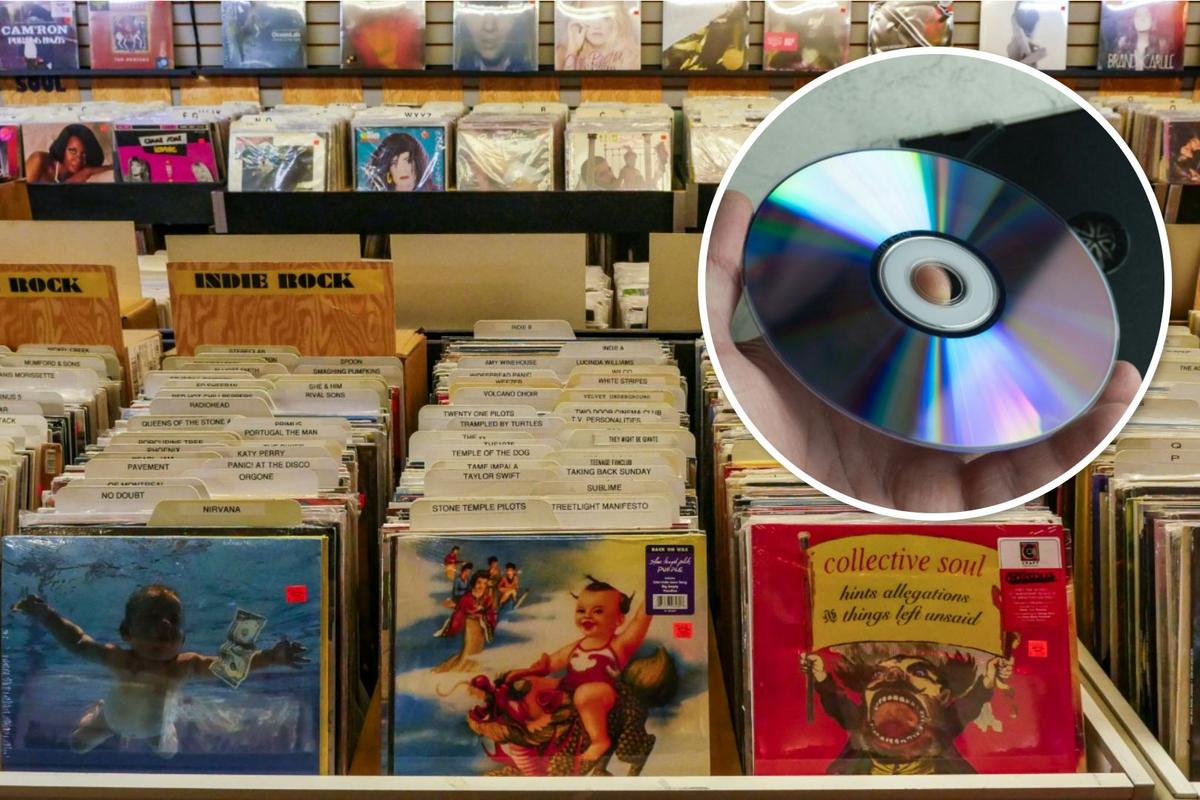

You may have heard about the uptick in CD sales in 2026, so here’s why the format may be making a comeback, according to a vinyl industry expert.
Luminate’s mid-year report came out in July and noted that CD sales outpaced vinyl during the first half of the year in the United States. Sales of the former format increased over 16 percent and the latter only grew by 2.4 percent from last year. Nearly 10 percent of the spike in CD sales was due to K-pop releases, but even without K-pop, the disc still saw a 6.7 percent increase.
The popularity of the CD as a format started to wane in the 2000s and then digital and streaming services took over as the predominant platform for music consumption for some time as vinyl slowly started to make a comeback.
LP sales spiked in 2007 and have been steadily climbing since then — but it seems that its ascent may have finally started to slow down as we’re seeing an uptick in CD sales again. It began in early 2022 when Billboard reported that, for the first time since 2004, CD sales improved year-over-year in 2021 (albeit by a 1.1 percent increase, but up is up).
What’s happening? Why does the popularity of the formats seem to shift back and forth? Will vinyl cease to be the most popular format and CDs make a real comeback?
There’s no real way to predict the future and what’s going to change within the world of music consumption, but we wanted to speak with someone who works in the vinyl industry and see what they think about these trends to get a better idea.
We reached out to a longtime veteran of the music business with deep ties to indie retail and the vinyl format, who will remain unnamed for privacy reasons, to ask whether the rising cost of vinyl records has anything to do with the spike in CD sales, whether they think CDs will become the leading music format again and more.
“It would be silly for anyone to say the cost of one format being three times what the cost of another format is, isn’t driving some people to choose the cheaper format,” our source told us, adding that the “price of a vinyl record based on inflation is sort of in line as what it’s always been.”
Let’s put these numbers into perspective for a moment. According to Keep ‘Em Spinning, which pulled data from Discogs, the average cost to buy a new vinyl record in 2025 was $37.22 — a 24 percent increase in price since 2020. The report said the increase was due to three factors: limited pressing plant capacity, inflation and demand, particularly from Gen Z.
Our source actually asserted that the pressing plants are more than capable of keeping up with the demand, despite what the casual fan may think about big name pop artists with multiple vinyl variants.
“We’re not in a world like we were during pandemic where the demand so far outstripped the global capacity that you were waiting six, nine, 12 months for records to show up. That is simply not the case,” they shared. “There might be individual plants that are backed up and that’s requiring people to be more flexible about where they put their jobs. But the overall install capacity is able to handle all the input that we’re putting into it.”
READ MORE: 21 Underrated ’80s Albums Every Rock Fan Should Own on Vinyl
They did, however, note that inflation and the rising costs of fuel have had an impact on the cost. So if it’s more expensive to buy vinyl, are CDs going to become the predominant listening format again, especially during an age when most storefronts are optimized to sell vinyl?
“There would have to be forces that are right now not on the table to make the industry really move from one format to another and I don’t see that coming. I think that there’s nothing on the near-term horizon that we see from a participant in the market that says that’s going to change.”
Keep reading for the full conversation about the current vinyl market, what’s influencing the cost, the value of CDs and more.
From your perspective, why has the cost of vinyl gotten so much more expensive over the last couple of years and what are the main drivers of that increase? Is it production, shipping, et cetera?
It would be silly for anyone to say the cost of one format being three times what the cost of another format is, isn’t driving some people to choose the cheaper format. Of course that’s happening.
Let’s look at what the cost of vinyl is today and market averages, opposed to what happens with big new release spikes where you’re selling the biggest pop records in the land for $50 for a single LP (which I personally find to be egregious and just almost immoral). If you look at what’s happened from sort of the inception of vinyl as a sound carrier and look at what pricing was in the ’80s and ’90s as CDs came in, the price of a vinyl record based on inflation is sort of in line as what it’s always been.
READ MORE: Is It Safe to Play Picture Disc Vinyl Records on Your Turntable?
Now, obviously the dollar amount seems like it’s a hell of a lot today, but when in comparison to all the other things that have changed in inflationary pressures, you’re getting a better deal now than for a lot of other things that have risen in price over the same time period.
But they are obviously demonstrably more expensive than the CD. So you have to believe that there are some fans that are deciding that they’re gonna go ahead and spend their money on something that doesn’t cost as much because we all know that, especially in the U.S. — and I can’t speak to inflationary pressures of the present moment outside the States, but certainly in the U.S. — all of the inflationary pressures brought on from the commencement of our Middle East affairs have increased the price of oil. They’ve increased the price of transport.
And all those things contribute to a higher cost of products for an LP once you get to the final stage.
You mentioned the biggest pop records selling — another thing that’s happening is obviously a lot of the big Taylor Swifts of the world are putting out seven to eight different variants of vinyl a lot of the time. Is that affecting the cost of the price at all and is that putting pressure on the pressing plants?
No, not really. I mean, I think that typically what all of us are trying to do whenever we’re coming up with a variant offer and essentially this is how do we ensure that sort of we have complete market coverage, I think that some of the stuff we’re all doing on the D2C [direct to consumer] side is a bit ridiculous and we could probably afford to pull back from all the crazy offers that end up being added during chart weeks.
But setting that aside, I think that the variants should all be priced relatively the same.
There are some exceptions to that: if you’re looking at something that is truly a hand-packed sort of a job, whether or not you’re putting the record inside something, it gets wrapped and tied with a ribbon, or if you’re looking at a record that has some sort of element on the inside of it, such as liquid or sand or flower petals. All those are incredibly detailed, hand-packed, manual jobs. Those are going to be more expensive.
But if you’re just looking at split colors, splatters, transparence, marbles, all the sort of normal variants, all those should roughly be about the same price. While it’s certainly more complicated for plants to do that work, there is absolutely enough installed capacity globally to handle any of the stuff that we’re throwing at it right now.
We’re not in a world like we were during pandemic where the demand so far outstripped the global capacity that you were waiting six, nine, 12 months for records to show up. That is simply not the case. There might be individual plants that are backed up and that’s requiring people to be more flexible about where they put their jobs. But the overall install capacity is able to handle all the input that we’re putting into it.
And again, I’m saying from a market standpoint. Looking at everybody that’s in the game, we’re good.
Another thing that we’ve noticed is some artists are actually staggering the release dates for their vinyl. So the vinyl doesn’t become available until a later date than when the album actually comes out on digital and CD and whatnot. Why has that kind of become a trend lately?
You’d really have to talk to individual artists and managers and labels to ask sort of their strategies. What I would my suggestion would be — and again, this is just my opinion — but I believe the biggest contributor is that a release date has been chosen. They want to maximize their ability for chart position and they’re gonna go to market with what they can actually marshal for that date. That’s how those decisions are made.
To describe that a bit more, if you have it up digitally and for CD for week one, then all of that streaming activity is consumption. The CDs that you can sell are albums sold. That all builds your week one chart position.
If the master of the recording was not turned in on a timeline that lets you put everything into one date, but you can still make one of the three… And I’ll just break it into three channels. There’s more than that obviously. But, you know, if you can only get streaming up, streaming goes up.
If you can only get streaming and CDs up, you get those up. If you can get all three of them up, then you get all three of them up. The timeline to make CDs is far shorter than the timeline to make It is to make a record, so it’s all about when the, the, the music is turned in and what they’ve decided to choose as their release date.
READ MORE: The 10 Strangest Things That Have Been Pressed Into Vinyl Records
Back in the battle days, if you go way back in the ’70s and ’80s, labels wouldn’t schedule something until everything was in for everything you’re gonna put the market. And at that time you did have three formats: I’d say in the late ’80s/early ’90s, but mostly early ’90s, where you had LPs, cassettes and CDs. Everything came out on three formats.
They all had different production timelines. They still do now. But you wouldn’t put anything out and plan for a street date until everything was in for you to be able to execute against that date. Well now, when artists can, whether they’re in a label system or not, where you can finish a record and put it up inside hours, that puts all the pressure on a release date and how you manage the building of those offers so that you can make a date essentially, right?
And so you make a date and you put into the market what you can put in.
Do pre-orders for vinyl count toward their first-week sales or does it have to be shipped?
Must be shipped.
So it actually affects their first week sales if they can’t get the vinyl in time.
Correct. Well it affects them if they planned on it and it didn’t arrive. If they’ve released something for only digital or only digital and CD and didn’t plan on shipping the LP, then it won’t impact their numbers because they’ve already accounted for the fact that they won’t have it, right?
So it all depends on what the label and/or artist and/or management team are planning to do and what falls out or what falls in based on those plans.
Are record stores ordering more CDs now to go with this growth or are they mainly still sticking to vinyl?
No, no, no. Where you’re seeing all the growth at this point is in two segments of the market. There’s the mass merchant market where you have Walmart primarily and Target carrying CD as a format. Walmart’s much deeper in this than Target is and they’re selling lots of units.
And then independent retail is also selling lots of CDs. I think independent retail’s up low double digits on CDs where their LPs year over year are up single digits. But they’re ordering it, they’re selling more of it and they’re pushing all of us to make more catalog available again, where maybe in the past it wasn’t available.

I’ve been here long enough to remember when they told us that all the physical business would be dead by 2005. I was told that, “Vinyl is never gonna come back,and why are you guys spending any time with it?” in 2007, 2008. There’s been a long decline of the CD format and it’s being found by a new generation of folks or kids or people that are probably driving older cars that still have CDs players in them.
So it’s like, here’s a format I can take on the road with me and I don’t have to worry about my cell service. So there’s that, too.
I think it’s also that there’s this appreciation now, either via nostalgia or interest from the generations that didn’t live through it.
I think there is that too.
Nostalgia has been a piece of that for a long period of time, but I think that nostalgia works for people that actually experienced it the first time. Is it nostalgia if you never actually consumed CDs to begin with?
Now it just might be like, “I like this. I think it’s cool. I’m gonna collect it.” I don’t think that’s nostalgia. I think that’s your own brand identity. People call themselves what they call them, but if you think it’s cool, then you’re gonna lean into it.
That’s one of the reasons why year after year after year, that’s why vinyl still matters. It’s because it’s fucking cool. There isn’t a cooler format. Although, I like the fact that this sort of upcoming generation of kids is assigning that coolness factor to CDs.
I think that’s smart because we did a terrible job in our late 20s and early 30s of making CDs not cool. And that’s not just from an industry standpoint of the way in which we used it, but also just the way in which it was consumed and described and talked about in the greater sort of pop culture ecosystem.
Do you think that the recent CD growth is going to change how labels are gonna start thinking about physical music or do you think vinyl is still going to be the main priority for a while?
I think that vinyl is the main priority as long as we do the right work as an industry and keep it relevant and we keep that value-price perception intact. As long as we don’t charge way too much for something that doesn’t deserve the charge and fans are still delighted and excited and surprised when they open a package and put a record on and have a great experience — we keep doing that, people will keep buying records. It’ll still be the leading format.
But if we blow that, then CDs have an opportunity to really come back. At this point, if you look at the way the install is for the marketplace in the U.S. — and install, what I mean by that is sort of the way actual physical storefronts are configured — most of that configuration supports a vinyl format.
READ MORE: Best Buy Ended CD Sales in July of 2018
So if you go back to the rise of the CD format, that was the first range of, “Oh, we have to actually change all of our racking, because we’re going from this giant LP format to something that’s much smaller.” We had the long boxes that sort of were the transition period, but then we got to jewel cases and so storefronts all had to change the way they racked their buildings and that includes something like a Walmart with 4,500 locations or Target with 1,800 locations.
So if you think about where we’re all moving is from a install base, it’s all to support the vinyl format. So there would have to be forces that are right now not on the table to make the industry really move from one format to another and I don’t see that coming. I think that there’s nothing on the near-term horizon that we see from a participant in the market that says that’s going to change.
Is there a point where you think that the cost of vinyl might start to trend back downward?
Yeah for sure, 100 percent yes.
I go back to that price perception: the value of what you get for what you pay. We have to all be very cognizant of when that could turn or if we’re smart enough to change the trajectory before it turns.
I buy examples of records that are overpriced for what I’m buying and I put things back on the shelf. I never would’ve done that 10 years ago. I just would’ve bought whatever I wanted to buy. But you tend to know who’s pricing it well and who’s not pricing it well from a consumer standpoint.
This is me as a vinyl fan, a consumer. I know what feels fair to me, knowing what it takes to make a great record, knowing what it takes to make a good record, knowing what it takes to make a kind of a shitty, mediocre record.
So appropriately priced, I’m happy with any version of that record that gets put into my face, but you can’t price a mediocre record like it’s a fucking perfect record.
I’ll give you two examples: I was in a record store in Minneapolis a couple weeks ago and I bought two records from Craft Recordings, which is distributed through Concord, which then comes through the Universal system.
But they’re reissue records on, the original label is Contemporary, which is a really cool West Coast jazz label. Both those records are expertly produced and they were in the bin at Cheapo’s in Minneapolis for $29.98 a piece. I couldn’t believe it. I was like, “Holy shit” [and] bought two of them. Because that record was produced at a level that I would’ve paid $10 more for.
Because I know what it takes to make a record to that degree — and that’s a $40 record. And that’s the accepted price point of a record that is expertly produced from an audiophile perspective. You’re getting a great cut, a great press, a great package and it sounds beautiful. You put the tonearm down, there is no surface noise and all you hear is the great music that comes out of the groove.
That’s a $40 record.
So it can be done both ways and there are examples of them going both ways. And by the way, the same thing is true of CDs. The reason why CDs as a format went away is because we took all the value out of it as an industry and tried to sell it for the lowest common denominator to boost chart numbers and the result of that was Napster.
The result of that was the, the buying public said, “You know, I’m just gonna go steal all the music for free because this is valueless to me.”
So we have an example in the very near past of how we fucked it up.
And I think right now what’s happening is you’re seeing the format really thrive because we have been pricing it appropriately for the last decade and it’s a great value. They sound great. They’ve got full art. They’ve got liner notes. I mean, I’d love the artwork to be bigger, which is why I collect records.
But lots of people are cool with that and it’s way better than a thumbnail on your digital device and you’re not gonna lose it when the net goes down. So it’s a great value. Again, kids think it’s cool. That’s cool. That’s how cool gets established, you know? Cool isn’t established by old people like me. That’s not how this works.
Since you’re a vinyl enthusiast and you’re an expert on them — can you explain why vinyl is your preferred and favorite format and why it might be the best of all of the other physical formats, like cassettes, CDs and everything else?
Well, I’ll tell you: I don’t look at it as it’s best or it’s better than the others, to be quite honest. I buy records because I like everything about them. I like the way they feel. I like the way they look. I like the spines and the racks in my office that are full of records. I like the process of taking a record out of a sleeve and flipping it around and looking at the labels and putting on the turntable.
There is a specific intentionality about how you interact with a record that is very different than the other formats, including streaming. I use everything. I play CDs in my car. I don’t have cassettes that I play, but I keep them around just because. I don’t have my original cassettes that I had as a kid.
I love music. It’s my medicine. So to me, the reason why I like LPs are all the reasons I just expressed, but also because the heyday of music occurred in the LP era, which means that the widest breadth of global culture exists on the LP format.
And what percentage of that never transitioned to CD and thus to digital, I have no idea. But it’s a huge loss. But those records are everywhere around the world in all sorts of places and can still be found. And so as a carrier of culture, vinyl is the predominant format for that, which by the way, is why they sent a record into space. There’s a reason why it is what it is and that’s why I like records.
See a history of different music formats below.
A Brief History of Recorded Music Formats
Music formats from yesteryear’s first wax cylinders to today’s modern streaming services…
Gallery Credit: Chris Wheatley