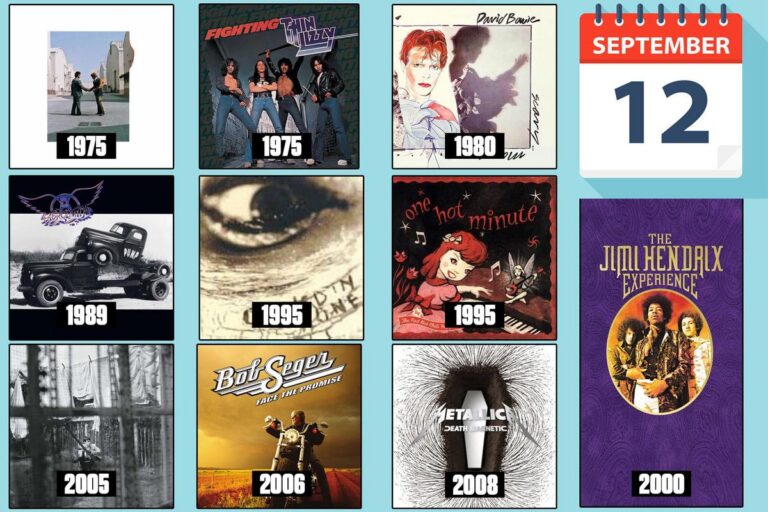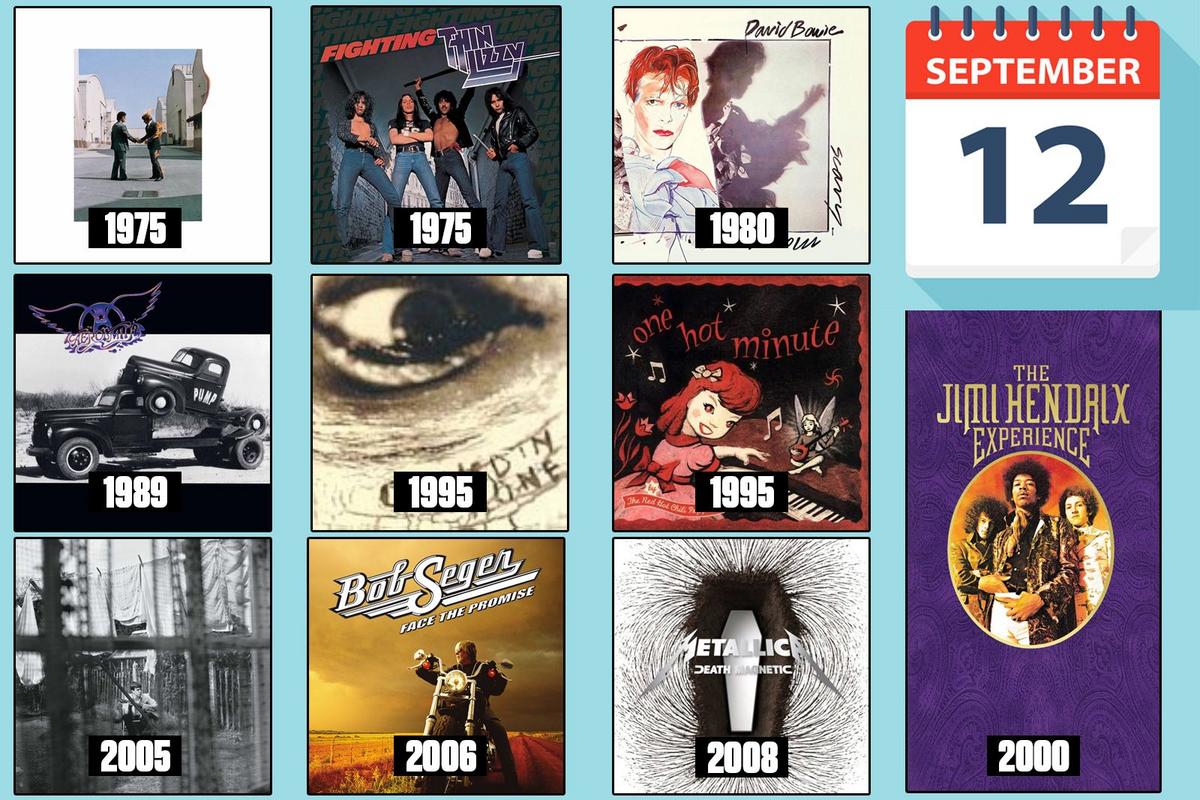

September 12 is a busier-than-usual day for album anniversaries, with no less than 10 famous or noteworthy titles celebrating their birthdays on this day. Here’s a quick rundown on the highs, lows and everything in between:
Pink Floyd, Wish You Were Here (1975)
It took Pink Floyd a bit to figure out how to record a follow up to 1973’s massively successful The Dark Side of the Moon, but they eventually landed on an album dominated by the nine-part “Shine On You Crazy Diamond,” a tribute to their former bandmate Syd Barrett. Wish You Were Here also found time to savagely critique the music business with “Welcome to the Machine” and “Have a Cigar.”
Read More: How Pink Floyd Remembered Syd Barrett on ‘Wish You Were Here’
Thin Lizzy, Fighting (1975)
After years of struggles and lineup changes, Thin Lizzy‘s classic four-piece roster finally jelled together while touring in support of 1974’s Nightlife. They emerged from the studio with Fighting, which as its name implied showcased a new, more aggressive attitude.
It became the band’s first album to chart in the UK, setting the stage for the breakthrough success of 1976’s Jailbreak.
Read More: How Thin Lizzy Set the Stage for a Breakthrough With ‘Fighting’
David Bowie, Scary Monsters (and Super Creeps) (1980)
After completing his critically acclaimed Berlin trilogy, David Bowie kicked off the ’80s by shifting his focus a bit more towards the mainstream on Scary Monsters (and Super Creeps), which resulted in the worldwide hits “Ashes to Ashes” and “Fashion.”
After spending a couple of years working on soundtracks, Bowie would blow the doors off the charts with his next album, 1983’s Let’s Dance.
Read More: Revisiting David Bowie’s Scary Monsters (and Super Creeps)
Aerosmith, Pump (1989)
After making one of rock’s most dazzling comebacks with 1987’s multi-platinum Permanent Vacation, Aerosmith somehow managed to outdo themselves two years later with Pump. The album was leaner, meaner and less glossy than its predecessor, and went on to become an even bigger commercial success.
Read More: Aerosmith’s Comeback Gets Even Stronger on ‘Pump’
Vince Neil, Carved in Stone (1995)
After the so-so reaction to his 1993 solo debut Exposed, former Motley Crue lead singer Vince Neil decided to swing for the fences. He hired the Dust Brothers – famous for their work with the Beastie Boys and Beck – to produce Carved in Stone, which melded hip-hop and rock.
Reviews were not favorable, and Neil’s ambition wasn’t rewarded commercially either. “That was before Kid Rock so no one was really ready for it then,” he told Classic Rock in 2000. “If it came out today, it’d probably sell 50 million copies.”
A little over a year later, Neil reunited with Motley Crue. He hasn’t released a solo album of original material since Carved in Stone.
Read More: How Vince Neil’s Solo Career Stalled With ‘Carved in Stone’
Red Hot Chili Peppers, One Hot Minute (1995)
By his own admission, Red Hot Chili Peppers guitarist John Frusciante wasn’t ready for the world-shaking success of the band’s 1991 album Blood Sugar Sex Magik. He quit the band mid-tour, and it took several years for the band to replace him with Jane’s Addiction guitarist Dave Navarro and release One Hot Minute.
Although the album had its high points, the chemistry between Navarro and his new bandmates never fully clicked, and the album sold about one-fourth of Blood Sugar Sex Magik‘s (admittedly amazing) total. After a few more years of turmoil, Frusciante returned to the group for 1999’s Californication, which put the band right back on top of the rock world.
Read More: The Red Hot Chili Peppers Deal With Turmoil on ‘One Hot Minute’
The Jimi Hendrix Experience, The Jimi Hendrix Experience (Box Set, 2000)
30 years after his untimely death and after years of patchy and sometimes controversial posthumous albums, Jimi Hendrix was honored with a comprehensive box set worthy of his legacy – right down to the luxurious purple cover fabric.
Read More: How the ‘Purple Box’ Threw Jimi Hendrix’s Vaults Wide Open
Paul McCartney, Chaos and Creation in the Backyard (2005)
Nigel Godrich clearly does not lack for confidence. The Radiohead and Beck producer intentionally and repeatedly pushed Paul McCartney -a %$#%#$ Beatle, in case you forget – outside his comfort zone as the two recorded 2005’s Chaos and Creation in the Backyard.
He refused to let McCartney record with his touring band, and fought him on arrangements and tempos. “There were one or two moments on the album when I had to think to myself, ‘You know, I could just fire this guy,”‘ McCartney told the Associated Press. But he stuck it out and the result is one of McCartney’s finest solo albums.
Read More: How Paul McCartney Reinvented on ‘Chaos and Creation’
Bob Seger, Face the Promise (2006)
Bob Seger made his fans wait over a decade for the follow-up to 1995’s It’s a Mystery, reportedly spending six years working on 2006’s Face the Promise. The album featured collaborations with Patty Loveless, Kid Rock and future Eagle Vince Gill. In 2026 Seger released an expanded edition of the album, featuring four previously unreleased tracks.
Read More: Bob Seger Expands ‘Face the Promise’ With Four New Songs
Metallica, Death Magnetic (2008)
Nearly two decades after shifting toward more conventional hard rock with their 1991’s “Black Album” – and half a decade after bewildering a large segment of their audience with the kinda pointlessly experimental St. Anger – Metallica made a welcome and convincing return to their thrash roots with Death Magnetic.
Read More: How Metallica Returned to Thrash With ‘Death Magnetic’
Top 30 Albums of 1986
World music, metal, art-rock and old-fashioned rock ‘n’ roll converged at the 1980s’ midpoint.
Gallery Credit: Michael Gallucci